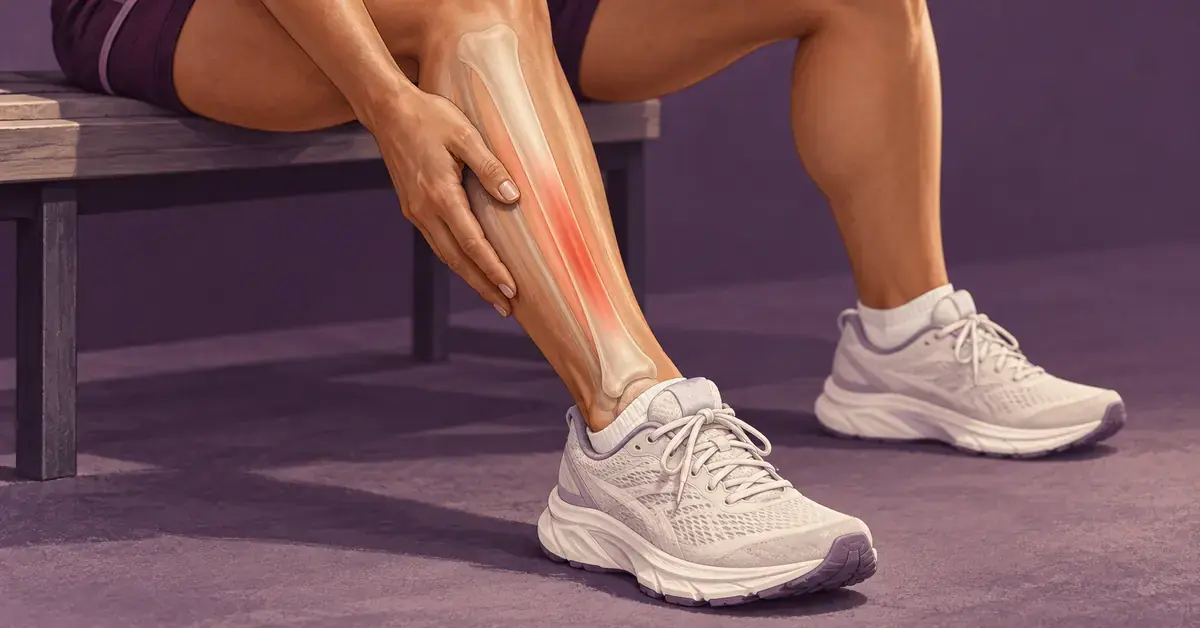
Shin splints are one of the most common reasons new and returning runners stop running, but they are also one of the most preventable. The medical name is medial tibial stress syndrome (MTSS) — a load-related overload injury where the shinbone (tibia) and the tissues attached to it are stressed faster than they can adapt. This guide explains what actually causes shin splints when you run, which prevention methods have real evidence behind them, how to tell the difference between shin splints and a stress fracture, and how to recover and return to running without the pain coming straight back.
Key Points
- Shin splints = medial tibial stress syndrome (MTSS): a load-related overload of the shinbone, not just a muscle strain.
- The main cause is doing too much, too soon — loading the leg faster than bone and tissue can adapt.
- Best-supported prevention: gradual mileage increases, calf/hip/foot strengthening, and a slight cadence lift for over-striders.
- Weak or no evidence: shock-absorbing insoles, static stretching and “special” socks do not reliably prevent shin splints.
- Diffuse inner-shin ache is typical of shin splints; sharp, pinpoint pain that persists at rest may be a stress fracture — get it assessed.
- Recovery: reduce load, fix the cause, return at roughly half your previous volume and build slowly.
What are shin splints?
Shin splints describe pain felt along the inner edge of the shinbone, usually in the lower two-thirds of the leg, that comes on with running and other high-impact activity. Clinicians call it medial tibial stress syndrome because the pain traces the medial (inner) border of the tibia rather than sitting in one small spot.
The older idea was that shin splints are simply “periostitis” — inflammation of the thin membrane covering the bone. Current thinking is broader: MTSS reflects the bone and surrounding tissue being loaded repeatedly before they have adapted, part of a bone-stress continuum. At the mild end is the diffuse ache of shin splints; left unmanaged, that overload can progress toward a tibial stress fracture at the severe end. That continuum is the single most useful idea for prevention, because it means shin splints are an early warning you can act on, not a condition you have to run through.
What causes shin splints when running?
The core cause is almost always a mismatch between how much load you place on the lower leg and how well your bones, muscles and tendons have adapted to it. Several factors feed into that mismatch.
Doing too much, too soon
Sudden jumps in running volume, intensity or frequency are the most consistently cited trigger. Bone adapts to impact slowly — over weeks and months — so a big week-on-week increase, a return to running after time off, or adding speedwork and hills all at once can load the tibia faster than it can strengthen. This is why shin splints are especially common in beginners and in runners ramping up for a first race.
Running form and low cadence
How you land matters because it changes how force travels up the shin. A low step rate (cadence) with a long, over-striding gait tends to increase the impact the tibia absorbs on each step. In one prospective study of cross-country runners, those with the lowest step rates had more shin injuries than those with the highest. This does not mean there is a single “correct” cadence for everyone, but an over-striding, heavy-landing style is a plausible contributor.
Footwear and running surfaces
Worn-out shoes, an abrupt change in shoe type (for example, switching to a much lower-drop or minimalist shoe without transition), and hard or cambered surfaces all change the load on the lower leg. No single surface or shoe causes shin splints on its own, but a sudden change that your legs have not adapted to can.
Individual risk factors
Some runners are simply more susceptible. Research links higher risk to being new to running, a previous history of shin splints, a higher body-mass index, reduced calf flexibility, flat or over-pronating feet, and low vitamin D or bone-density issues. Female runners appear in several studies as higher-risk, partly tied to bone health. You cannot change all of these, but knowing your risk helps you plan a more cautious build-up.
How to prevent shin splints when running
Prevention is mostly about controlling load and improving the lower leg’s capacity to handle it. The honest summary of the research is that no single trick is a guaranteed fix — a 2025 meta-analysis of about 8,200 participants found the strongest support for neuromuscular and strength training, and for over-pronation insoles in runners who need them, while finding no significant benefit from shock-absorbing insoles, static stretching or “special” socks. The measures below combine that evidence with sensible load management.
Build your mileage gradually
Increasing training load slowly is the most important single step. A long-standing rule of thumb is to raise weekly running volume by no more than about 10% from one week to the next. Treat that as a guide rather than a proven law — it has not been validated in a controlled trial — but the principle holds: give bone and tissue time to adapt. Build in an easier recovery week every third or fourth week, and increase either distance or intensity, not both at once. If you are completely new to running, following a structured, beginner-friendly plan such as a Couch to 5K training plan keeps the progression gentle and predictable.
Strengthen your calves, hips and feet
Stronger lower-leg and hip muscles help absorb impact and stabilise the tibia on landing, and strength training is one of the few interventions with reasonable evidence behind it. Useful exercises include:
- Eccentric calf raises — rise onto your toes with both feet, then lower slowly on one leg. Two to three sessions a week is a common recommendation.
- Bent-knee (soleus) calf raises — the soleus muscle does a lot of the work absorbing running impact.
- Hip and glute work — single-leg squats, bridges and lateral band walks improve pelvic stability so the shin is not overloaded.
- Foot and ankle work — heel walks and controlled toe raises build the muscles around the shin and ankle.
Strengthening the small front-of-shin muscle alone does little; the bigger wins come from calf, hip and foot strength that changes how force is managed with every stride.
Adjust your running form and cadence
If you tend to over-stride and land heavily, a modest increase in cadence can reduce the load on the shin. Lab studies show that increasing step rate by around 5–10% (without running faster) lowers peak tibial acceleration and loading rates. Count your steps per minute on an easy run, then aim to lift it slightly — shorter, quicker, lighter steps that land closer to under your body. A GPS running watch that displays live cadence makes this far easier to practise. Make the change gradually; a large, forced change in gait can create new problems.
Choose and rotate the right shoes
Well-fitting, reasonably cushioned shoes that suit your foot and gait give the lower leg a stable platform. Replace shoes before they are badly worn, introduce any new shoe type gradually rather than overnight, and consider rotating two pairs so your legs are not loaded in exactly the same way every run. Our guide to choosing the right running shoes covers drop, stack height, cushioning and when to replace them. Note that for the general runner, pricey shock-absorbing insoles have not been shown to prevent shin splints; over-pronation insoles may help runners whose feet roll in significantly, which is best assessed individually.
Vary your surfaces and respect recovery
Mixing softer surfaces — grass, trails, synthetic track — into a programme that is otherwise all hard road can reduce cumulative impact, provided you transition gradually. Just as important is sleep, nutrition and rest days, because bone adapts during recovery, not during the run itself. Cross-training on a bike, in the pool or on an elliptical lets you keep your aerobic fitness while giving the shins a break. If you are training toward a goal race, plan your weeks and long runs sensibly; our marathon pace chart can help you keep easy days genuinely easy so the hard days do not pile up.
Warm up and support bone health
Begin runs with a few minutes of easy jogging and some dynamic movement rather than cold, static stretching, which the evidence does not support for shin-splint prevention. Over the longer term, adequate calcium and vitamin D and sufficient overall energy intake matter for bone strength — relevant for Kiwi runners through the lower-light winter months and for anyone cutting calories hard while training.
Listen to early warning signs
Prevention is not only about what you do before a run — it is also about how you respond to the first symptoms. A faint, diffuse ache along the inner shin that appears toward the end of a run and settles quickly afterwards is an early signal that load is edging ahead of adaptation. Treated as information, it is easy to manage: pull back a week, drop one hard session, check your shoes and keep the strength work going. Treated as something to push through, the same ache can deepen into persistent pain and, eventually, a stress reaction or fracture that costs weeks or months. Keeping a simple training log — weekly kilometres, surfaces, new shoes and any niggles — makes these patterns far easier to spot before they become injuries.
Common mistakes that cause shin splints
Knowing the usual errors is as valuable as knowing the fixes. The most frequent mistakes include:
- Ramping up too fast — adding distance and speedwork in the same week, or doubling mileage after a layoff.
- Running through early pain — ignoring a diffuse shin ache in the hope it “warms out”, which can push a mild overload toward a stress fracture.
- Skipping strength work — treating running as the only training and never loading the calves, hips and feet.
- Chasing a magic number — forcing a sudden jump to a “180 cadence” or switching to minimalist shoes overnight.
- Doing all runs hard — no genuinely easy days, so the legs never recover.
- Keeping worn-out shoes — running hundreds of extra kilometres on compressed, dead cushioning.
Shin splints vs stress fracture: how to tell
Because shin splints sit on the same overload continuum as a tibial stress fracture, telling them apart matters. The broad rule is that shin-splint pain is diffuse — spread over several centimetres of the inner shin — and often eases as you warm up, whereas stress-fracture pain is pinpoint, worsens with activity and can persist at rest or at night. The table below summarises the typical differences, but it is a guide, not a diagnosis.
Shin Splints vs Stress Fracture
| Feature | Shin splints (MTSS) | Tibial stress fracture |
|---|---|---|
| Pain location | Diffuse, spread over several cm of the inner shin | Pinpoint, one small spot on the bone |
| Pain with activity | Often eases as you warm up, aches afterwards | Worsens with activity; can persist at rest or at night |
| Onset | Gradual, over days to weeks | Often progresses from untreated shin splints or a sharp load spike |
| Hop/press test | Tenderness spread along the bone border | Sharp, focal pain at one point |
| Typical recovery | About 2–4 weeks of relative rest | About 6 weeks or more; professional care advised |
| Diagnosis | Usually clinical | May need MRI or CT; early fractures can be missed on X-ray |
If you can press on one small, specific point on the bone and reproduce sharp pain, or if hopping on the leg hurts in a focal spot, treat it as a possible stress fracture and get it assessed. Early stress fractures do not always show on an X-ray; an MRI or CT scan is more sensitive when imaging is needed.
How to treat and recover from shin splints
If shin splints have already started, the priority is to remove the overload and let the tissue settle, then rebuild carefully. There is no single proven treatment, but the sensible sequence is well established:
- Reduce the load. Cut back or pause running for a short period. Relative rest — easy cross-training that does not hurt — is usually better than complete inactivity.
- Manage symptoms. Ice after activity and simple pain relief can ease soreness; neither fixes the underlying overload.
- Address the cause. Use the downtime to start calf and hip strengthening and to review your shoes and recent training jumps.
- Return gradually. Resume running only once you can walk and do light activity pain-free, then start well below your previous volume — often around half — and build back slowly, backing off if pain returns.
Mild shin splints often settle within about two to four weeks of sensible management, though timelines vary. A confirmed tibial stress fracture typically needs longer — commonly six weeks or more of reduced loading — and should be managed with professional guidance.
A structured return is more reliable than a feelings-based one. A practical pattern is to begin with a walk-run approach on soft, flat ground — for example, alternating one to two minutes of easy jogging with walking — then extend the running portions over successive sessions only while you stay pain-free both during and the day after. Keep early runs at a conversational easy pace, leave at least a day between them, and hold off on hills, speedwork and long runs until you have rebuilt a comfortable base. If pain reappears at any step, drop back to the previous level rather than abandoning the plan entirely. Continuing the calf, hip and foot strengthening through this phase is what reduces the chance of the problem returning once your mileage climbs again.
When to see a doctor or physiotherapist
See a health professional if shin pain is sharp and localised to one spot, keeps you awake, does not settle after two to three weeks of rest, returns immediately every time you run, or is severe enough to change how you walk. A GP, sports-medicine doctor or physiotherapist can confirm the diagnosis, rule out a stress fracture or other causes, and build a graded return-to-running plan. In New Zealand, running injuries are generally covered by ACC, and a physiotherapist can usually be seen without a doctor’s referral, so getting assessed early is straightforward and worthwhile rather than guessing.
Who is most at risk?
Shin splints are most common in people whose legs have not yet adapted to running load: beginners, runners coming back after a break, and anyone increasing training sharply for an event. Risk is higher again with a previous history of shin splints, reduced calf flexibility, flat or over-pronating feet, a higher body-mass index, and lower bone density or vitamin D. Military recruits and dancers show high rates for the same reason — rapid, repetitive impact loading. If you recognise yourself here, the message is not to avoid running but to build up more conservatively, strengthen early, and treat the first twinge as information rather than something to push through.
Disclaimer
This article is general information about running health and injury prevention and is not medical advice. It does not replace diagnosis or treatment by a qualified health professional. Shin pain can have several causes, including tibial stress fractures and other conditions that need assessment. If you have persistent, worsening or localised shin pain, see a GP, sports-medicine doctor or physiotherapist. In New Zealand, running injuries are usually covered by ACC.
Sources
- Shin Splint: A Review (PMC / National Library of Medicine)
- Preventive interventions for medial tibial stress syndrome: systematic review and meta-analysis (Gait & Posture, 2025)
- Shin splints vs. stress fractures: what’s the difference? (UCLA Health)
- Shin splints vs stress fracture (Hospital for Special Surgery)
- Shin Splints (Merck Manual, Professional Version)
- Effects of step rate manipulation on joint mechanics during running (Heiderscheit et al., PMC)
- Association of step rate with shin injury in cross-country runners (PubMed)
- Shin pain and the 10% guideline (American Academy of Pediatrics, HealthyChildren.org)
Frequently Asked Questions (FAQ)
Can you keep running with shin splints?
You can sometimes run through very mild shin splints, but it is risky because the pain signals an overloaded bone that may progress to a stress fracture. The safer approach is to reduce load, switch to pain-free cross-training for a short period, fix the cause, and return gradually once walking and light activity are pain-free.
How long do shin splints take to heal?
Mild shin splints often settle within about two to four weeks of relative rest and sensible load management, but recovery varies between individuals. If pain is sharp, pinpoint or still there after a few weeks of rest, it may be a tibial stress fracture, which usually needs six weeks or more and professional assessment.
Does increasing my running cadence prevent shin splints?
A modest cadence increase of around 5–10 percent, without running faster, has been shown in lab studies to reduce the impact load on the shin, which plausibly lowers risk for over-striders. No trial has proven that cadence alone prevents shin splints, so treat it as one useful tool alongside gradual load increases and strength work, and change your gait gradually.
Do special insoles or cushioned shoes stop shin splints?
For most runners, shock-absorbing insoles have not been shown to prevent shin splints, and cushioned shoes alone are not a reliable fix. Over-pronation (motion-control) insoles may help runners whose feet roll inward significantly, which is best assessed individually. Well-fitting shoes that you replace before they wear out still matter as part of overall load management.
Are shin splints a sign of a stress fracture?
Shin splints and tibial stress fractures sit on the same overload continuum, so untreated shin splints can progress toward a stress fracture. The warning signs that it has become more serious are pain that narrows to one pinpoint spot, worsens with activity and persists at rest or at night. If that happens, stop running and get it assessed, as early stress fractures do not always show on an X-ray.