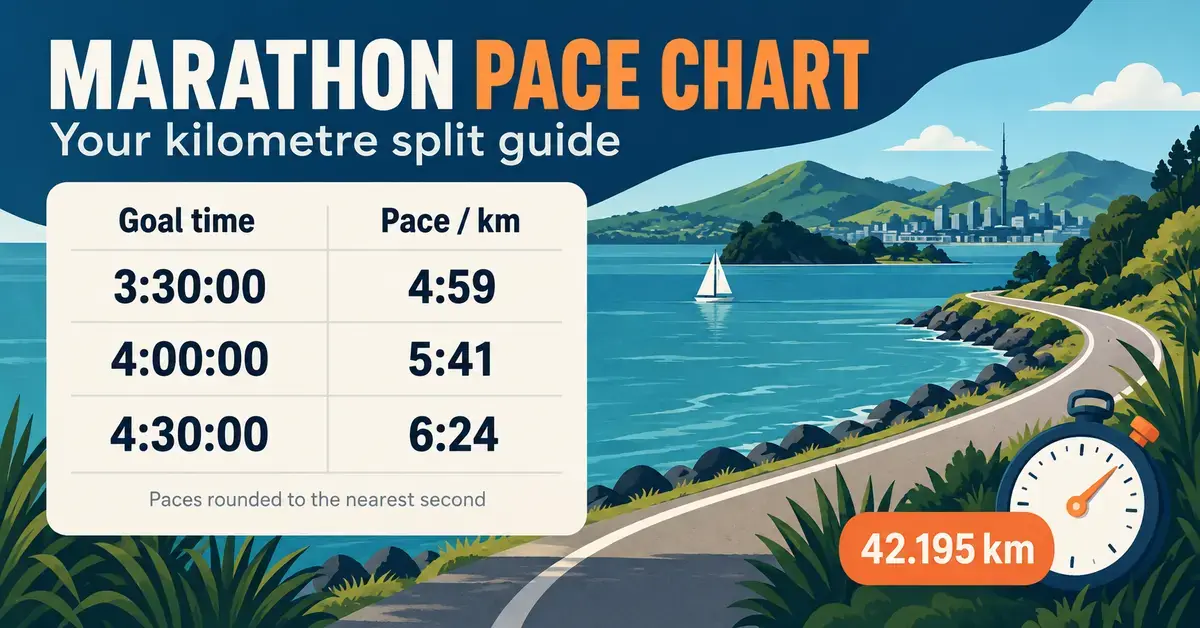
A marathon pace chart turns a single goal finish time into the exact per-kilometre pace and split times you need to hit along the way, so you can check your progress at every distance marker instead of guessing. Over the full 42.195 km, holding one steady, realistic pace is the difference between a controlled finish and a painful walk-run over the closing kilometres, whether you are racing the forest loop at the Rotorua Marathon or a flat waterfront course in Christchurch.
This guide explains how to read a marathon pace chart in kilometres, how to choose a goal time you can actually sustain, and how to adjust your target when hills, coastal wind or summer heat get in the way. Every pace and split in the table below is calculated for the true marathon distance of 42.195 km, and the physiology and prediction methods are drawn from published running-science sources listed at the end.
Key Takeaways
- One number to run to: A pace chart converts your goal finish into a target pace per kilometre plus 10 km, halfway and 30 km split times.
- Start controlled: Running the first 10 km too fast is the leading cause of hitting the wall around 30 km.
- Even or negative splits win: Holding a steady pace, or running the second half slightly faster, beats a fast start for nearly every runner.
- Base your goal on a recent race: Use the Riegel formula (half time × ~2.11) rather than an aspirational number.
- Adjust for conditions: Ease your target pace for hills, wind and especially heat and humidity, from the start.
Why pacing decides your marathon
Pacing decides your marathon because the body can only store a limited amount of carbohydrate, and running too fast early burns through it too soon. Many runners treat the marathon like two half marathons back to back and set off at a pace they cannot hold for 42 km. The result is almost always a sharp slowdown in the final third of the race.
A marathon pace chart exists to prevent exactly that. It gives you a fixed number to run to — a target pace per kilometre — so your effort in the opening kilometres stays honest even while adrenaline is telling you to go faster.
What happens when you start too fast
Starting too fast drains your glycogen — the carbohydrate your muscles and liver store as fuel — far quicker than your body can replace it. Your muscles hold only enough glycogen for roughly 90 to 120 minutes of hard running, so when you exceed your sustainable pace you rely more heavily on fast-burning carbohydrate and less on fat.
When those carbohydrate stores run low, usually somewhere around the 30 to 32 km mark, pace drops suddenly and dramatically. Runners call this “hitting the wall”, and research on marathon performance links it directly to glycogen depletion and the less efficient switch to burning fat. Even, conservative early pacing spreads your fuel use across the whole distance and keeps that wall at bay.
Even splits or negative splits?
An even split — running each half of the race in the same time — or a slight negative split — running the second half a little faster than the first — produces the highest success rate for the vast majority of runners. A negative split is only possible if you hold back early, so in practice both strategies start with the same discipline: resist the temptation to bank time in the first 10 km.
The table below shows how a controlled marathon builds through three phases. Your perceived effort should rise steadily, not spike in the first hour.
| Race phase | Distance | Perceived effort (1–10) | Pacing focus |
|---|---|---|---|
| Controlled start | km 1–10 | 4–5 (easy) | Let faster runners go, breathe deeply, lock onto your chart pace |
| Steady cruise | km 11–30 | 6–7 (working but relaxed) | Hold form, follow your fuelling and drinking plan, stay smooth |
| The real marathon | km 31–42.2 | 8–10 (hard, focused) | Hold pace by effort, drive your arms, break the distance into small goals |
The master marathon pace chart (km)
The master pace chart below lists the even pace per kilometre you need for target finish times from a fast sub-3-hour marathon to a 5:30 completion, along with the cumulative time you should see at the 10 km, halfway (21.1 km) and 30 km points. Find the row closest to your goal, memorise your pace per kilometre, and check your watch against the split column as you pass each marker.
Choose a target that matches your current fitness and recent long-run pace — not an aspirational number your training has not yet earned. Picking too aggressive a row is the single most common way runners talk themselves into hitting the wall.
| Target finish | Pace per km | 10 km split | Half (21.1 km) split | 30 km split |
|---|---|---|---|---|
| 2:45:00 | 3:55 | 39:06 | 1:22:30 | 1:57:15 |
| 3:00:00 | 4:16 | 42:39 | 1:30:00 | 2:07:57 |
| 3:15:00 | 4:37 | 46:13 | 1:37:30 | 2:18:39 |
| 3:30:00 | 4:59 | 49:46 | 1:45:00 | 2:29:18 |
| 3:45:00 | 5:20 | 53:19 | 1:52:30 | 2:39:57 |
| 4:00:00 | 5:41 | 56:53 | 2:00:00 | 2:50:39 |
| 4:15:00 | 6:03 | 1:00:26 | 2:07:30 | 3:01:18 |
| 4:30:00 | 6:24 | 1:03:59 | 2:15:00 | 3:12:00 |
| 5:00:00 | 7:07 | 1:11:06 | 2:30:00 | 3:33:30 |
| 5:30:00 | 7:49 | 1:18:12 | 2:45:00 | 3:54:36 |
These splits assume a flat, well-measured course in neutral weather. A GPS running watch makes it easy to check your rolling pace, but trust the official course markers over your watch for cumulative time, because GPS almost always over-reads distance on a winding, crowded course. If the half marathon is your event instead, the same method applies over 21.1 km — see our separate half marathon pace chart.
Quick Facts
| Marathon distance | 42.195 km (26.2 miles) |
| Key split markers | 10 km, half (21.1 km), 30 km |
| Where runners “hit the wall” | Typically around 30–32 km |
| Ideal racing temperature | About 10–15°C, low humidity |
| Heat pace penalty | Roughly 1–2 sec/km per °C above ~15°C (more in humidity) |
| Best pacing model | Even split or slight negative split |
How to choose a realistic goal time
The most reliable way to choose a marathon goal is to base it on a recent, fully-run shorter race rather than on hope. A timed 10 km or half marathon from the last few weeks tells you far more about your race-day fitness than any single long training run.
Predicting your marathon from a recent race
The standard tool for this is the Riegel formula, published by engineer and marathoner Pete Riegel in 1977: predicted time = old time × (new distance ÷ old distance) raised to the power of 1.06. In plain terms, doubling the distance multiplies your time by about 2.11, not 2.
So a 1:45:00 half marathon predicts roughly a 3:38 marathon (1:45 × 2.11). A quicker and simpler rule of thumb is to double your half marathon time and add 10 to 20 minutes, which lands in the same range. Treat any calculator result as a ceiling, not a promise: the formula assumes you have done the marathon-specific training — the long runs and weekly volume — to hold that pace over double the distance. Without those, aim a row or two slower on the chart.
Cross-checking against your training
Before you commit to a goal row, sanity-check it against how your build-up has actually gone:
- Long runs: Your goal marathon pace should feel close to the steady pace you held on your longest 30–35 km runs, not faster.
- Weekly volume: If your training was interrupted by illness or niggles, pick a more conservative target.
- Muscular durability: The marathon does far more muscle damage than a half, so late-race fade is about durability as much as fitness.
- Heart rate: If you train by heart rate, your marathon effort should sit in a controlled aerobic zone you can hold for hours, not near your threshold.
Adjusting your pace for New Zealand courses and conditions
A pace chart assumes a flat course and calm, cool weather, so on a real New Zealand course you should treat it as a flexible blueprint rather than a fixed instruction. Iconic events such as the Wellington Marathon and the hillier Queenstown Marathon throw wind and elevation at you, and the right response is to hold a steady effort while letting your actual pace vary. You can check confirmed dates for these events on our New Zealand running calendar.
Hills and wind
On a climb or into a headwind your pace will drop even though you are working just as hard, and forcing your watch back to flat-course pace will spike your heart rate and cost you dearly later. Shorten your stride, keep your effort even, and take back the time gently on the descents and tailwind sections rather than all at once.
| Condition | Effect on pace | How to respond |
|---|---|---|
| Coastal headwind | Can cost 15–30 sec/km | Lower your head, relax your shoulders, tuck in behind a group to draft |
| Uphill / rolling hills | Slows forward pace | Shorten stride, run by effort not by pace, keep your arms driving |
| Downhill | Speeds you up | Lean slightly from the ankles, stay relaxed, let gravity give back time |
| Heat and humidity | Raises heart rate and fluid loss | Ease your target pace from the start (see below) and drink to thirst |
Heat and humidity
Heat is the condition most likely to wreck a chart-perfect plan, so adjust before the gun rather than after you overheat. Distance running is most efficient around 10–15°C; above that, published estimates suggest you lose roughly 1–2 seconds per kilometre for every degree Celsius over about 15°C in dry air, and that penalty roughly doubles in high humidity because sweat evaporates poorly.
In practice, that means shifting your goal one row slower on the chart for a warm, muggy Kiwi summer morning is realistic, not defeatist. Start at the adjusted pace from kilometre one — you cannot claw back a pace you never had the conditions to hold.
Running with pace groups and timing mats
Running inside an official pace group is one of the easiest ways to stick to your chart, because a trained pacer does the arithmetic for you. Pacers carry tall flags showing target finishes such as 3:30, 4:00 or 4:30 and are practised at running smooth, even splits over the full distance, so you can focus on form, fuelling and drinking instead of staring at your watch.
Sitting in a group also shelters you from wind and pulls you through the quiet middle kilometres where solo runners often drift. A few habits make it work well:
- Ask the plan: Before the start, ask whether the pacer runs even splits or banks a small buffer, so nothing surprises you mid-race.
- Give space at aid stations: Groups bunch up around water tables; leave clearance and rejoin calmly.
- Keep your own record: Glance at your watch at the 10 km, 21.1 km and 30 km mats to confirm you are on schedule. Some events publish these mat times and even official race photos afterwards.
- Thank your pacer: If a volunteer pacer carries you to a personal best, say so at the finish. Pacing culture even has its odd corners, from cult training songs to running folklore documented on Wikipedia.
Fuelling and hydration keep your pace honest
Fuelling protects your pace because no amount of discipline can hold back the wall if your carbohydrate stores run dry. Because your muscles only hold enough glycogen for around 90 to 120 minutes of hard effort, most runners aim to take in roughly 30 to 60 grams of carbohydrate per hour once past the first half hour — typically from gels, chews or sports drink — rather than waiting until they feel empty.
Start fuelling early and at regular intervals, such as every 30 to 40 minutes, so the carbohydrate is absorbed before you need it. For hydration, drink to thirst rather than to a rigid schedule, and take on extra fluid and electrolytes on hot, humid days when sweat losses are higher. Practise your exact race-day fuelling and drinking plan on your long runs, because your stomach needs training as much as your legs; race day is not the time to try a new gel or a drink you have never used.
Common marathon pacing mistakes to avoid
Most marathon pacing failures come from a short list of avoidable errors rather than a lack of fitness. Watch for these:
- Banking time early: Running the first 10 km faster than chart pace to “save” minutes almost always costs you far more later.
- Choosing an aspirational goal: Picking a row your training has not supported turns the last 10 km into survival.
- Ignoring the weather: Holding cool-weather pace on a hot, humid day is a fast route to heat exhaustion.
- Chasing your GPS watch on hills: Forcing flat-course pace uphill spikes your effort and empties your legs.
- Skipping early fuel and fluid: Waiting until you feel low means starting your nutrition too late to help.
- Reacting to other runners: Matching a surge from a stranger who is running their own (possibly doomed) race pulls you off plan.
The bottom line on marathon pacing
A marathon pace chart converts months of training into a clear, checkable plan for race morning: a target pace per kilometre and the split times that prove you are on track. Pick a goal that matches your recent races and long runs, start at or just behind that pace, adjust honestly for hills, wind and heat, and lean on a pace group to carry the mental load. Do that, and the closing kilometres become a controlled push toward the line rather than a fight against the wall.
Sources
- RunnersConnect – The Science of Marathon Bonking: Glycogen Depletion
- Berndsen, Lawlor & Smyth – Exploring the wall in marathon running (Journal of Sports Analytics)
- RunnersConnect – How Accurate Are Race Calculators? A Riegel Formula Guide
- Running Writings – Calculating the effects of heat and humidity on marathon performance
- Outside – How Much Does Heat Slow Down Your Race Pace?
Frequently Asked Questions (FAQ)
What is the exact distance of a marathon?
A marathon is 42.195 kilometres, equal to 26.2 miles. This is the internationally standardised distance used for every certified road marathon, and it is the figure all of the pace and split calculations in this guide are based on.
How do I use a marathon pace chart during the race?
Find your target finish time in the chart, note the required pace per kilometre, and remember the cumulative split times for 10 km, halfway and 30 km. As you pass each of those markers, compare your elapsed time on the course clock or watch with the chart. If you are ahead early, ease off; small deficits late in the race are normal.
Why do I always slow down after 30 km?
A dramatic slowdown late in a marathon is usually caused by running the first 10 to 15 km faster than your sustainable pace, which drains your carbohydrate (glycogen) stores too early. When that fuel runs low around the 30 km mark, your pace drops sharply — the classic “wall”. Even pacing and steady fuelling from the start are the main defences.
Should I run even splits or a negative split?
For almost all recreational and competitive runners, an even split or a slight negative split — second half a touch faster than the first — gives the best result and the lowest risk of a blow-up. Both approaches depend on the same discipline: holding back in the opening kilometres instead of chasing an early lead.
Can my half marathon time predict my marathon pace?
Yes, a recent half marathon is one of the best predictors. Using the Riegel formula, multiply your half time by about 2.11 (or simply double it and add 10 to 20 minutes) for a realistic marathon estimate. The prediction only holds if you have done the long runs and weekly mileage needed to sustain that pace over the full distance.