The Rotorua Marathon, often referred to as "The People's Marathon," stands as New Zealand’s most historic and legendary road race. Scheduled for Saturday, 3 May 2025, the event celebrates its 61st edition, offering participants the unique challenge of a full 42.2km clockwise lap around Lake Rotorua. This comprehensive guide covers everything from the event's humble 1965 beginnings to the technical elevation profiles of the "Hills of Rotorua," alongside essential training, nutrition, and logistical advice. Whether you are aiming for a personal best on the World Athletics certified course or joining the thousands of walkers and relay teams, this article provides the actionable insights needed to conquer the "lake lap" and finish triumphantly at the Rotorua lakefront.

The Rotorua Marathon is deeply woven into the fabric of New Zealand distance running. Since its inaugural race in 1965, it has evolved from a small club event into a massive festival of running that attracts over 3,000 participants annually. The headline event remains the full marathon, which is famous for its "one lap, one lake" format—a psychological and physical journey that begins and ends in the heart of the city. Beyond the 42.2km distance, the event now includes a half marathon through the Whakarewarewa Forest, a 10km geothermal trail, and a 5km fun run, ensuring there is a category for every level of fitness. The atmosphere is bolstered by local school-led aid stations and a "Survivors Club" for those who have completed the race 15 times or more, highlighting the event’s enduring community legacy.
- Official Date: Saturday, 3 May 2025 (Full Marathon starts at 8:00 AM).
- Race Categories: Full Marathon (42.2km), Half Marathon (21.1km), 10km, 5km.
- Course Certification: World Athletics and AIMS Certified since 2017.
- Key Landmark: The full 42.2km lap follows the circumference of Lake Rotorua.
- Event Hub: The finish line is located at the Rotorua Lakefront, beside the Novotel.
Official Date: Saturday, 3 May 2025 (Full Marathon starts at 8:00 AM).
Race Categories: Full Marathon (42.2km), Half Marathon (21.1km), 10km, 5km.
Course Certification: World Athletics and AIMS Certified since 2017.
Key Landmark: The full 42.2km lap follows the circumference of Lake Rotorua.
Event Hub: The finish line is located at the Rotorua Lakefront, beside the Novotel.
History and Cultural Significance
The Rotorua Marathon is New Zealand’s oldest marathon, first held in 1965 after eight trailblazing runners from the Rotorua Athletic and Harrier Club completed an unofficial lap of the lake in 1962. It was in 1974 that women were officially allowed to enter, and by the 1980s, entry numbers had exploded, cementing the race as a "bucket list" item for Kiwis. The name "Rotorua" itself is a shortened version of the Māori name Te Rotorua-nui-a-Kahumatamomoe, and the race respects this heritage by taking runners through various iwi lands and geothermal landscapes. This deep connection to the land and its people makes the "Lake Lap" more than just a race; it is a pilgrimage for the New Zealand running community.
| Milestone Year | Event | significance |
|---|---|---|
| 1965 | Inaugural Fletcher Rotorua Marathon | Start of the official tradition |
| 1974 | First female entrants allowed | Gender inclusivity landmark |
| 1977 | Clockwise route adopted | Current iconic course direction |
| 1993 | Survivors Club formed | Rewards 15+ years of participation |
| 2017 | AIMS Certification | Recognition as a world-class course |
The "State of Emergency" Cancellation
In 1999, the race was famously cancelled just five minutes before the gun due to 200mm of rainfall and local flooding. It remains the only year the race did not run until the COVID-19 postponements.
Mastering the Lake Rotorua Course
The 42.2km course is a point-to-point lap that begins at the Rotorua Lakefront and travels clockwise around the lake. The first 10km are relatively flat as you head through the city suburbs, allowing runners to settle into their rhythm. However, the true test begins as you reach the northern side of the lake, where the terrain becomes undulating and technically challenging. The "back half" of the race is where the iconic Rotorua hills reside, requiring careful pacing to ensure you have energy left for the final 10km flat sprint back toward the Novotel finish line.

- The Start: Government Gardens/Lakefront area.
- Hamurana (15km-20km): Scenic, flat sections along the northern shore.
- The Hills (20km-30km): The most demanding part of the course.
- The Finish: Rotorua Lakefront Reserve.
The Start: Government Gardens/Lakefront area.
Hamurana (15km-20km): Scenic, flat sections along the northern shore.
The Hills (20km-30km): The most demanding part of the course.
The Finish: Rotorua Lakefront Reserve.
Technical Elevation Profile
While the course is at lake level, it is far from flat. The elevation profile shows six distinct hills between the 10km and 26km marks. The most significant climb occurs at approximately 19.8km, with a gradient of nearly 10% over 700 meters. This section, often called "The Hill," can easily add a minute to your kilometer split. Runners must be prepared for these punchy climbs, as they are the primary reason the Rotorua Marathon is considered more difficult than flat city courses like Auckland or Christchurch.
| Hill Location | Gradient | Distance | Strategy |
|---|---|---|---|
| 9.8km | 2.4% | 250m | Small intro, keep rhythm |
| 13.5km | 2.7% | 800m | Steady grind, don’t push |
| 19.8km | 9.3% | 700m | The big one; shorten stride |
| 25.6km | 5.7% | 350m | Final significant climb |
| 35km | 1.0% | 2km | Long, gradual false flat |
Managing the 26km Wall
Many runners "hit the wall" at 26km because they have attacked the previous five hills too aggressively. The secret is to maintain an even effort level rather than an even GPS pace through the hilly section.
Training for the Rotorua Hills
Successful training for Rotorua requires a shift away from pure flat road running. Because the course features approximately 350-400m of total elevation gain, your weekly training should include at least one hill repetition session. Focus on "strength endurance"—the ability to run uphill with good form and then immediately transition back to marathon pace on the descent. Since the surface is 100% tarmac, your long runs should be performed on road surfaces to harden your joints against the impact.
- Hill Sprints: 6-8 reps of a 400m hill at 5% gradient.
- Tempo Runs: Practice holding goal pace on undulating roads.
- Base Phase: Aim for a 12-16 week buildup with a 10% weekly mileage increase.
- Specific Surface: Ensure 80% of training is on asphalt/sealed roads.
Hill Sprints: 6-8 reps of a 400m hill at 5% gradient.
Tempo Runs: Practice holding goal pace on undulating roads.
Base Phase: Aim for a 12-16 week buildup with a 10% weekly mileage increase.
Specific Surface: Ensure 80% of training is on asphalt/sealed roads.
Simulation Runs
Try to find a route that mimics the "flat start, hilly middle, flat end" structure of the Rotorua course during your 30km training runs.
Nutrition and Hydration Protocol
The Rotorua climate in May can be unpredictable—chilly mornings followed by intense autumn sun. This makes hydration and electrolyte management critical. Aid stations are typically spaced every 5km and are famously manned by local schools. Runners should aim to take small sips at every station to prevent cumulative dehydration. For the full marathon, supplemental fueling with energy gels is essential to maintain glycogen stores, especially before the hilly middle section. .Read more in Wikipedia.

- Carbo-loading: Increase carb intake 3 days before the race (oats, pasta, rice).
- Hydration: Drink 500ml of water 2 hours before the start.
- On-Course: Take one gel every 45-60 minutes.
- Recovery: Consume a high-protein snack (banana/sandwich) immediately after finishing.
Carbo-loading: Increase carb intake 3 days before the race (oats, pasta, rice).
Hydration: Drink 500ml of water 2 hours before the start.
On-Course: Take one gel every 45-60 minutes.
Recovery: Consume a high-protein snack (banana/sandwich) immediately after finishing.
Registration Tiers and Deadlines
Securing an entry early is highly recommended to take advantage of "Early Bird" pricing. The Rotorua Marathon typically operates on a three-tier system: Early Bird (until February), Standard (February to April), and Late (May). Entries are limited for certain categories, particularly the half marathon, which often sells out due to its scenic route through the Redwoods.
| Tier | Availability | Estimated Cost (Full) |
|---|---|---|
| Early Bird | Until 31 Jan | $125 – $145 |
| Standard | 1 Feb – 15 Apr | $155 – $175 |
| Late Entry | 16 Apr – Race Day | $190+ |
Merchandise and Bibs
Online entrants have the option to have their bib couriered or to pick it up at the Race Expo held at the Novotel. Early registrants also receive personalized bibs with their names printed.
Race Day Logistics and Transport
The event village is centered at the Rotorua Lakefront Reserve. For the 2025 race, the finish line has been refreshed to sit beside the Novotel, providing a premium experience for finishers. Parking within the city center can be busy, so participants are encouraged to use local council parking buildings or walk from their accommodation. A bag drop service is provided at the start line, and participants are given a gear bag at the Expo to ensure their dry clothes are waiting for them at the finish.
- Start Time: 8:00 AM (Marathon), 8:15 AM (Half/10km).
- Parking: Pukuatua St and Haupapa St parking buildings.
- Bag Drop: Available on the Lakefront from 7:00 AM.
- Expo Location: Novotel Rotorua Lakeside.
Start Time: 8:00 AM (Marathon), 8:15 AM (Half/10km).
Parking: Pukuatua St and Haupapa St parking buildings.
Bag Drop: Available on the Lakefront from 7:00 AM.
Expo Location: Novotel Rotorua Lakeside.
Gear Selection for May Conditions
Rotorua weather in May is usually crisp (4°C – 7°C at start) but can warm up to 16°C by midday. Layering is key. Many runners wear "throwaway" clothes for the first 5km and discard them at designated aid stations for charity collection. High-quality moisture-wicking socks are non-negotiable to prevent blisters on the hilly sections.
| Item | Recommendation | Why? |
|---|---|---|
| Shoes | Cushioned Road Shoes | Impact protection for 42km tarmac |
| Socks | Technical (non-cotton) | Prevents moisture buildup/blisters |
| Anti-Chafe | Apply liberally | Prevents skin irritation from salt/sweat |
| Headwear | Running Cap | Sun protection and sweat management |
Spectator Guide and Viewing Spots
The out-and-back nature of the smaller races and the circular lap of the marathon provide excellent viewing opportunities. The "Village Green" at the lakefront is the hub of the action, featuring food trucks and big screens. For those following a marathoner, the Ngongotahā area (approx. 10km mark) is a great spot to cheer before heading to the northern side of the lake.
- Village Green: Best for start/finish atmosphere.
- Ngongotahā Village: High-energy cheering zone at 10km.
- Hamurana Springs: Quiet, scenic spot for northern-side support.
- Fenton Street: The final 2km stretch toward the lakefront.
Village Green: Best for start/finish atmosphere.
Ngongotahā Village: High-energy cheering zone at 10km.
Hamurana Springs: Quiet, scenic spot for northern-side support.
Fenton Street: The final 2km stretch toward the lakefront.
Post-Race Recovery in Rotorua
Rotorua is arguably the best place in the world to recover from a marathon. The city's geothermal activity provides numerous hot spring and spa options. A visit to the Polynesian Spa or a soak in a natural hot stream can help relax muscles and reduce inflammation. "Marathon Monday" is a local tradition where many participants can be seen walking stiff-legged through the Redwoods forest, which is an excellent form of active recovery to flush out lactic acid.
- Immediate: Active walking and 500ml of electrolyte drink.
- Soak: 20-minute hot pool session (Wait 2 hours post-race).
- Nutrition: Celebratory high-carb dinner in Eat Streat.
- Stretch: Light yoga or foam rolling 24 hours later.
Immediate: Active walking and 500ml of electrolyte drink.
Soak: 20-minute hot pool session (Wait 2 hours post-race).
Nutrition: Celebratory high-carb dinner in Eat Streat.
Stretch: Light yoga or foam rolling 24 hours later.
Final Thoughts
The Rotorua Marathon is more than just a 42.2km race; it is a rite of passage for New Zealand runners. Its hilly terrain, historic significance, and the sheer mental challenge of circling the lake make it a unique endurance experience. By preparing specifically for the undulating profile, mastering your race-day nutrition, and respecting the legacy of the "People's Marathon," you set yourself up for one of the most rewarding finishes in the sport. Crossing that line at the Rotorua lakefront, with the cheers of the community and the steam of the geothermal vents in the air, is an achievement that stays with you forever.
FAQ
When is the next Rotorua Marathon? The next event is scheduled for Saturday, 3 May 2025.
Is the course flat? No, the course is undulating with several significant hills between the 10km and 26km marks.
Can I walk the full marathon? Yes, there is a dedicated walking category for the full marathon with a generous 9-hour cut-off time.
Where is the best place to stay? Accommodation near the Rotorua Lakefront or on Fenton Street is best for easy access to the start and finish lines.
Is the Rotorua Marathon AIMS certified? Yes, the full marathon course is AIMS and World Athletics certified, making it a qualifier for major world marathons.
What is the "Survivors Club"? The Survivors Club is a prestigious group of runners who have completed the Rotorua Marathon 15 times or more.
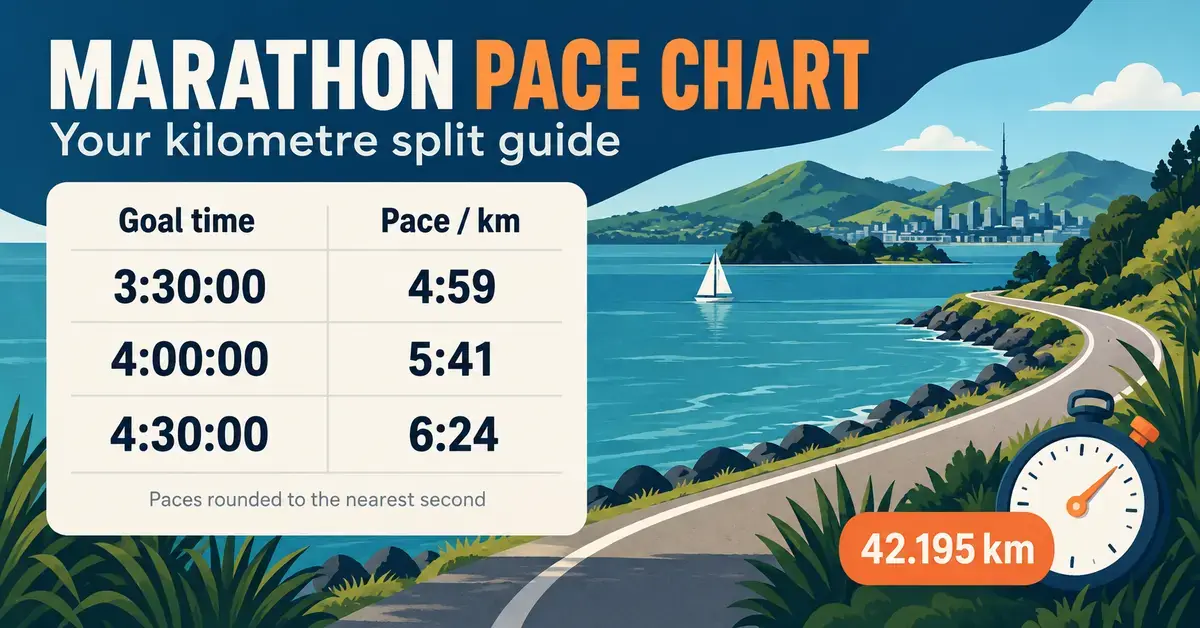
Are there pacers for the race? Yes, official pacers are usually available for common time goals (e.g., 3:30, 4:00, 4:30).
How do I get to the start line? The start and finish lines are at the Rotorua Lakefront, easily accessible by foot from most CBD hotels.
What drinks are available at aid stations? Water and electrolyte drinks (usually Tailwind or similar) are provided roughly every 5km.
What is the average temperature in May? Mornings are cold (around 5°C), while daytime highs usually reach 14°C to 16°C.
IMAGE LIST FORMAT: create image for; rotorua-marathon-lake-view.jpg – “A group of runners on a paved road alongside Lake Rotorua with steam vents in the background and a clear autumn sky.” create image for; rotorua-marathon-lake-lap.jpg – “A bird’s-eye view of a marathon course winding around a large lake with forest and hills in New Zealand.” create image for; rotorua-aid-station.jpg – “Local school children cheering and handing out water cups to runners at a vibrant marathon aid station in Rotorua.”
METAS: META TITLE: Rotorua Marathon 2025 | Course Guide & Training Tips META DESCRIPTION: Conquer the Lake Lap with our guide to the Rotorua Marathon. Explore elevation maps, registration dates, training plans, and the history of NZ's iconic race.