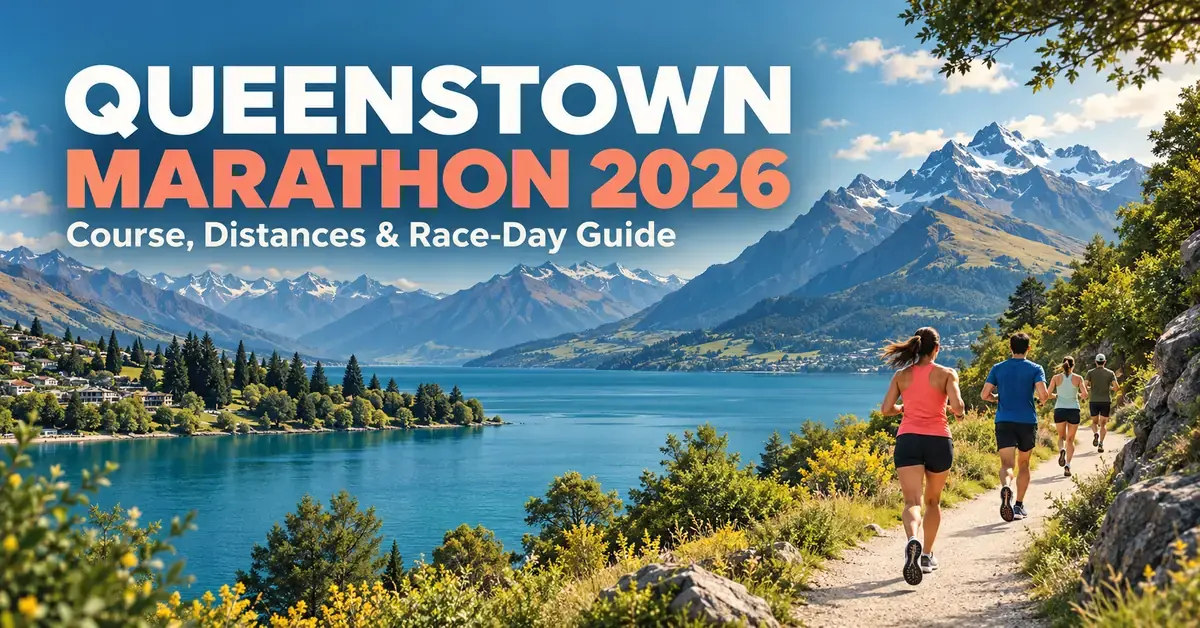
The Queenstown Marathon is New Zealand’s most scenic big-city race, and the 2026 edition takes place on Saturday 14 November 2026 in Queenstown, Central Otago. Officially the New Zealand Sotheby’s International Realty Queenstown Marathon presented by ASICS, it draws more than 13,000 runners across four distances and threads a point-to-point course from the Wakatipu Basin to the centre of town. This guide explains how the event works: the distances and start times, the Millbrook-to-Queenstown course and its elevation, how to enter, how the race-morning shuttles operate, where the aid stations are, and how to train for Central Otago’s late-spring conditions. The information below is drawn from the official event details and is intended to help first-timers and experienced runners plan with confidence.
Key Facts
| Event | New Zealand Sotheby’s International Realty Queenstown Marathon (presented by ASICS) |
| Date | Saturday 14 November 2026 |
| Location | Queenstown, Central Otago, New Zealand |
| Distances | Marathon 42.2km, Half Marathon 21.1km, 10km, Kids Run 2.2km |
| Marathon start / finish | Millbrook Resort (near Arrowtown) → Queenstown Recreation Ground |
| Terrain | About 70% hard-packed trail, 30% sealed road |
| Marathon elevation | ~340m total climb, ~440m net descent (rolling) |
| Course cut-off | 4:30pm, with staged checkpoint cut-offs |
| Certification | AIMS-certified; accepted as a Boston Marathon qualifier |
| Official website | queenstown-marathon.co.nz |
What is the Queenstown Marathon?
The Queenstown Marathon is an annual running festival held each November in the Queenstown Lakes District on New Zealand’s South Island. It is marketed as “The World’s Most Beautiful Marathon” because the route runs almost entirely on lakeside and riverside trails beneath the Crown Range and the Remarkables. Rather than a single race, it is a one-day event with four distances — a full marathon, a half marathon, a 10km and a children’s run — all finishing in the heart of Queenstown. In recent editions the combined field has topped 13,000 entrants, with close to 4,000 in the marathon itself, making it one of the largest participation marathons in the country.
The event sits near the end of the New Zealand running season, a few weeks after the Auckland Marathon, and it is a popular “destination race” for visitors who combine the run with a holiday. If you are mapping out a full year of events, the wider New Zealand running calendar shows how Queenstown fits alongside the country’s other major marathons. Its closest cousin in spirit is the scenic, trail-flavoured Hawke’s Bay Marathon, which shares the same ASICS partnership.
Race distances and start times
Four distances are offered, each starting at a different point and time but all finishing at the Queenstown Recreation Ground in the central business district. Start times are staggered through the morning so that the different fields converge on the finish area across the day. The table below summarises the options; confirm exact wave times on the official event schedule close to race day, as groups are assigned by estimated finish time.
Distance Comparison
| Distance | Approx. start time | Start area | Terrain | Best for |
|---|---|---|---|---|
| Marathon (42.2km) | 8:45am | Millbrook Resort, near Arrowtown | 70% trail / 30% road, rolling | Experienced runners; Boston qualifiers |
| Half Marathon (21.1km) | 8:00am | Wakatipu Basin, near Arrowtown | Mixed trail & road, mainly flat | Regular runners; the most popular option |
| 10km | 7:30am | Lakeside, near Queenstown | Mostly flat lakeside path | Beginners and walkers |
| Kids Run (2.2km) | 1:00pm | Queenstown Gardens | Flat, sealed loop | Children and families |
Which distance should you choose?
Choose the distance that matches your current training, not your ambition for race day. The 10km is the most accessible option and welcomes walkers, making it ideal for first-timers and families. The half marathon is the single most popular distance at Queenstown and a sensible step up for anyone who already runs regularly; if you are weighing it up, our guide to the half marathon distance explains the training commitment involved. The full marathon suits experienced runners comfortable spending four to six-plus hours on their feet, and because the course is AIMS-certified it can be used to chase a Boston Marathon qualifying time. The Kids Run is a short, flat 2.2km loop of the Queenstown Gardens for younger participants.
The marathon course: Millbrook to Queenstown
The marathon course is a point-to-point route that starts at Millbrook Resort near Arrowtown and finishes in central Queenstown. From the resort’s grounds, runners head through the historic gold-mining village of Arrowtown and onto the Arrow River trails before reaching the shores of Lake Hayes, one of the most photographed stretches of the whole course. The middle section follows the Kawarau and Shotover rivers across the Wakatipu Basin, with the Remarkables filling the skyline. The final 10km hugs the Frankton Arm and Lake Wakatipu, passing through the Queenstown Gardens before the finish at the Queenstown Recreation Ground. The half marathon covers the most scenic portion of this route, starting in the countryside near Arrowtown, while the 10km runs the flat lakeside stretch into town.
Trail versus road surface
Around 70% of the marathon is run on smooth, hard-packed gravel trails and cycle paths, with the remaining 30% on sealed road. This matters because the footing is different from a standard city marathon: the trails are firm and fast but can feel subtly uneven underfoot over 42km, and a wet spring can leave softer patches. Standard road racing shoes are fine for almost everyone — aggressive trail lugs are unnecessary — but the mixed surface is worth rehearsing in training so your feet and ankles are used to it.
Elevation profile and how to pace it
The Queenstown Marathon is described as “mainly flat,” but that is not the same as pancake-flat. Course analyses put the total climbing at roughly 340 metres against a net descent of about 440 metres over the full marathon, delivered as a series of gentle rolls rather than big climbs. The early kilometres trend downhill from Millbrook, which tempts runners into a fast start; the middle section around Lake Hayes and the Shotover throws up short, punchy rises; and the closing lakeside kilometres are genuinely flat. Even effort, rather than even pace, is the sensible approach. Translating your goal time into realistic per-kilometre splits with a marathon pace chart before race day will stop you overcooking the downhill opening.
The net-downhill trap
A net-downhill course sounds like a gift, but the descents load your quadriceps heavily through eccentric (braking) contractions, and legs that are not conditioned for it fade badly in the final 10km. Include some controlled downhill running in your build-up so your muscles adapt to the repeated braking. On the day, resist the urge to hammer the first downhill kilometres from Millbrook; bank energy, not seconds.
Registration, entry fees and transfers
Entries open online well in advance and the event regularly sells out, so securing a place early is wise. Pricing is tiered, with cheaper “early bird” phases that step up to the standard price as the event approaches and remaining places dwindle. As a guide, 2026 entry fees (including processing fees and GST) were listed at NZ$277 for the marathon, NZ$204 for the half marathon, NZ$136 for the 10km and NZ$58 for the Kids Run; always check the official site for the current price, as tiers change through the year. A standard entry includes your race bib with timing chip and a finisher’s medal; the race-morning shuttle is a separate paid add-on booked during registration.
Transferring between distances
If your training changes, the organisers usually allow transfers between distances — for example dropping from the marathon to the half — through the online entry portal, subject to availability and an administration fee. Deadlines apply, and transfers typically close in the weeks before the event, so make the decision early rather than hoping to change on race week.
Getting to the start: shuttles and race-day logistics
Because the race is point-to-point, almost everyone uses the official event shuttle to reach their start line. Shuttles run from Queenstown on race morning with pickup times assigned by start group, so you travel out to Millbrook (marathon), the Wakatipu Basin (half) or the lakeside 10km start and then run back into town. In 2026 the shuttle was priced at around NZ$20 for the marathon and half marathon and about NZ$14 for the 10km. Parking at the start lines is very limited, so the shuttle is strongly recommended; drive into Queenstown, park in a public car park near the finish, and let the buses handle the rest.
Bag drop and gear
An official gear-bag service carries your warm layers from the start to the Event Hub at the Queenstown Memorial Centre, where you collect them after finishing. Only the official event gear bags may be used, and bags must be claimed by the end of the day. Because the start can be cold, many runners wear a cheap throwaway layer they can discard, or pack warm clothing into the gear bag to change into at the finish.
Aid stations, hydration and fuelling
The Queenstown Marathon is fully supported, with 11 aid stations on the marathon course, five on the half and two on the 10km — roughly one every four kilometres on the full route. Stations provide water and PURE Electrolyte Hydration (served in lemon on course), along with toilets and first aid. Red Bull features at a designated station on each course, and cola is available at the later marathon stations to give tiring runners a caffeine-and-sugar lift. Central Otago’s air is dry even when temperatures are cool, so dehydration can creep up; sip early and often rather than waiting until you feel thirsty.
Avoiding a late-race slump
The stretch around Frankton, roughly 30–35km into the marathon, is where many runners hit a wall. Carry your own energy gels so you are fuelling with products your stomach already tolerates, and take on carbohydrate and electrolytes before this point rather than during the slump itself. A simple plan — a gel every 30–45 minutes from early in the race — keeps blood glucose steady for the flat final push along the lakefront.
Training for Queenstown’s spring conditions
November is late spring in Queenstown, and race morning can swing from a frosty start near 4°C to a sunny afternoon around 18°C. Train by effort rather than fixed pace so you can adapt to wind and temperature on the day, and practise layering during cold early runs so you know exactly what to wear and what to discard. Because so much of the course is on gravel, building some of your long runs on hard-packed trails or limestone paths will prepare your legs for the surface. Central Otago also has high UV even in spring, so a cap, sunglasses and sweat-resistant SPF 50+ sunscreen are worth training with too.
Simulating the trail surface
If you live in a city with few trails, seek out park paths, rail trails or limestone tracks for part of your mileage. Even one trail session a week helps condition the small stabilising muscles around the ankle and reduces the low-grade fatigue that uneven ground can cause late in a race. Pair this with your usual road sessions so you keep your leg speed.
What to wear and pack
Gear choice for Queenstown is about versatility across surfaces and a wide temperature range. Lightweight road or hybrid shoes with a little grip suit the hard-packed trails; dedicated moisture-wicking running socks reduce blister risk over the long gravel sections. A GPS watch helps you hold even effort on the rolling profile — if you are upgrading, our guide to choosing a GPS running watch covers the features that matter for a race like this. For the cold start, a disposable layer or packable jacket plus a cap and sunglasses for the sunny finish will cover most conditions.
Spectator guide and best vantage points
Queenstown is an excellent race to support because several points are easy to reach by car, bike or on foot. Arrowtown is the place to catch the marathon start and the first few kilometres, with cafes close by. Lake Hayes offers a quiet, photogenic spot mid-race, while the Frankton Arm is a high-energy location to cheer runners into the final 10km. The finish at the Queenstown Recreation Ground is the natural gathering point, with food, music and a festival atmosphere as every distance crosses the line. Spectators can also hire bikes or e-bikes to follow the trail network and see their runner at multiple points.
Recovery and things to do after the race
Once you have your medal, keep moving for a few minutes to prevent blood pooling, rehydrate, and eat a carbohydrate-and-protein meal within an hour or two. A gentle walk along the Lake Wakatipu waterfront — or a brief, cold dip in the lake — can ease stiff legs, and Queenstown’s food scene makes refuelling easy. The town is also a long-standing filming and screen-tourism destination; the surrounding Southern Lakes have appeared in many productions, and curious visitors can read more via Wikipedia. The day after, a scenic gondola ride or an easy stroll through the Queenstown Gardens is ideal active recovery before you travel home.
Common mistakes to avoid
Most Queenstown problems are avoidable with a little planning. Watch for these:
- Starting too fast on the Millbrook descent. The downhill opening feels effortless and wrecks quads that are not conditioned for it.
- Skipping trail training. Running your whole build-up on smooth footpaths leaves you underprepared for 42km of gravel.
- Leaving the shuttle booking too late. Start-line parking is minimal; book transport during registration.
- Underdressing for the start. A frosty Millbrook morning calls for a throwaway layer you can discard once warm.
- Relying only on course nutrition. Carry your own gels so you are not caught out by a product your stomach dislikes.
- Ignoring the sun. Central Otago UV is strong even in spring; a cap, sunglasses and sunscreen matter.
Sources
Frequently Asked Questions (FAQ)
When is the Queenstown Marathon 2026?
The event is held on Saturday 14 November 2026 in Queenstown, Central Otago. All four distances run on the same morning, with start times staggered from early in the day and the full-marathon course closing at 4:30pm.
Is the Queenstown Marathon course flat?
It is mainly flat but rolling, with roughly 340 metres of total climb and a net descent of about 440 metres over the marathon. There are no long climbs, but a series of gentle rises and a downhill start mean even-effort pacing works better than a fixed pace.
Do I need trail shoes for the Queenstown Marathon?
No. Around 70% of the course is smooth, hard-packed gravel trail and 30% sealed road, so standard road or lightweight hybrid running shoes are suitable for almost everyone. Aggressive trail lugs are not needed; good moisture-wicking socks matter more for comfort.
How do I get to the start line?
Most runners use the official event shuttle, which departs Queenstown on race morning at a pickup time assigned to your start group and drops you at your start line. Shuttles are a paid add-on booked during registration, and start-line parking is very limited, so the shuttle is strongly recommended.
Is the Queenstown Marathon a Boston qualifier?
Yes. The marathon course is AIMS-certified, so a qualifying time run here can be submitted toward Boston Marathon registration. Meeting the current Boston qualifying standard for your age and gender is still required, and entry is subject to Boston’s cut-off process.