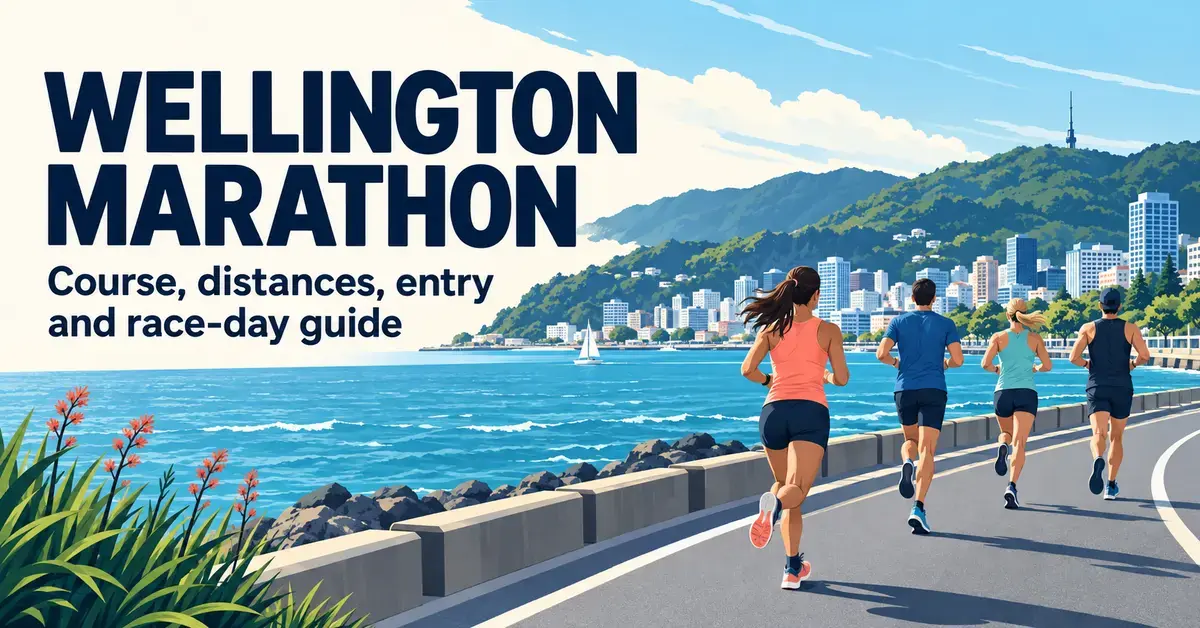
The Wellington Marathon is an annual winter road race held along the waterfront of New Zealand’s capital, run on a flat, sea-level course certified to World Athletics (IAAF) and AIMS standards. First staged in 1986 and now organised by MDJ Media & Events Ltd, it draws more than 4,000 runners and walkers each year across four distances — the full marathon, the half marathon, a 10 km event and the children’s Magic Mile. This guide explains when and where the race takes place, how the out-and-back course is laid out, what each distance costs, how to handle Wellington’s famous wind, and how to train, fuel, travel and recover so runners of every level reach the start line prepared.
What is the Wellington Marathon?
The Wellington Marathon — currently titled the Gazley Volkswagen Wellington Marathon after its naming sponsor — is a city road race that loops around Wellington Harbour. Established in 1986, it is often described as the capital’s favourite footrace and is close to four decades old. It is organised by MDJ Media & Events Ltd, a family-owned company managed by Michael Jacques, who has spent more than 50 years in endurance sport as a runner, coach, journalist and organiser.
The event is deliberately inclusive: every distance welcomes walkers as well as runners, and every finisher receives a medal. The Heart Foundation has been the official charity partner for over 15 years, with participants raising more than NZ$100,000 for heart-health programmes. Unlike the trail races in the surrounding hills, this is a dedicated sealed-road event built around the city’s harbour and maritime setting.
When and where does the Wellington Marathon take place?
The Wellington Marathon is held on a Sunday in late June or early July — midwinter in the Southern Hemisphere. The 2026 edition was run on 28 June 2026, and the next edition is scheduled for Sunday 4 July 2027. Always confirm the exact date on the official website, as it can shift slightly from year to year.
The race is based at Hnry Stadium on Waterloo Quay, the venue Wellingtonians know as “the Cake Tin.” Note the name change: the stadium was called Sky Stadium until early 2026, when the accountancy-automation firm Hnry took over the naming rights for five years from 1 March 2026. Older guides still refer to it as Sky Stadium (and, before that, Westpac Stadium), but the venue and its Waterloo Quay location are unchanged. All distances start and finish on the stadium’s Fran Wilde Walkway.
Key Facts
| Event | Gazley Volkswagen Wellington Marathon |
|---|---|
| Location | Hnry Stadium (“the Cake Tin”), Waterloo Quay, Wellington |
| Next edition | Sunday 4 July 2027 (2026 held 28 June 2026) |
| Distances | Marathon 42.195 km, Half 21.1 km, 10 km, Kids’ Magic Mile (~1 mile) |
| Course | Flat, sea-level out-and-back around the harbour |
| Certification | World Athletics (IAAF) & AIMS |
| First held | 1986 |
| Organiser | MDJ Media & Events Ltd |
| Field size | More than 4,000 runners and walkers a year |
| Official website | wellingtonmarathon.co.nz |
The course: a flat waterfront out-and-back
The Wellington Marathon course is almost entirely flat and run at sea level, which is its defining feature and the reason it is popular with runners chasing a personal best. Organisers point out that the only real climb is the ramp back into the stadium. The marathon and half marathon are certified to IAAF and AIMS standards, so results can be used for qualifying purposes elsewhere.
From the stadium, runners head south on Waterloo Quay toward the Railway Station and return north near the Bluebridge Ferry Terminal, tracing the harbour bays past landmarks including the Railway Station, the Michael Fowler Centre, Te Papa Tongarewa, Oriental Parade, Shelly Bay and Queens Wharf. Because the route is an out-and-back rather than a point-to-point, the scenery repeats — an advantage for pacing and for spectators.
Full marathon route (42.195 km)
The full marathon covers two laps of the half-marathon loop. Each lap runs through the CBD, along Oriental Parade, around Evans Bay Parade and Cobham Drive out to the Miramar Peninsula, then back to the stadium. There is a cut-off at the end of the first lap (about 22.2 km) that must be reached by 11:00am. If you want a refresher on exactly how long a marathon is, the standard distance is 42.195 km (26.2 miles).
Half marathon, 10 km and Kids’ Magic Mile
The half marathon is a single lap of that loop, turning back at the Miramar Peninsula and passing the same landmarks without repetition. The 10 km event runs out to the end of Oriental Parade and back, making it a good option for first-timers and walkers. The Kids’ Magic Mile is roughly one mile (about 1.6 km), running from the stadium to the Bluebridge Ferry terminal and back so younger participants can experience a stadium finish.
Distance Comparison
| Distance | Route | Start time | Min. age | Entry fee (NZD) |
|---|---|---|---|---|
| Full Marathon (42.195 km) | Two laps to the Miramar Peninsula and back | 7:30am (walk 7:00am) | 15 | 0–0 |
| Half Marathon (21.1 km) | One lap to the Miramar Peninsula and back | 9:00am | 13 | –0 |
| 10 km | Out to the end of Oriental Parade and back | 9:30am | 10 | – |
| Kids’ Magic Mile (~1.6 km) | Stadium to Bluebridge Ferry terminal and back | 9:40am | 5–12 | – |
How to enter and what it costs
Entry is handled online through the official Wellington Marathon website, and pricing uses a tiered structure that rewards early commitment. The published fee bands for the upcoming edition (in New Zealand dollars) run across four windows: Super-Early (until 1 January), Early (2 January–1 April), Normal (2 April–1 June) and Late (2–30 June). Registering early is the cheapest option and secures your place before entries close at 12 noon on 30 June, with race-pack collection on the Saturday before race day.
- Full Marathon: NZ$100 (Super-Early) rising to NZ$160 (Late)
- Half Marathon: NZ$75 rising to NZ$120
- 10 km: NZ$55 rising to NZ$85
- Kids’ Magic Mile: NZ$10 rising to NZ$25
Age limits and walkers
Minimum ages apply to each distance: 15 for the full marathon, 13 for the half marathon, 10 for the 10 km and ages 5–12 for the Kids’ Magic Mile. Participants under 16 need parental consent. Walkers are welcome in every distance, and the marathon even has a dedicated walk start ahead of the runners.
Refunds and changing distance
Withdrawals made before midnight on 28 June receive a refund minus a NZ$15 administration fee; after that date, entries and changes are non-refundable. Runners can usually switch distances — for example, dropping from the full to the half if training has not gone to plan — by contacting the organiser before entries close. Always check the current terms on the official site, as deadlines are set fresh each year.
Racing in “Windy Wellington”: weather and pacing
Wind, not hills, is the main variable in Wellington. The capital’s exposed harbour setting means an out-and-back course typically delivers a headwind on one leg and a tailwind on the return, and midwinter temperatures usually sit around 8–13°C. The single most useful tactic is to run by effort rather than a fixed pace: hold back into the headwind, shorten your stride, tuck in behind a group to draft, and then let the tailwind carry you home.
Check the forecast in the days beforehand. A southerly is cold and often damp, while a northerly is milder but gustier. Resist the temptation to chase your goal split during an early tailwind, because banked time is easily lost when you turn into the wind later in the race.
Training for a flat road marathon
A flat road race places a constant, repetitive load on the same muscles for the whole distance, without the natural breaks that changing trail terrain provides. Train mostly on sealed roads so your joints adapt to that impact, and build your weekly structure around a progressively longer weekend run, a tempo session at or slightly faster than goal pace, occasional intervals for leg speed, and easy recovery runs to accumulate base mileage.
Add one weekly strength session focused on calves, glutes and core to protect your form over the final 10 km, when fatigue causes technique to break down. A marathon pace chart is a practical way to translate your goal finish time into per-kilometre splits, and practising those splits in training makes race-day effort feel familiar. Runners new to the local scene can also tap into organised group runs through the wider running scene in Wellington.
Nutrition and hydration on race day
The course has staffed drink stations plus roving support, and first aid is available on course and at the stadium. Take on fluids regularly rather than waiting until you feel thirsty, and if you rely on a specific electrolyte or gel, carry your own so you are not dependent on what is supplied. For fuelling, most marathoners take carbohydrate gels or chews every 30–45 minutes, beginning at around the 45-minute mark rather than loading up in the first few kilometres.
The golden rule is to test everything in training — never try a new gel, drink or breakfast on race morning, because an unfamiliar product under race stress is a common cause of stomach trouble. Runners looking for motivation sometimes read about record-setting endurance athletes such as Chrissie Wellington on Wikipedia.
Race-morning logistics at Hnry Stadium
Start times are staggered by distance, so know exactly when your event sets off. For the July edition the sequence is: Marathon Walk 7:00am, Marathon Run 7:30am, Half Marathon 9:00am, 10 km 9:30am and Kids’ Magic Mile 9:40am. Arrive at least an hour early to collect yourself and warm up.
- Bag drop: secure gear storage is inside the stadium at Aisle 11, and your race number carries a detachable bag tag.
- Public transport: the stadium is about 1 km from Wellington’s main train and bus stations, and a free shuttle runs between the CBD and the venue on race morning.
- Parking: stadium parking requires a pre-purchased NZ$10 ticket collected at race-pack pickup; otherwise public parking is available within a 15-minute walk.
- Road closures: the course roads are closed, so spectators cannot drive the route — plan to move around on foot, by bike or by train.
Spectator guide and best cheering points
The out-and-back layout is a gift for supporters, who can see their runner several times from a single spot without travelling far. The most popular vantage points are Oriental Parade, the Evans Bay waterfront and the area around Te Papa, all of which have cafes and open space for families. The final stretch back toward the stadium is where encouragement matters most.
Because the course roads are closed to traffic, the waterfront path is the easiest way to hop between points by bike or on foot. If you are visiting for the weekend, the same waterfront hosts other mass-participation events such as Round the Bays Wellington.
Gear for coastal running
Because the weather drives so much of the race, gear choice matters. A lightweight road shoe with good energy return suits the flat tarmac, and moisture-wicking layers keep you comfortable once you warm up. Many locals carry a thin windproof gilet or arm warmers that can be adjusted on the move. New Zealand’s UV levels are high even under cloud, so a cap and sports sunscreen are worth it, along with anti-chafe balm and blister-resistant socks. If you are choosing footwear, our guide to running shoes covers the main options.
- Shoes: road-specific trainers; carbon-plated models are popular among personal-best hunters.
- Layers: moisture-wicking base plus a packable windproof for a cold start.
- Sun and skin: cap, sunscreen, sunglasses and anti-chafe balm.
Recovery after the race
Recovery begins the moment you cross the line. Keep moving rather than sitting straight down, rehydrate, and eat a meal combining carbohydrate and protein within an hour or two to start repairing muscle. A gentle walk the following day does more for stiff legs than resting completely, because light movement keeps blood flowing to the tissues you have stressed. Build back gradually over the following week with easy walking or swimming before returning to running.
Common mistakes to avoid
Most avoidable problems at Wellington come down to the wind, pacing and preparation rather than fitness.
- Chasing an early tailwind: banking time downwind, then blowing up when you turn into the headwind.
- Pacing rigidly: holding a fixed pace instead of running by effort on a windy day.
- New kit on race day: untested gels, shoes or breakfast that upset your stomach or cause blisters.
- Dressing wrong for the start: shivering at a cold winter start line, or overdressing and overheating once running.
- Leaving entry late: paying the top Late-tier fee when Super-Early entry is far cheaper.
- Driving to the course: forgetting the roads are closed and getting stuck away from your runner.
How does it compare to other New Zealand marathons?
Wellington’s signature is flatness combined with wind, which sets it apart from the country’s hillier or more remote events. Where some New Zealand marathons trade speed for elevation and scenery, Wellington offers a fast, certified, sea-level loop close to the city centre — a profile it shares with the coastal, flat North Shore Marathon in Auckland. If you are targeting a personal best, Wellington’s terrain is ideal; the trade-off is that a strong wind can neutralise that advantage, so it rewards runners who pace tactically rather than those who simply chase a number.
Sources
- Gazley Volkswagen Wellington Marathon — official website
- Wellington Marathon — The Course
- Wellington Marathon — Entry Info and fees
- Wellington Marathon — Race Info (start times, logistics)
- Wellington Marathon — About (history and organiser)
- NZ Herald — Wellington Regional Stadium renamed Hnry Stadium
- Running Calendar NZ — Wellington Marathon
Frequently Asked Questions (FAQ)
When is the Wellington Marathon held?
It takes place on a Sunday in late June or early July, in the middle of the New Zealand winter. The 2026 event was run on 28 June 2026 and the next edition is scheduled for Sunday 4 July 2027, starting and finishing at Hnry Stadium on Waterloo Quay. Confirm the exact date on the official website each year.
Is the Wellington Marathon course flat?
Yes. It is one of the flattest marathon courses in New Zealand, run at sea level along the harbour, and organisers note the only real hill is the ramp into the stadium. The marathon and half marathon are certified to IAAF and AIMS standards, so the flat profile is well suited to a personal best — wind permitting.
What distances can I enter?
There are four options: the full marathon (42.195 km), the half marathon (21.1 km), a 10 km event and the Kids’ Magic Mile (about one mile). The full marathon runs two laps of the half-marathon loop out to the Miramar Peninsula, while the 10 km turns back at the end of Oriental Parade.
Can walkers take part?
Yes. Walkers are welcome in every distance, and every finisher receives a medal. The full marathon has a dedicated walk start at 7:00am, ahead of the 7:30am marathon run, so walkers have extra time on the course.
How much does entry cost?
Fees are tiered and rise as race day approaches. In New Zealand dollars the full marathon runs from about $100 (Super-Early) to $160 (Late), the half marathon from $75 to $120, the 10 km from $55 to $85 and the Kids’ Magic Mile from $10 to $25. Entries close at 12 noon on 30 June.