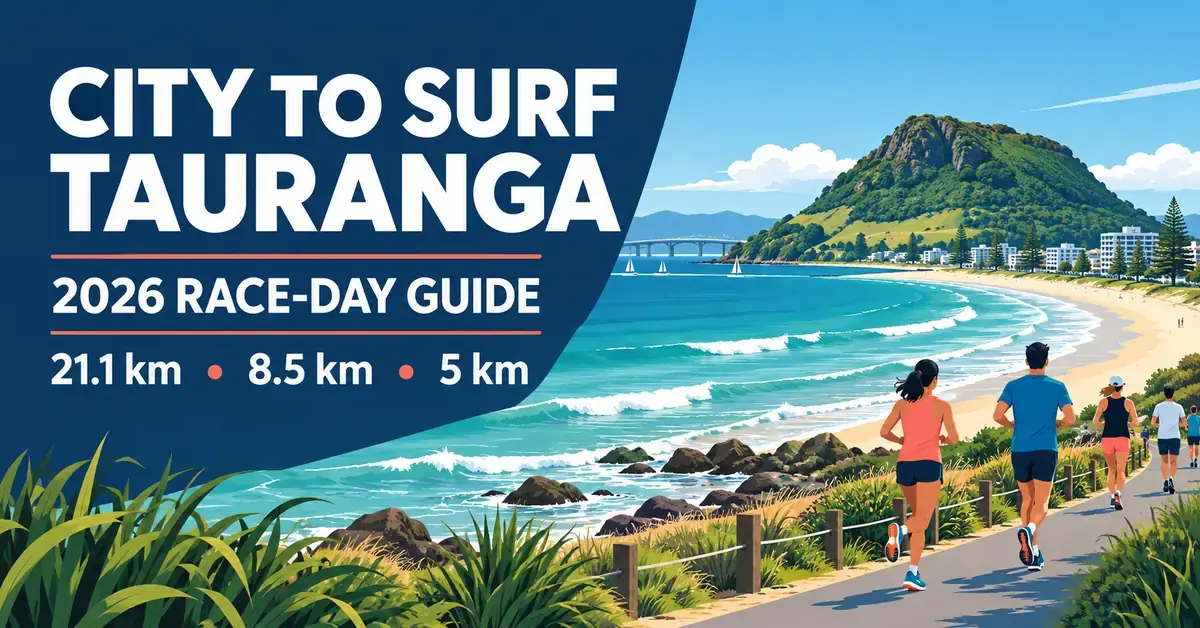
The Mitre 10 Mega Tauranga City to Surf is the largest fun run and walk in the Bay of Plenty: a point-to-point event that starts beside Tauranga Harbour and finishes on the sand of Mount Maunganui Main Beach. In 2026 it is held on Sunday 8 November, with three distances that can each be run or walked — a 21.1 km half marathon, an 8.5 km course and a 5 km course.
This guide explains the 2026 route changes, where each distance starts, how the shuttle and gear transport work, what entry costs and how to find your official results afterwards. Every figure below is drawn from the official 2026 event information so you can plan your race morning with confidence.
Key Points
- Coastal point-to-point event: the Mitre 10 Mega Tauranga City to Surf crosses Tauranga Harbour and finishes on Mount Maunganui Main Beach.
- 2026 date: Sunday 8 November 2026.
- Three distances, run or walk: 21.1 km half marathon, 8.5 km and 5 km.
- 2026 route change: with the Mauao base track restricted, the historic 11 km is now 8.5 km, but the beach finish remains.
- Plan the logistics: a one-way shuttle runs to the start and Mainfreight moves your gear to the finish.
What is the Tauranga City to Surf?
The Tauranga City to Surf is an annual mass-participation running and walking event that crosses Tauranga Harbour toward Mauao (Mount Maunganui). It is named the Mitre 10 Mega Tauranga City to Surf after its principal sponsor, and it welcomes everyone from competitive runners chasing a fast half marathon to families walking the 5 km. Grief Support Services is the event’s charity partner, and other supporters include United Airlines, the Foundation Clinic and the Bay of Plenty Times.
What sets the event apart is its coastal, point-to-point format. Instead of looping back to the start, the longer distances cross the Tauranga Harbour Bridge and follow the water toward the base of Mauao, and every distance shares the same finish on the Main Beach. Because walkers are welcome in all three distances, the field is broad, drawing entrants from Rotorua, Hamilton, Auckland and across the wider Bay of Plenty.
The atmosphere is closer to a community celebration than a hard-nosed race. Corporate teams, running clubs, school groups and families in fancy dress line up alongside club runners chasing a personal best, and the roads are closed to traffic so you get an uninterrupted view of the harbour. That mix is a large part of why the event has grown into the region’s headline mass-participation run and walk.
When and where does it take place?
The 2026 event is on Sunday 8 November. The 21.1 km half marathon and the 8.5 km course both start at the Tauranga Yacht and Power Boat Club at Sulphur Point, while the 5 km starts on Mount Maunganui Main Beach. All three distances finish on the Main Beach. To see how the race fits alongside other events through the year, check the wider New Zealand running calendar.
Quick Facts
| Event | Mitre 10 Mega Tauranga City to Surf |
|---|---|
| 2026 date | Sunday 8 November 2026 |
| Distances | 21.1 km half marathon, 8.5 km, 5 km (each run or walk) |
| Start (21.1 km & 8.5 km) | Tauranga Yacht and Power Boat Club, Sulphur Point |
| Start (5 km) | Mount Maunganui Main Beach |
| Finish | Mount Maunganui Main Beach (all distances) |
| Title sponsor | Mitre 10 MEGA |
| Charity partner | Grief Support Services |
| Timing / results | Bib transponder; results online via the official event website |
The three distances explained
All three City to Surf Tauranga distances can be entered as a run or a walk, and each has its own start location, start time and minimum age. Choose the distance that matches your current fitness and how much of the harbour crossing you want to take on.
| Distance | Start location | Start times (2026) | Minimum age |
|---|---|---|---|
| 21.1 km half marathon | Tauranga Yacht and Power Boat Club, Sulphur Point | 8:00am and 8:05am (run waves), 8:10am (walk) | 16 years |
| 8.5 km run or walk | Tauranga Yacht and Power Boat Club, Sulphur Point | 9:00am and 9:05am (run waves), 9:10am (walk) | 12 years |
| 5 km run or walk | Mount Maunganui Main Beach | 10:00am (mass start) | 5 years |
21.1 km half marathon
The half marathon is the flagship distance, covering the standard 21.1 km half-marathon distance. It leaves the Yacht Club at Sulphur Point, works through estuary shared paths, crosses the Tauranga Harbour Bridge and heads for the coast before the beach finish. Runners set off in two waves from 8:00am, with walkers starting from 8:10am. You must be at least 16 to enter.
8.5 km run or walk
The 8.5 km is the event’s most popular option and the direct successor to the historic 11 km course (see the course section below for why it was shortened for 2026). It shares the harbour-crossing character of the half marathon over a more manageable distance, starts from the Yacht Club from 9:00am, and is open to entrants aged 12 and over.
5 km run or walk
The 5 km is the family-friendly distance, starting and finishing around Mount Maunganui Main Beach with a mass start at 10:00am and a minimum age of just five years. It is an ideal first event: if you are building toward it from scratch, a structured couch to 5k training plan gives you a realistic runway of a few weeks.
The 2026 course and the Mauao base track closure
The biggest change for 2026 is that access to the Mauao base track is restricted following tragic events in early 2026, so the organisers have re-routed parts of the course. The historic 11 km event has been shortened to 8.5 km, while the half marathon and 5 km keep their advertised distances through alternative routing. Importantly, the finish line remains where it has always been — on Mount Maunganui Main Beach.
For most participants the experience is unchanged in spirit: you still leave the city side, cross the water and finish on the sand. If you have run the event before, the main thing to confirm on the official course maps is the exact routing around the base of Mauao, since that is where the changes apply.
What surfaces will you run on?
The course is predominantly sealed, with the memorable exception of the finish. Knowing what is underfoot at each stage helps you pace sensibly and pick the right shoes.
| Race sector | Typical surface | Gradient | Pacing focus |
|---|---|---|---|
| Sulphur Point start | Wide, flat sealed roads | Flat | Settle your early adrenaline and find clear space |
| Estuary shared paths | Concrete paths and boardwalk sections | Gently rolling | Keep a light, quick cadence and start fuelling |
| Tauranga Harbour Bridge | Firm sealed pedestrian lanes | A single sustained incline | Shorten your stride and run to effort, not pace |
| Mount Main Beach finish | Soft coastal sand | Flat but shifting underfoot | Lift your knees, quicken turnover and drive to the line |
How to check your City to Surf Tauranga results
Your time is recorded by a timing transponder attached to your race bib, which registers as you cross the mats, so results are available soon after you finish. Official results are published online and, in past years, have been hosted through timing providers such as SportSplits and The Timing Team, linked from the official event website. To find yours:
- Open the results link on the official event website after race day.
- Search by name or bib number to pull up your individual finisher card.
- Read net time, not gun time: your net time runs from when you crossed the start mat, which matters most in the larger waves.
- Filter the field by distance, gender and age group to see where you placed.
Entry fees and how to enter
Entries are made online through the official event website. The prices below are the 2026 early-bird rates, available from 15 December 2025 until 31 March 2026; entry fees typically rise in later windows, so entering early is the cheapest option.
| Distance | Adult (early bird) | Student (early bird) |
|---|---|---|
| 21.1 km half marathon | $80 | $75 |
| 8.5 km run or walk | $60 | $55 |
| 5 km run or walk | $45 | $40 |
| Family Pass | $140 | |
Race-day logistics: shuttles, parking and gear
Because the event is point-to-point, transport needs a little planning. A common approach is to leave your car near the Mount Maunganui finish and take the athlete shuttle to your start. The official one-way shuttle runs from the Mount Surf Club to the start line for $10 per person between 6:15am and 8:15am. Gear is transported from the start to the finish by Mainfreight, so you can leave a warm layer in your bag and collect it on the beach.
Book your shuttle when you enter rather than on the day, arrive with time to spare for parking near a busy beachfront, and remember the 5 km starts at the Mount, so its participants do not need the shuttle at all. If friends or family are coming to watch, the Main Beach finish is the best place for them to be: it is easy to reach, and they will see every distance come home in the same spot rather than having to move between start and finish lines.
Training for a mixed road-and-sand course
Prepare for the specific demands of this course rather than just logging flat kilometres. A frequent mistake is training only on level ground or a treadmill, which leaves your calves and ankles under-prepared for the bridge climb and the soft-sand finish. Build gradually over roughly 8 to 12 weeks, and rehearse the finish by running the last few minutes of a session on a beach if you can. Because the route is almost entirely sealed until the sand, a well-cushioned pair of road running shoes you have already broken in is the right choice.
A simple weekly structure
A reliable week combines easy aerobic running, one harder session and a longer weekend run, with recovery built in. Scale the volumes to your target distance — a 5 km walker needs far less than a half-marathon runner. The single most useful event-specific session is hill or bridge repeats: find a local overpass, motorway on-ramp or steady hill and practise climbing with relaxed shoulders and a shortened stride, exactly as you will need to on the Harbour Bridge. In the last two or three weeks, taper your volume so you arrive rested rather than fatigued.
| Session type | Purpose | Typical frequency |
|---|---|---|
| Easy aerobic run | Build endurance at a conversational pace | 2–3 times per week |
| Hill or bridge repeats | Condition your legs for the Harbour Bridge climb | Once per week |
| Long run | Build stamina and rehearse fuelling | Once per week |
| Recovery and mobility | Aid repair and ankle stability for the sand | 2–3 days per week |
Wind, sun, sand and common mistakes
The most avoidable problems on race day come from the exposed harbour crossing and the summer-into-spring conditions, not the distance itself. Running across open water means you may meet a headwind on the bridge, and Bay of Plenty mornings can bring strong sun and high UV. The soft-sand finish then asks tired legs for a completely different stride. Plan for all three.
- Do not fight a headwind: tuck in behind other runners, shorten your stride and run to effort, accepting slightly slower splits on the bridge.
- Do not skip sun protection: a breathable cap and sunscreen matter on an exposed coastal course.
- Do not wear anything new: race in shoes, socks and clothing you have already tested in training to avoid blisters and chafing.
- Do not sprint onto the sand: lift your knees, quicken your turnover and stay relaxed rather than lengthening your stride.
- Do not skip your fuelling and hydration plan: use the on-course water and electrolyte stations, and for the half marathon aim to take on carbohydrate you have rehearsed on long runs. Aid stations sit at 5, 9, 14 and 17 km on the half marathon and at 4 km on the 8.5 km course. The soft, shifting sand of the final stretch is the event’s signature moment (Wikipedia).
The finish line and recovery
The final stretch onto the sand is the moment the event is known for, and the beach is where the crowd support is loudest. Once you cross the timing mat, keep moving gently off the soft sand onto firm ground so your heart rate can settle rather than stopping dead. Collect your gear bag, change into dry clothing, and rehydrate with water or an electrolyte drink before you cool down too far. A few minutes of easy walking and light stretching goes a long way toward how you feel the next day, and it leaves you free to enjoy the finish-line atmosphere with everyone else coming home.
Who the event suits
The Tauranga City to Surf suits a wide range of participants because every distance can be walked as well as run. Complete beginners and families gravitate to the beachside 5 km; regular runners and social groups favour the 8.5 km; and those chasing a scenic half marathon take on the full 21.1 km harbour crossing. If you enjoy it and want another local goal race in the region, the Tauranga Marathon is a natural next step.
Sources
Frequently Asked Questions (FAQ)
When and where is the Tauranga City to Surf held?
The 2026 Mitre 10 Mega Tauranga City to Surf is on Sunday 8 November 2026. The 21.1 km and 8.5 km distances start at the Tauranga Yacht and Power Boat Club at Sulphur Point, the 5 km starts on Mount Maunganui Main Beach, and all three distances finish on the Main Beach.
What distances can I enter, and can I walk them?
There are three distances: a 21.1 km half marathon, an 8.5 km course and a 5 km course. Each can be entered as either a run or a walk, with walkers setting off in their own waves. Minimum ages are 16 for the half marathon, 12 for the 8.5 km and 5 for the 5 km.
Why was the course changed for 2026?
Access to the Mauao base track is restricted following tragic events in early 2026, so the organisers re-routed part of the course. The historic 11 km distance has been shortened to 8.5 km, while the half marathon and 5 km keep their advertised distances through alternative routing. The finish stays on Mount Maunganui Main Beach.
How do the shuttles and gear transport work?
A one-way athlete shuttle runs from the Mount Surf Club to the start line for $10 per person, operating between 6:15am and 8:15am on race morning. Your gear bag is transported from the start to the finish by Mainfreight, so you can leave a warm layer and collect it on the beach.
Where do I find my official results?
Your finish time is recorded by a timing transponder on your race bib and published online soon after the event. Results have historically been hosted through timing providers such as SportSplits and The Timing Team, linked from the official event website; search by your name or bib number and read your net time.