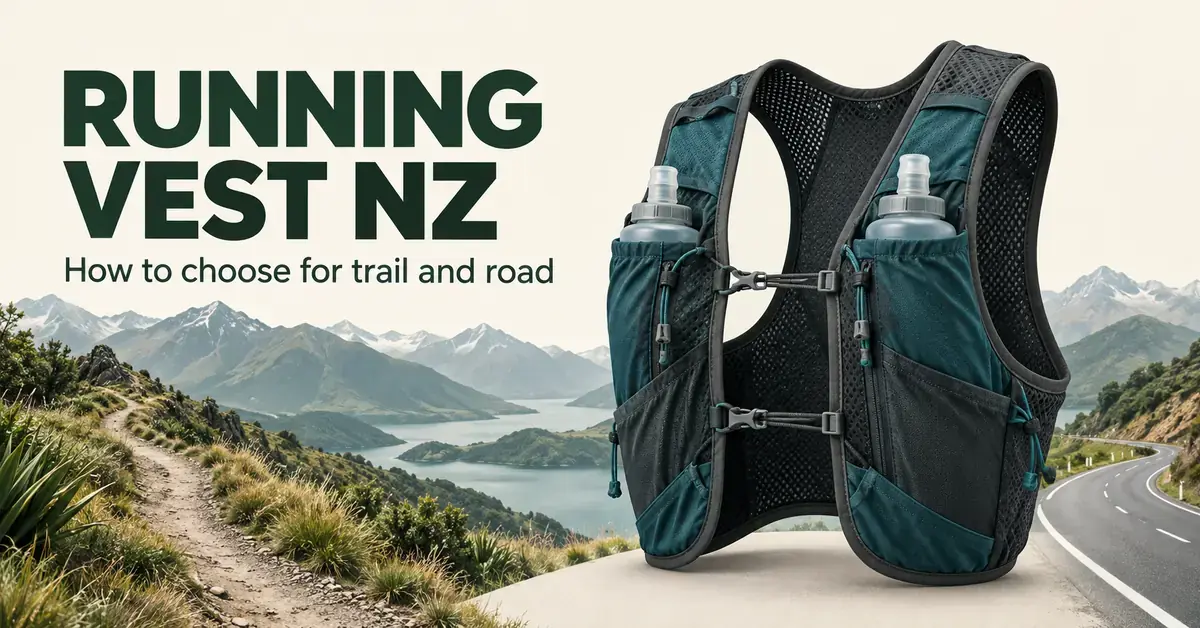
A running vest is a close-fitting, lightweight harness worn over your torso to carry water, food and safety gear while you run, and choosing the right one is one of the most useful upgrades a New Zealand runner can make. Unlike a daypack, a vest wraps around your ribcage like a piece of apparel so the load sits still, letting you cover long road or trail distances without the bounce and shoulder strain of a traditional backpack.
This guide is about picking the vest itself: how to match capacity and fit to the kind of running you actually do, what the popular models cost in New Zealand, and the mistakes that lead to a vest that chafes or gets left in the cupboard. For the deeper mechanics of hydration systems and how much fluid to carry, it pairs with our companion guide to the running hydration pack. General background on gear and apparel categories is widely catalogued online, including on Wikipedia.
Key Points
- Fit before features: a running vest is sized by chest measurement (XS–XL), and the correct size matters more than any single feature.
- Buy for your usual run: 5–8 L suits most Kiwi trail runners; 2–5 L for road racing; 10–12 L for long alpine ultras with heavy mandatory gear.
- Check the gear list first: events like the Kepler Challenge require thermals and seam-sealed waterproofs, which dictates the minimum capacity.
- Price in New Zealand: roughly NZ$150 entry-level, NZ$250–300 for race and ultra vests; “Set” versions include flasks and save money.
- Test loaded: fill the flasks and jog before you buy — a good vest barely bounces and never chafes.
What a running vest is and how it differs from a pack or belt
A running vest is a torso-hugging carry system built around soft, stretchy panels and a set of front and back pockets, designed so weight sits close to your centre of gravity and does not swing. The name covers everything from a minimalist 2-litre racing harness to a 15-litre fastpacking rig, but the defining feature is the same: it fits like clothing rather than hanging off your shoulders like a bag.
That is what separates a vest from a conventional hydration backpack. A pack pulls backwards on the shoulders and is fine for hiking, but the sway becomes tiring and destabilising once you start running. A vest spreads the same load across your chest and upper back, which keeps your stride efficient and stops the load from riding up.
Modern vests achieve that fit through soft, breathable stretch-mesh panels that expand and contract as your lungs work on a climb, paired with a more durable, often water-resistant fabric on the rear compartment that shelters spare layers. This second-skin construction is why a well-chosen vest can be worn for hours without the rubbing that a rigid pack causes, even when it is fully loaded with winter safety gear.
Vest, belt or handheld: which carry system do you need?
Not every run needs a vest. The right carry system depends on how much fluid and gear you must take and for how long. Use this quick decision guide before you spend anything:
- Handheld flask (250–600 ml): best for runs under about an hour where you want one drink and nothing else. Cheapest option, but occupies a hand and carries almost no gear.
- Running belt: a slim waistband for a phone, keys, gels and a small flask. Ideal for road runs, parkrun and shorter training where a vest is overkill. See our guide to the running belt for the trade-offs.
- Running vest: the answer once you need to carry roughly 1 litre or more of fluid plus food, a layer and safety gear — that is, most trail runs over 90 minutes and any event with a mandatory kit list.
In short: a belt carries essentials, a vest carries essentials plus water and safety gear, and a handheld carries a single drink. Most Kiwi trail runners end up owning a belt for short outings and a vest for everything longer.
Matching a running vest to your kind of running
The single most important choice is capacity, measured in litres of total storage, because it dictates how much you can carry and how the vest feels when partly full. Buy for the runs you do most often, not the one epic mission you might attempt once. A vest that is permanently stuffed strains the zips, while an oversized vest carrying a single flask flaps against your back and rubs.
New Zealand running spans flat urban waterfronts and remote alpine tussock, so the sensible capacity varies widely. The bands below map volume to the type of running each suits.
Road and trail running also pull the choice in different directions. On the road you are rarely far from help or a tap, so the priority is a light, low-profile vest that carries your own drinks and gels and nothing more. On the trail, self-sufficiency matters: you may be hours from the nearest road, the weather can change fast, and a race may compel you to carry a full survival kit — so capacity, secure pockets and durable fabric outrank outright minimalism.
Capacity bands and who they suit
- 2–5 L race vests: minimal storage for road marathons, fast summer trail sessions and short races. Enough for two flasks, gels, a phone and a light shell.
- 5–8 L all-rounders: the sweet spot for most Kiwi trail runners. Room for around 1–1.5 litres of fluid plus a standard mandatory-gear list on training runs and mid-distance events.
- 10–12 L ultra vests: built for long mountain ultras and events with heavy compulsory kit, such as the alpine Kepler Challenge, where you must carry full thermals and waterproofs.
- 15 L and up fastpacks: hybrid vest-packs for self-supported multi-day trips and remote backcountry missions where you carry sleeping and cooking gear.
If you are unsure between two sizes, the larger all-rounder is usually the safer buy in New Zealand because compression straps let a bigger vest carry a small load neatly, whereas a small vest simply cannot expand for a wet, cold day in the hills.
Popular running vests in New Zealand compared
New Zealand runners can buy from global specialists and one strong local brand, with vests widely stocked by retailers such as Further Faster, Torpedo7, Bivouac, Rebel Sport and the manufacturers’ own New Zealand stores. The table below compares commonly available models by capacity, whether flasks are included and the runner each suits, so you can shortlist before trying them on.
Comparison
| Model | Capacity | Flasks included | Best suited to | Approx. NZ price |
|---|---|---|---|---|
| Salomon Active Skin 8 Set | 8 L | Yes (2 × 500 ml) | First vest, everyday trail training | ~NZ$150–180 |
| Salomon ADV Skin 5 Set | 5 L | Yes (2 × 500 ml) | Fast trail racing, marathons up to ~60 km | ~NZ$260–280 |
| Salomon ADV Skin 12 | 12 L | Yes | Long mountain ultras, heavy mandatory kit | ~NZ$300+ |
| Ultimate Direction Ultra Vest 6.0 | ~10 L | Varies by version | Long trail runs, self-supported days | ~NZ$250 |
| Macpac Amp Ultra 10 L | 10 L | Yes (2 × 500 ml) | All-round trail, NZ-designed | RRP ~NZ$280 (often on sale) |
| Macpac Amp Ultra 15 L | 15 L | Yes | Fastpacking, multi-day missions | RRP ~NZ$300 |
| Nathan Pinnacle 12 L | 12 L | Yes | Long runs, body-hugging women’s option | Check retailer |
| CamelBak Apex Pro | ~12 L | Yes | Structured carry with large storage | Higher end |
Capacity is total pack volume; prices are approximate 2026 NZ recommended retail and change with sales. Flask inclusion differs between “Set” and base versions — confirm with the retailer.
Prices are approximate 2026 recommended retail in New Zealand dollars and move with regular sales, so treat them as a guide and confirm at the retailer. Note too that “Set” versions include soft flasks while base versions may not, which changes the real cost of getting running.
What you actually pay in New Zealand
Expect to spend roughly NZ$150 for a capable entry-level all-rounder, NZ$250–300 for a race-focused or long-ultra vest, and more for structured, high-capacity models. Salomon’s Active Skin 8 sits at the affordable end around NZ$150 and includes two 500 ml flasks, while the ADV Skin 5 Set, a dedicated racing vest, is closer to NZ$280. Locally, the Macpac Amp Ultra 10 L carries a recommended price near NZ$280 but is frequently discounted, and the Ultimate Direction Ultra Vest 6.0 runs about NZ$250. Buying the flasks-included “Set” is almost always cheaper than adding flasks separately later.
Getting the fit right so the vest disappears
Fit matters more than any feature, because a technically brilliant vest that is the wrong size will bounce and chafe no matter how you pack it. Running vests are sold in chest sizes, typically from XS to XL, rather than one-size-fits-all, so a correct size is the foundation of a comfortable ride.
To size yourself, wrap a soft tailor’s tape around the widest part of your chest while wearing the top you would normally run in, then compare that measurement in centimetres against the specific brand’s chart. Sizing is not consistent between brands, so never assume your Salomon size equals your Ultimate Direction size.
Men’s, women’s and unisex fits
Many ranges offer a women’s-specific cut alongside unisex models, and it is worth trying both. Women’s vests typically adjust the chest-strap placement and panel shaping so flasks and straps sit comfortably, while unisex vests suit a wider range of body shapes. Fit is individual, so the label matters less than how a given vest actually sits on your torso when loaded.
Checking the fit before you commit
Load the vest and move in it before deciding, ideally in store. Fill the flasks or bladder with water, put on the layers you would run in, then jog on the spot and lean forward to mimic a descent. Run through these checkpoints:
- Shoulders: the straps should lie flat over your collarbones without digging into your neck or riding up.
- Ribs: the side panels should wrap snugly and evenly, with no pinching, gaping or single pressure points.
- Breathing: the sternum straps should hold the load still without restricting a deep breath on a climb.
- Bounce: a correctly sized, cinched vest should barely move when you jump; noticeable slap means it is too big or too loose.
Most vests use adjustable, elasticated sternum straps so you can tighten the fit on the move as you drink your flasks empty and the load shrinks. Practise those adjustments at home so they become second nature mid-run.
How a vest carries your kit: pockets, flasks and poles
A good vest lets you reach most of your water and food without breaking stride, and the pocket layout is what makes that possible. The best designs let you access flasks, gels and a phone from the front while keeping bulky safety layers stowed low on the back, so you rarely have to stop or take the vest off.
Typical layouts pair stretch front pockets for two soft flasks and quick-access nutrition with a larger rear compartment for a jacket and thermals, plus a secure zipped pocket for a phone or keys and small stash pockets for rubbish. On hydration itself — front soft flasks versus a rear bladder, and how much to drink — our companion running hydration pack guide covers the trade-offs in full so this article does not repeat them.
Carrying trekking poles
If you run steep terrain or long climbs, collapsible poles save your legs, and most trail vests include a way to stow them. Front bungee loops on the chest straps give the fastest stow-and-go for rolling courses, while rear horizontal straps or an over-the-shoulder quiver keep poles clear of your chest on sustained mountain days. Choose the system that matches how often you expect to deploy and pack the poles.
Mandatory safety gear and why vest choice depends on it
Your vest choice is often dictated by the compulsory kit a race requires, not by how much water you want, so check the gear list before you buy. Many New Zealand trail and ultra events enforce mandatory equipment because alpine weather can turn dangerous quickly, and the vest simply has to be big enough to carry all of it comfortably.
The Kepler Challenge in Fiordland is a good benchmark for how much space a serious event demands. Its compulsory gear includes two thermal long-sleeved tops, one set of thermal long johns, a thermal hat, gloves, a seam-sealed windproof and waterproof jacket, and seam-sealed overtrousers — “seam-sealed” meaning the manufacturer has taped and heat-sealed every seam. That volume of clothing is why long alpine events push runners towards 10–12 litre vests rather than a compact racer. If you are stepping up in distance, our guide to ultramarathon events in New Zealand explains how kit requirements scale with the race.
Beyond clothing, look for a vest with a loud, built-in emergency whistle on the sternum strap, secure internal loops for a personal locator beacon (PLB), and reflective detailing for low-light visibility — small features that matter on remote or dark routes.
Common mistakes when buying a running vest
Most vest regret comes from a handful of avoidable errors rather than buying the “wrong” brand. Knowing them in advance saves both money and blisters:
- Buying on capacity alone: a 12-litre vest is useless if it does not fit your chest. Size first, then choose the volume within a good fit.
- Guessing the size online: brands size differently, so measure your chest and check each brand’s chart rather than assuming a “medium” is universal.
- Oversizing “to be safe”: a big, half-empty vest bounces and rubs. Match capacity to your usual run, not your rare epic.
- Skipping the loaded test: an empty vest feels great in the shop; only a water-filled, jogging test reveals bounce and hot spots.
- Ignoring the mandatory-gear list: buying a race vest that cannot fit compulsory kit means buying twice.
- Neglecting care: letting salt and sweat dry into the fabric shortens the vest’s life dramatically.
Caring for your vest so it lasts
A little routine maintenance is the difference between a vest lasting one season and lasting several, because dried sweat is corrosive to elastic and zips. Rinse the vest in cool, clean water after sweaty or salty runs, hand-wash the strap and armpit zones with a mild technical wash rather than harsh detergent or fabric softener, flush the zips of grit, and always air-dry it out of direct sunlight. Never put it through a hot machine cycle or tumble dryer, which can destroy heat-sealed seams and water-resistant coatings. Rounding out your kit with quality running socks and a reliable GPS running watch means the whole system is ready when you are.
Sources
- Salomon — ADV Skin 5 product specifications
- Salomon New Zealand — Active Skin 8 Set
- Macpac — Amp Ultra 10L Running Vest
- Macpac — Amp Ultra 15L Running Vest
- Gearshop NZ — Ultimate Direction Ultra Vest 6.0
- Further Faster — Hydration packs and vests (NZ retailer)
- Kepler Challenge — Compulsory gear list
- GearJunkie — Best running hydration packs and vests (2026)
Frequently asked questions
What size running vest do I need for a typical New Zealand trail race?
For most popular New Zealand trail races, a 5–8 litre vest is the sweet spot. It holds around 1–1.5 litres of fluid plus a standard mandatory-gear list — a waterproof jacket, thermal top, hat, gloves and survival blanket — with room left for gels and a phone. Step up to 10–12 litres only for long alpine events with heavy compulsory kit.
How do I stop my running vest from bouncing?
Bounce is almost always a sizing or adjustment problem. Buy the correct chest size for your body, keep the sternum straps cinched, and press the air out of your flasks or bladder so water cannot slosh. Test a loaded vest by jogging on the spot before a run; a well-fitted vest should barely move.
How much does a good running vest cost in New Zealand?
Expect roughly NZ$150 for a capable entry-level all-rounder, NZ$250–300 for a race or long-ultra vest, and more for large structured models. Buying a “Set” version with soft flasks included is usually cheaper than adding flasks later. Prices move with sales, so compare retailers before committing.
Do running vests come with water flasks included?
It depends on the version. “Set” models from brands like Salomon, and local vests such as the Macpac Amp Ultra, typically include two 500 ml soft flasks, while some base models are sold without. Most vests also accept a 1.5–2 litre bladder that is bought separately. Always check what is in the box.
Can I use a running vest for road marathons, not just trails?
Yes. Many road marathoners use a slim 2–5 litre race vest to carry their own drinks and gels, so they never have to slow at crowded aid stations. On the road you need far less capacity than on the trail, so choose the lightest vest that fits your flasks and a couple of gels comfortably.