A half marathon pace chart converts your goal finish time into a single number you can actually run to: the pace per kilometre, plus the clock times you should see as you cross the 5 km, 10 km and 15 km markers. Over the 21.0975 km distance, holding an even effort from the start line to the finish is the difference between a controlled race and a painful fade over the final stretch, whether you are running the flat Auckland waterfront, the Wellington harbour front or a Christchurch road course.
This guide gives you a full pace chart in kilometres for goal times from 1:30 to 2:30, explains how to choose a target you can realistically hold, and shows how to adjust your effort for the hills, wind and heat you will meet on New Zealand courses. Every figure below is calculated against the official half marathon distance of 21.0975 km.
Key Points
- A half marathon is 21.0975 km; a pace chart turns your goal finish time into a per-kilometre pace and 5/10/15 km split times.
- Even or slightly negative splits are the most efficient way to run the distance; starting too fast is the number-one cause of a late fade.
- Predict a realistic goal from a recent 5 km or 10 km using the Riegel formula — roughly your 10 km time × 2.2.
- On hills, in wind and in heat, run to effort rather than to a fixed number, then return to chart pace when the course allows.
- Official pace groups hold steady splits and reduce watch-watching, but keep verifying your own times at the mats.
Why pacing decides your half marathon
Pacing matters more than any other single race-day decision because the half marathon is long enough for early mistakes to compound. Many runners treat 21.1 km like an extended 10 km and set off on adrenaline, which spends carbohydrate stores too quickly and leaves little in reserve for the closing kilometres.
Running faster than your sustainable effort early on causes your muscles to accumulate lactate and hydrogen ions faster than your body can clear them. That accelerates fatigue and brings on the classic late-race slowdown — often called “hitting the wall” — during the final third of the course. A pace chart exists to keep you honest in exactly the phase where you feel strongest and are most tempted to go too fast.
Even splits versus negative splits
For most runners, an even split (the same pace throughout) or a slight negative split (a second half fractionally faster than the first) produces the best result. Sports-science analyses of marathon and half-marathon fields consistently link positive splits — starting fast and slowing down — with worse finishing times, while even and negative pacing preserve glycogen, keep cardiac output stable and improve heat management.
An even split is the most energy-efficient approach because your muscles work at a steady output. A negative split is often easier to execute in practice, because holding back early builds in a safety margin. The table below shows how the effort you invest should change across the three phases of the race even when the pace target stays the same.
| Race phase | Share of the race | Perceived effort (1–10) | What to focus on |
|---|---|---|---|
| Kilometres 1–5 | First 25% | 5–6 (controlled, easy) | Let quicker runners go, settle your breathing, run relaxed form |
| Kilometres 6–15 | Middle 50% | 7–8 (steady working effort) | Lock into your chart pace, tuck into a group, stay on top of hydration |
| Kilometres 16–21.1 | Final 25% | 8–10 (concentrated push) | Hold form as fatigue rises, lift your cadence, run the pace you banked |
The half marathon pace chart in kilometres
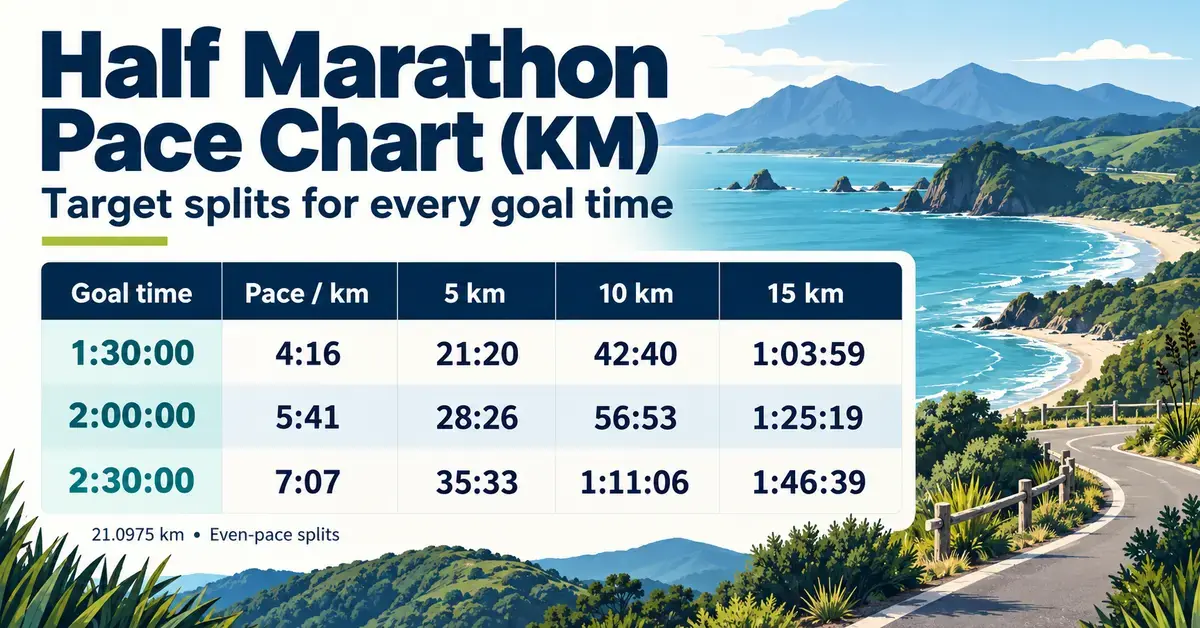
The chart below lists even-split target times from a 1:30 finish through to 2:30. Find the row for your goal time, then memorise your per-kilometre pace and the split times for the 5 km, 10 km and 15 km markers so you can check your progress against a GPS watch or the on-course timing mats.
Choose a row that matches your current fitness and recent long-run data, not an aspirational number your training does not yet support. If you want the equivalent reference for the full 42.195 km distance, see the dedicated full marathon pace chart.
| Goal finish time | Pace per km | 5 km split | 10 km split | 15 km split |
|---|---|---|---|---|
| 1:30:00 | 4:16 /km | 21:20 | 42:40 | 1:04:00 |
| 1:35:00 | 4:30 /km | 22:30 | 45:00 | 1:07:30 |
| 1:40:00 | 4:44 /km | 23:40 | 47:20 | 1:11:00 |
| 1:45:00 | 4:59 /km | 24:55 | 49:50 | 1:14:45 |
| 1:50:00 | 5:13 /km | 26:05 | 52:10 | 1:18:15 |
| 1:55:00 | 5:27 /km | 27:15 | 54:30 | 1:21:45 |
| 2:00:00 | 5:41 /km | 28:25 | 56:50 | 1:25:15 |
| 2:10:00 | 6:10 /km | 30:50 | 1:01:40 | 1:32:30 |
| 2:20:00 | 6:38 /km | 33:10 | 1:06:20 | 1:39:30 |
| 2:30:00 | 7:07 /km | 35:35 | 1:11:10 | 1:46:45 |
How to read the chart
Read the chart in two directions. Across your goal row, the pace-per-km figure is the number to keep on your watch, and the split columns are the running-total (elapsed) times you should see at each marker — not the time for that 5 km segment on its own. If your watch shows 56:50 as you pass 10 km, you are exactly on 2:00 pace.
Quick Facts
| Official distance | 21.0975 km (rounded to 21.1 km) — half the 42.195 km marathon |
| Even-split maths | Goal time ÷ 21.0975 = pace per km |
| Sub-1:45 target | 4:59 /km |
| Sub-2:00 target | 5:41 /km |
| Typical hill slowdown | 20–45 sec/km on a sustained climb |
| Warm/humid day | Ease target by roughly 10–20 sec/km |
| 10 km to half estimate | 10 km time × ~2.2 (Riegel formula) |
How to choose a realistic goal time
Pick your goal time from evidence, not hope. The most common pacing error happens before the race even starts: choosing a target based on what a training partner is running, or on a personal best set years ago, rather than on current fitness. An honest look at your recent races and weekly mileage will point you to the right row on the chart.
The most reliable predictor is a recent, fully-timed shorter race — a local parkrun 5 km or a 10 km road event — fed into an established conversion formula.
Predicting your half from a 5 km or 10 km
The widely used Riegel formula estimates a longer-distance time as T2 = T1 × (D2 ÷ D1)^1.06, where T1 is your known time over distance D1. For a 10 km to half marathon conversion this works out to roughly your 10 km time multiplied by 2.2. A 50:00 10 km predicts about 1:50; a 45:00 10 km predicts about 1:39. Research shows this formula is well calibrated up to the half marathon distance, so it is a dependable starting point.
- Check your long-run pace: your target half-marathon pace should feel roughly 15–30 seconds per km faster than an easy everyday training run.
- Weigh your consistency: if training has been broken up by niggles or missed weeks, drop to a more conservative row to protect your finish.
- Account for the surface: smooth road racing feels different from the gravel, clay and bush single-track many Kiwis train on, so a road goal from trail training can flatter you.
- Use heart rate if you train with it: identify the pace that keeps you comfortably below your anaerobic threshold for long blocks, and let that anchor your goal.
If you are still building toward the distance, the wider half marathon training and race guide covers plans and preparation in more depth, and a couch to 5k training plan is a sensible first step if you are new to structured running.
Adjusting your pace for New Zealand courses and conditions
A pace chart assumes a flat course and still air, which almost no New Zealand event delivers. Courses like the Wellington waterfront, the Auckland Marathon harbour crossing and the scenic Queenstown Marathon each add wind, gradient or both. The fix is to run to effort rather than to a fixed number when conditions change, then return to your chart pace when the course allows.
Managing hills and elevation
On a sustained climb your speed will drop no matter how fit you are, and forcing your watch back to flat-course pace spikes your heart rate into a zone you cannot hold. Shorten your stride, drive your arms, keep your effort steady and accept a slower split — then use the following descent to bring your average back.
| Condition | Effect on watch pace | How to adjust |
|---|---|---|
| Sustained headwind | Can slow you 10–20 sec/km | Drop your shoulders, tuck behind a group, run to effort not speed |
| Steep gradient / hills | Cuts forward speed on the climb | Shorten your stride, pump your arms, accept a slower split |
| Downhill sections | Naturally increases pace | Lean slightly from the ankles, stay relaxed, bank a faster kilometre |
| Heat and humidity | Raises heart rate and sweat loss | Ease your target pace by roughly 10–20 sec/km to avoid overheating |
Wind and heat
Wind and heat both raise the effort needed to hold a given pace, so plan to run slightly slower rather than fight the number. In a strong headwind, shelter behind other runners and save energy for the sheltered or tailwind sections. On a warm, humid day, ease your target by 10–20 seconds per km from the first kilometre, drink at every aid station, and treat finishing strongly as the win rather than chasing an out-of-reach time.
Running with official pace groups
Official pace groups are one of the simplest ways to hold your chosen splits. Experienced club runners carry tall flags showing finish times such as 1:45, 2:00 or 2:15 and are trained to run smooth, metronomic kilometres across the whole course. The full marathon distance they often also pace is exactly double the half, at 42.195 km, as explained on Wikipedia.
Running with a group removes the constant mental load of checking your watch, so you can focus on your breathing and rhythm and use the group’s momentum through the quieter middle kilometres.
Tips for staying with a pacer
Pace packs feel crowded, especially near early water stations, so leave space and stay relaxed. A GPS running watch is still worth wearing so you can confirm your own splits at the timing mats.
- Don’t panic if they edge ahead: pacers often adjust slightly for hills or bottlenecks; trust their experience and reel them back in.
- Ask about the plan: before the start, check whether the pacer intends an even split or a conservative positive split.
- Keep your own record: use your watch to verify your times at the 5 km, 10 km and 15 km mats.
- Thank them afterwards: if a pacer guides you to a personal best, a quick thanks past the finish line goes a long way.
Common pacing mistakes to avoid
Most half-marathon pacing failures come from a short list of avoidable errors, not from a lack of fitness. Knowing them in advance is the easiest way to protect your goal time.
- Starting too fast: the biggest and most common mistake. Adrenaline and a crowded start line push runners well under target for the first 2–3 km. Line up in the correct time-estimate wave and consciously hold back early.
- Chasing a lost target: if a bottleneck costs you time, do not sprint to recover it. Claw back 2–3 seconds per km over the next half hour instead.
- Ignoring the conditions: running your flat-course number into a headwind or on a hot day drains you early. Adjust for effort, not ego.
- Trusting GPS blindly: watches drift near buildings, trees and tight corners. Certified courses are measured precisely, so use the physical markers and mats as your reference.
- Setting a goal from an old PB: base your target on recent race data and current mileage, not a time you ran seasons ago.
Sources
Frequently Asked Questions (FAQ)
What is the exact distance of a half marathon?
A half marathon is officially 21.0975 km, almost always rounded to 21.1 km. That is exactly half of the 42.195 km full marathon distance. Every pace and split figure in the chart above is calculated against 21.0975 km, which is why they line up precisely with certified course markers.
How do I read a half marathon pace chart in km?
Find the row for your goal finish time. The pace-per-km column is the number to hold on your watch, and the 5 km, 10 km and 15 km columns are the cumulative elapsed times you should see at each marker. For example, on 2:00 pace you should pass 10 km at 56:50 and 15 km at 1:25:15.
Is an even split or a negative split better for a half marathon?
For most runners, an even split or a slight negative split gives the best result and the lowest risk of fading late. Positive splits — going out fast and slowing down — are consistently linked with worse finish times because they burn through glycogen too early. An even effort is the most efficient; a negative split is often easier to execute because it builds in a safety margin.
How can I predict my half marathon time from a 5 km or 10 km?
Use the Riegel formula: predicted time = known time × (new distance ÷ known distance) raised to the power 1.06. In practice, that means about your 10 km time multiplied by 2.2 — so a 50:00 10 km predicts roughly 1:50. The estimate assumes you have done the long runs needed to support that pace over the full 21.1 km.
How much should I slow down on hills or in the heat?
On a sustained climb, expect your pace to drop by roughly 20–45 seconds per km, and focus on holding steady effort rather than a fixed number — you can recover time on the descent. On a warm or humid day, ease your target by about 10–20 seconds per km from the start to keep your heart rate under control and avoid heat exhaustion.