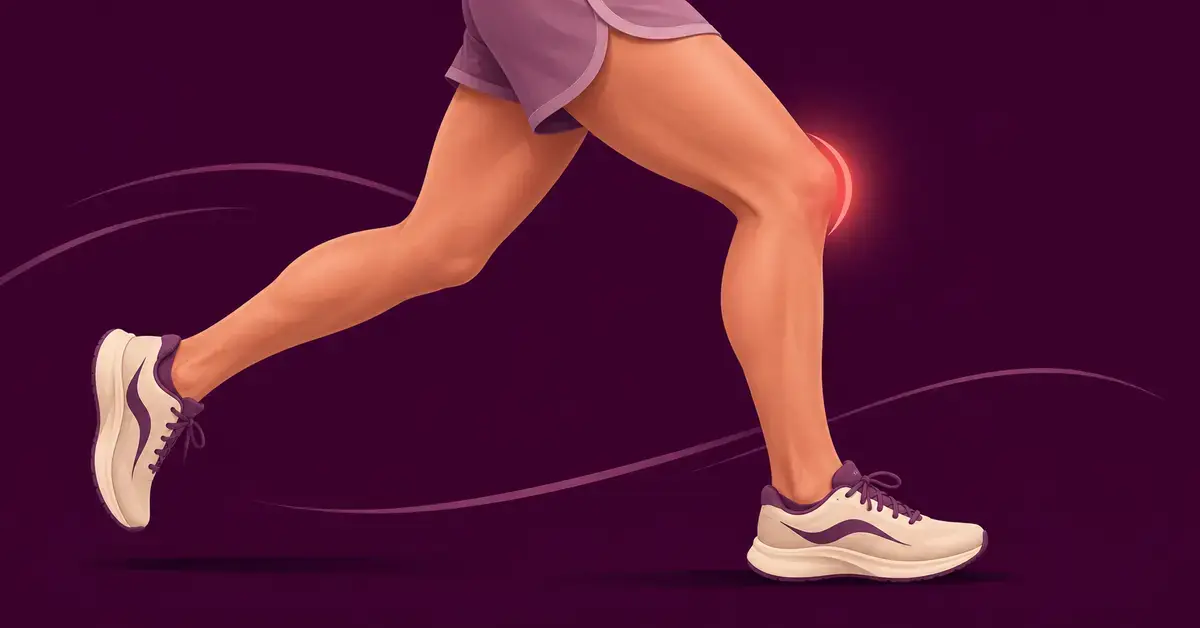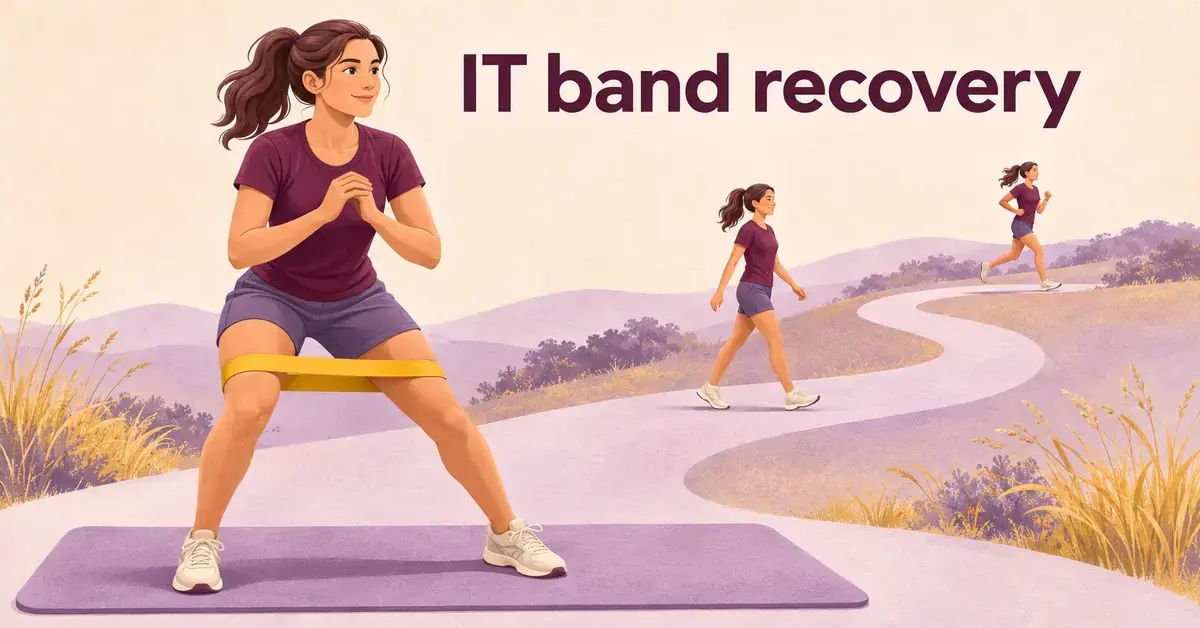
Iliotibial band syndrome — usually shortened to IT band syndrome or ITBS — is the most common cause of pain on the outside of the knee in runners, and one of the most common running overuse injuries of any kind. It shows up as a sharp or burning ache on the outer knee that tends to arrive at a predictable point in a run and then eases with rest. The encouraging part is that it responds well to the right changes: managing your training load, strengthening your hips, and easing back gradually. This guide explains what ITBS is, why it happens, which fixes the evidence actually supports (and which it does not), the stretches and exercises worth doing, and how to follow a safe return-to-run plan.
Key Points
- IT band syndrome is the most common cause of pain on the outside of the knee in runners; estimates suggest it affects roughly 5-14% of runners (up to about 12% in one clinical reference).
- The pain is now understood as compression of sensitive tissue under the IT band, not the band “rubbing” over bone — so grinding the band with a foam roller rarely fixes it.
- The main drivers are training errors (sudden mileage, lots of downhill or cambered running) and weak hips and glutes.
- What works: cut your running load below the pain threshold, strengthen the glutes and hips, and lift your cadence by about 5-10%.
- Most runners recover in about 4-12 weeks with a gradual, criteria-based return to running — distance before speed, flat before hills.
What is IT band syndrome?
IT band syndrome is an overuse injury that causes pain on the outer side of the knee, where the iliotibial band crosses the joint. The iliotibial band is a long, strong strip of connective tissue (fascia) that runs down the outside of your thigh. It starts at the outside of your hip — where it connects to the tensor fasciae latae muscle and part of the gluteus maximus — and runs all the way down to a bony point on the outer shinbone just below the knee, called Gerdy’s tubercle. Along the way it helps stabilise the knee and control the leg as you run.
ITBS is the most common cause of pain on the outside of the knee in runners and cyclists. Estimates of how many runners it affects vary with how studies are run, but figures generally fall somewhere between 5% and 14%, with one widely cited clinical reference putting it at up to around 12%. It was first described in 1975 in US Marine recruits, and it turns up across many sports — but endurance runners are the classic case, because the injury is driven by repetition.
What causes IT band syndrome in runners?
IT band syndrome is caused by doing too much, too soon, with a body that is not yet strong or stable enough to handle it. Two things usually combine: errors in how you train, and weaknesses in how your hips and legs control your stride.
Training errors
Sudden jumps in load are the classic trigger. Common culprits include:
- Increasing your weekly distance too quickly, or adding back-to-back run days before you are ready.
- A lot of downhill running, which loads the outer knee more than flat ground — relevant on Aotearoa’s hilly trails and road routes.
- Running repeatedly on a cambered (sloped) surface, such as the same side of a crowned road or a beach, so one leg works at an angle every stride.
- A rapid spike in speed work or hill reps without building up to it.
Hip and glute weakness and running form
Weakness higher up the chain lets the knee drift out of line, which loads the IT band. Research on runners with ITBS points to weaker hip abductors — particularly the gluteus medius, the muscle on the side of your hip that keeps your pelvis level when you stand on one leg. When it cannot do that well, the knee rolls inward and the hip drops on each footstrike. A narrow stride, where your feet land close to or across your body’s midline, and a low running cadence (few steps per minute) add to the same problem.
Friction or compression? What the research now says
The old explanation was that the IT band rubs back and forth over a bony bump on the outer thigh, like a rope over a pulley, causing friction and inflammation. Current anatomy research has largely overturned that picture. Studies show the band is firmly anchored to the thighbone and cannot actually slide forwards and backwards over the bone the way the friction theory assumed.
Instead, the pain is now understood as compression: at around 30 degrees of knee bend — roughly the angle at footstrike while running — the band presses down on a layer of sensitive, richly supplied fat and connective tissue underneath it. That is why the ache so often strikes at the same point in a run and feels worse downhill. The mechanism matters because it changes what you should do about it: if the tissue is being compressed, grinding the band harder from the outside is unlikely to be the answer.
Symptoms: how to know if it’s your IT band
The signature symptom is sharp or burning pain on the outside of the knee that appears at a consistent time or distance into a run. Typical signs include:
- Pain or a tender spot on the outer knee, often a few centimetres above the joint line, that you can press on and feel.
- Pain that reliably kicks in after a set distance or time — many runners say it hits at, for example, the same kilometre mark every run — and settles with rest.
- Worse symptoms running downhill, going down stairs, or on uneven ground, because those positions load the compression point.
- In stubborn cases, aching when walking, cycling or simply bending the knee.
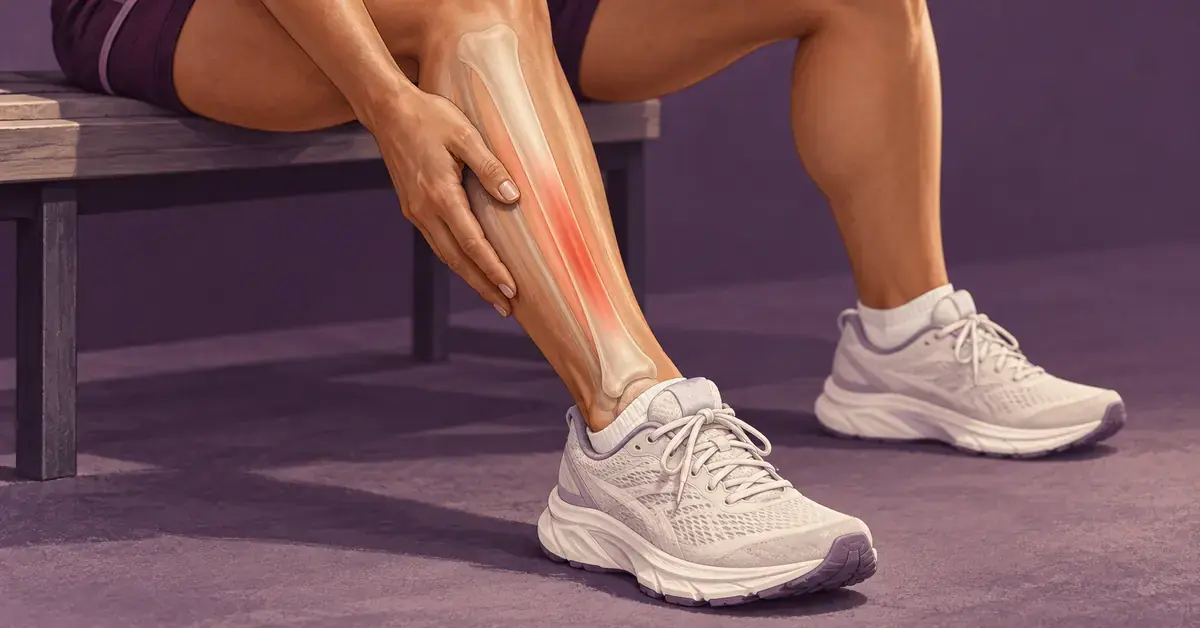
Because several running injuries cluster around the knee, it helps to know what ITBS is not. If your pain is at the front of the knee or around the kneecap rather than the outer side, it is more likely runner’s knee. If the ache is along the front of your lower leg rather than the knee, that points towards shin splints instead. Pain that locks or swells the joint, or that follows a specific twist or fall, is a reason to get it looked at rather than self-managed.
How to treat IT band syndrome
The treatment that works is a combination: take the load off the irritated tissue, fix the hip and form issues that overloaded it, and rebuild slowly. No single stretch or gadget fixes ITBS on its own.
Reduce the load — but not total rest
Dialling your running back below the level that triggers pain is the first and most important step. For many runners that means cutting volume, dropping downhill and tight-turn routes, and keeping every run short of the point where the outer knee starts to bite. You rarely need to stop moving altogether: easy cycling (with a sensible saddle position), pool running and walking usually stay comfortable and keep your fitness ticking over while the tissue calms down.
Strengthen your hips and glutes
Building strength in the hip abductors and glutes is the best-supported active treatment. An influential rehabilitation study found that around nine in ten runners with ITBS became pain-free after about six weeks of a focused gluteus medius strengthening programme. Strength work is not a magic bullet on its own — it works best paired with the load management above — but it addresses the control problem that let the band get overloaded in the first place. Give it several weeks; strength changes are not instant.
Adjust your running form
Small form tweaks reduce the load at the knee. The best evidence is for cadence: a University of Wisconsin study found that increasing step rate by 5 to 10 percent reduced the energy absorbed at the knee and hip. Aim for a modest lift from your own comfortable cadence rather than chasing a fixed “180 steps per minute” target — count your steps for a minute and nudge it up by a handful. A metronome app or the cadence readout on a running watch makes it easy to check. Widening a very narrow stride slightly and avoiding always running on the same road camber help too.
Stretching and foam rolling: what helps, what doesn’t
This is where a lot of runners waste effort. The IT band itself is dense, strong fascia and does not meaningfully stretch or lengthen, so you cannot “stretch it out” the way you can a muscle. Aggressive foam rolling directly on the painful outer knee is also questionable: because the problem is compression, pressing hard on that spot can add to it rather than relieve it. Foam rolling may dull pain for a while by changing how the area feels, but it does not fix the underlying cause. What is useful is improving mobility in the muscles that feed into the band and control the hip — the hip flexors, glutes and tensor fasciae latae — so your stretching effort is better spent there.
Stretches and exercises that help
A practical routine pairs mobility work for the hip with strength work for the glutes. Build up gradually and stop any movement that sharpens the outer-knee pain.
Strengthening (the priority):
- Clamshells: lie on your side, knees bent, and lift the top knee while keeping your feet together and pelvis still. Add a resistance band above the knees to progress.
- Side-lying hip abduction: lie on your side and lift the top leg straight up, leading with the heel, to target the gluteus medius.
- Single-leg glute bridges: on your back, drive through one heel to lift your hips, keeping them level.
- Step-downs: stand on a low step and slowly lower the other foot towards the floor, keeping your knee tracking over your toes and your pelvis level. This trains the single-leg control running demands.
- Side planks: hold a side plank, or add a top-leg lift, to build lateral hip and trunk strength.
Mobility (stretch the muscles, not the band):
- Standing hip/TFL stretch: cross the sore leg behind the other, then lean your hips away from the sore side until you feel a stretch down the outer hip and thigh.
- Hip flexor stretch: from a half-kneeling position, tuck your pelvis and ease forward to open the front of the hip.
- Figure-four glute stretch: lying on your back, cross one ankle over the opposite knee and draw the legs towards your chest to stretch the glutes.
A safe return-to-run plan
Return to running on the basis of how the knee responds, not a fixed calendar. Most runners settle down and get back to full training within about 4 to 12 weeks, but rushing the comeback — especially onto hills — is the quickest way to flare it again. Before your first run back you should be able to walk for 30 minutes with no outer-knee pain, and your single-leg strength should feel roughly even side to side. From there, let pain in the 24 hours after a session be your guide: if there is none, you progress; if there is, you hold or step back a stage. If you are rebuilding from a low base, a structured plan such as a couch to 5K plan gives you a gentle framework to layer this onto.
Return-to-Run Plan
| Stage | What you do | Move on when |
|---|---|---|
| 1. Settle it down | Swap running for pain-free cross-training (easy cycling, pool running); keep walking comfortable; start your hip and glute strength work. | You can walk for 30 minutes with no outer-knee pain. |
| 2. Walk-run | Alternate about 1 minute of easy jogging with 1-2 minutes of walking on flat ground, 2-3 times a week. | You finish the session with no pain during it or in the next 24 hours. |
| 3. Continuous easy runs | Build towards 20-30 minutes of continuous easy running on flat routes, every other day. | You run 30 minutes pain-free and your single-leg strength feels even side to side. |
| 4. Rebuild volume and add hills | Increase weekly distance by no more than about 10%; reintroduce gentle downhills and your normal hilly routes last. | Pain stays away as distance, then speed, then hills come back. |
How to prevent IT band syndrome
Preventing ITBS comes down to loading your body gradually and keeping your hips strong. The same habits that treat it also keep it away:
- Build mileage gradually. Increasing your weekly distance by no more than roughly 10% is a useful rule of thumb rather than a hard law — the point is to avoid sudden spikes, and to insert easier weeks.
- Keep up hip and glute strength. Two short sessions a week of the exercises above, maintained year-round, is cheap insurance.
- Vary your surfaces and direction. Avoid always running the same camber or always circling a track the same way, and introduce downhill running progressively.
- Mind your cadence and stride. A slightly quicker, slightly less bouncy stride reduces the load each step puts through the knee.
- Use shoes that suit you and replace them when they are worn. Our guide to choosing running shoes covers how to pick a pair for your mileage.
- Don’t train through a sharpening niggle. ITBS caught early, at the first consistent twinge, is far quicker to settle than one you have run on for a month.
Common mistakes runners make with ITBS
Most setbacks come from a handful of avoidable errors:
- Running through sharp pain. Pushing on when the outer knee is actively hurting keeps the tissue irritated and drags out recovery.
- Only foam rolling. Relying on rolling the band while ignoring the hip strength and training-load problems treats the symptom, not the cause.
- Trying to “stretch out” the band. The band does not lengthen, so aggressive stretching of it wastes effort that mobility work for the hip muscles would reward.
- Coming back too fast on hills. Downhill running is the hardest load for a recovering IT band and should be the last thing you add back.
- Masking it with painkillers. Using anti-inflammatories to run on a sore knee removes the warning signal without fixing anything.
When to see a physiotherapist or doctor
See a health professional if the pain is not improving after a few weeks of sensible self-management, if it is getting worse, or if it stops you walking normally. A physiotherapist can assess your hip strength and running mechanics, confirm it really is ITBS rather than another knee problem, and tailor the strength and return-to-run plan to you. Get it checked promptly, rather than self-treating, if the knee locks, gives way or swells, or if the pain began with a specific fall or twist — those point to something other than a straightforward overuse injury.
A note on medical advice
This article is general information for runners, not a diagnosis or a treatment plan for your individual situation. IT band pain can overlap with other knee conditions, and only a qualified health professional who can examine you — such as a physiotherapist or your GP — can confirm what is going on and advise what is safe for you. If pain is severe, persistent or worsening, seek professional care before continuing to run.
Sources
Frequently asked questions
Can I keep running with IT band syndrome?
Often yes, in milder cases, as long as you stay below the level that brings on pain — that usually means shorter runs, flat routes and fewer sessions while the tissue settles. The key is that the outer-knee pain should not come on during the run or linger into the next day. If it does, or if the pain forces you to change your stride, stop and let it recover rather than pushing through.
Is IT band syndrome the same as runner’s knee?
No. They are two different injuries that are easy to confuse because both affect the knee in runners. IT band syndrome causes pain on the outer side of the knee, while runner’s knee (patellofemoral pain) is felt at the front, around or behind the kneecap. The causes and the pain location differ, so it is worth being sure which one you have before you treat it.
Why does the pain start at the same distance every run?
The predictable onset is a hallmark of ITBS. The injury is driven by repeated compression of the sensitive tissue under the band at a certain knee angle, so it takes a fairly consistent number of footstrikes before the irritation builds enough to hurt. That is why many runners find the pain arrives at almost exactly the same time or distance each time.
Does IT band syndrome ever need surgery?
Very rarely. The large majority of runners recover with non-surgical measures — load management, hip strengthening and a gradual return to running. Surgery is only considered in stubborn cases that have not improved after many months of thorough conservative treatment, and it is the exception rather than the rule.