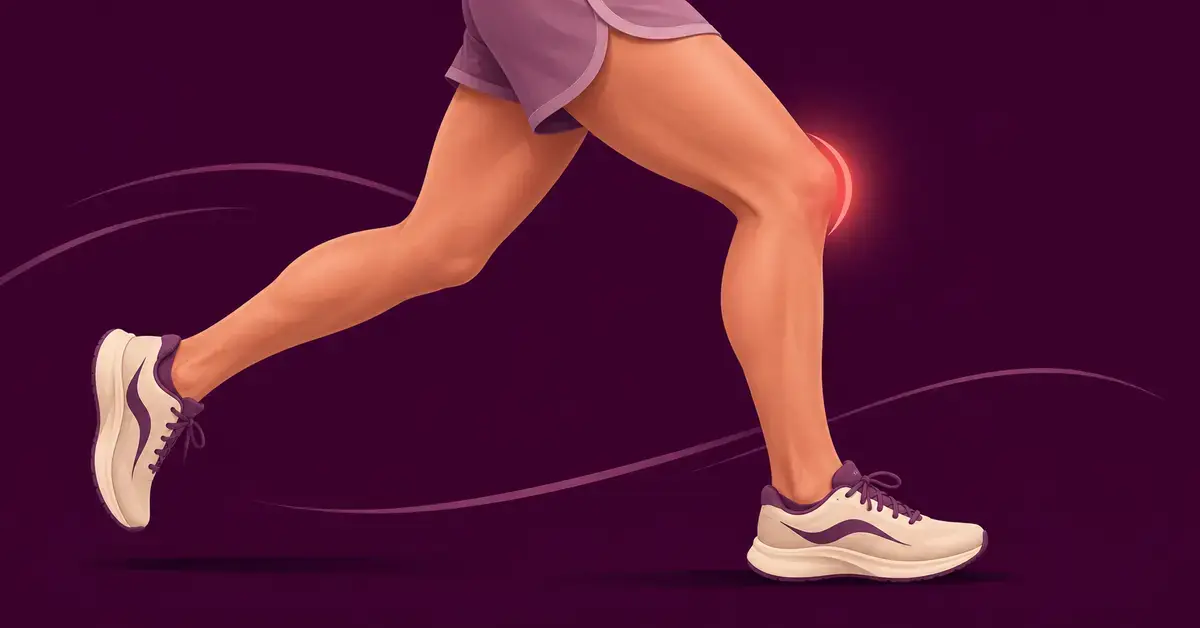
The simplest way to breathe while running is to breathe deeply from your belly, use your mouth as well as your nose, and settle into a steady rhythm that matches your stride. Do those three things and you take in more oxygen, feel less winded, and cut down on the side stitches that catch so many runners off guard. This guide explains each technique, shows you which breathing pattern suits which pace, and gives you practical fixes for a stitch when one strikes.
Key Points
- Breathe from your belly, not your chest. Let your stomach rise as you inhale so the diaphragm does the work and your lungs fill fully.
- Use your mouth as well as your nose. Nose-only breathing suits easy jogging; once you pick up the pace, breathe through both to get enough air.
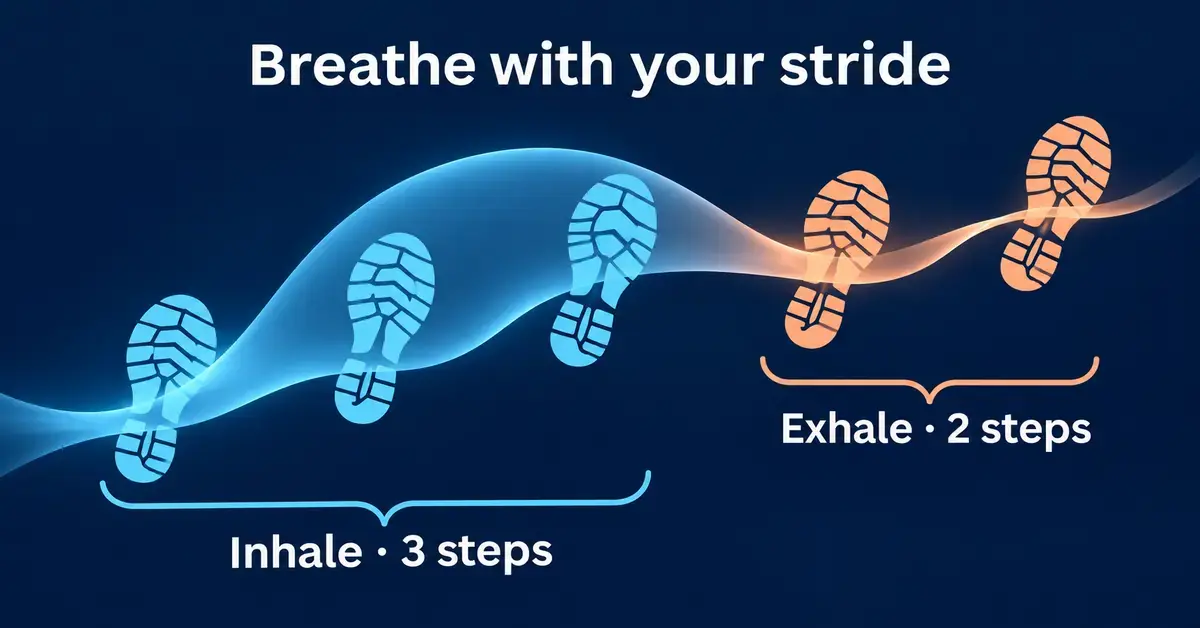
- Match your breath to your steps. A 3:2 rhythm (inhale for three footstrikes, exhale for two) is a solid all-round pattern; switch to 2:1 for hard efforts.
- Ease a side stitch by slowing down, exhaling hard through pursed lips, and pressing gently on the sore spot.
- Prevent stitches by leaving 2–3 hours after a big meal, skipping sugary drinks before you run, and building core strength.
Breathe from your belly, not your chest
Diaphragmatic breathing — often called belly breathing — is the foundation of good running breath. The diaphragm is the dome-shaped muscle beneath your lungs. When you breathe deeply, it pulls down and lets your lungs fill from the bottom up, so each breath moves more air. Shallow chest breathing does the opposite: it only fills the top of the lungs and leans on small muscles in the neck and shoulders that tire quickly and tense you up.
You can tell which type you default to with a quick check. Place one hand on your chest and one on your stomach and take a slow breath in. If the lower hand moves out and the upper one stays still, you are breathing from the diaphragm. If your chest and shoulders rise while your belly stays flat, you are chest breathing.
How to practise belly breathing
The easiest place to learn it is lying down, where gravity is out of the way:
- Lie on your back with your knees bent and feet flat on the floor.
- Rest a hand or a light book on your stomach.
- Breathe in slowly through your nose and make the hand or book rise, keeping your chest and shoulders still.
- Breathe out gently and let it fall. Repeat for a few minutes a day until it feels automatic.
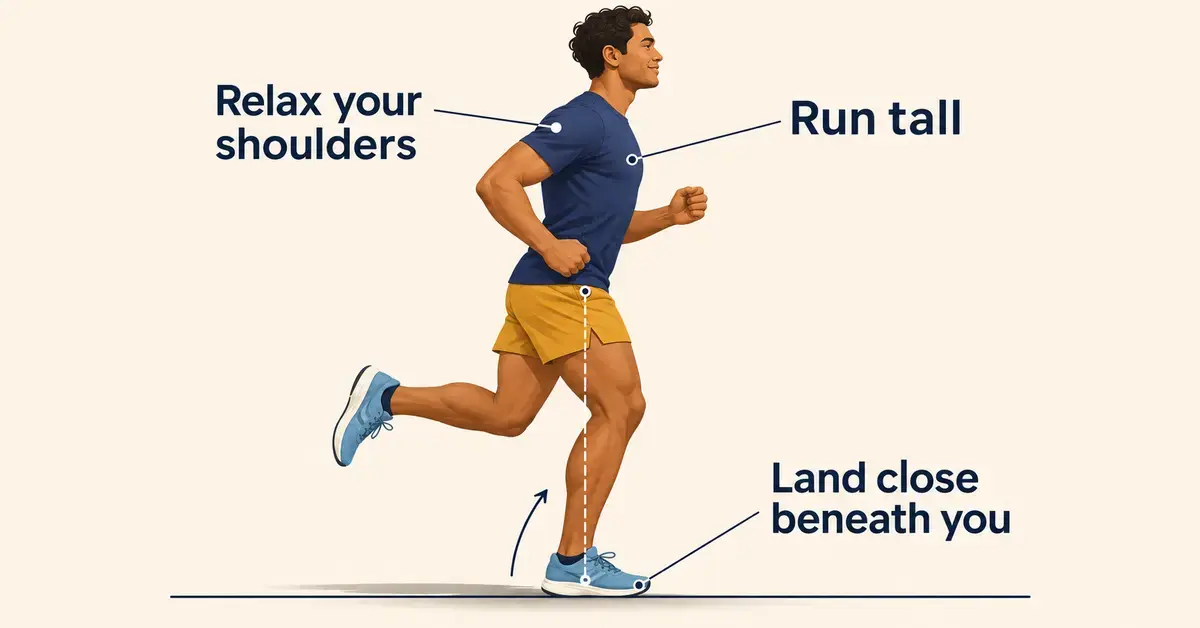
Once it feels natural at rest, carry it into easy walks, then slow jogs. It will not hold up perfectly when you are running hard — nobody’s does — but the habit of filling your lungs fully still pays off. Keeping relaxed, upright posture helps too: slumping folds your torso and squashes the diaphragm, which is one reason good proper running form and easy breathing go hand in hand.
Should you breathe through your nose or your mouth?
Use whatever lets you take in enough air — and for most running, that means both. Your nose warms, humidifies and filters the air, which is pleasant on an easy jog, in cold air, or in dusty conditions, and it naturally encourages slower, deeper breaths. But the nose is a narrow airway, and it simply cannot shift the volume of air you need once your effort climbs.
So a sensible rule of thumb is:
- Easy, conversational running: nose-only or a nose-and-mouth mix is fine and comfortable.
- Moderate to hard running: breathe in and out through your mouth (or nose and mouth together) to get the oxygen your muscles are demanding.
You may have read that nasal-only breathing makes you a fitter or more efficient runner. The honest answer is that the evidence is mixed. Small studies in recreational runners suggest you can take in a similar amount of oxygen either way — reaching the same VO2 max at a lower breathing rate once you adapt to nasal breathing — but there is no clear proof that nose-only breathing lifts performance in trained runners. Treat it as a tool for easy runs and recovery, not a rule you must force at race pace. If you are a new runner, do not stress about it at all — just breathe.
Rhythmic breathing: match your breath to your steps
Rhythmic breathing means timing your inhales and exhales to a set number of footstrikes — for example, breathing in for three steps and out for two. Coordinating breath and stride gives you a steady cadence to lock onto, helps you breathe fully rather than in ragged gasps, and spreads the jolt of each landing more evenly across your body.
Why the rhythm may help with side stitches
The impact of a footstrike is greatest at the moment you start to breathe out, because your core muscles relax slightly as you exhale and your organs drop. If you always exhale as the same foot lands, that side takes the repeated strain. An odd-numbered pattern such as 3:2 shifts the exhale from one foot to the other on each cycle, so the load alternates. Many coaches recommend this to reduce side stitches and one-sided strain.
It is worth being clear about the evidence: this is a long-standing coaching idea with a plausible mechanism, not a proven law. Coaches and runners observe that we naturally fall into stable breath-to-stride patterns (2:1 is especially common at speed), but the specific claim that an odd ratio prevents stitches has not been firmly settled by controlled trials. Use it because it gives you a rhythm and many runners find it helps — not because a study guarantees it.
Breathing Patterns by Pace
| Effort / pace | Breath pattern (inhale:exhale steps) | How it feels | When to use it |
|---|---|---|---|
| Easy / recovery | 3:3 or 4:4 | Relaxed; you could hold a conversation | Warm-ups, long slow runs, beginners |
| Steady / moderate | 3:2 | Working but controlled; short sentences | Most everyday runs — the default pattern |
| Tempo / threshold | 2:2 | Hard; only a few words at a time | Faster continuous efforts |
| Hard / intervals | 2:1 | Very hard and breathless | Reps, hills, shorter races |
| Sprint / finish | 1:1 | All-out | Final kick and maximal sprints |
You do not need to count every step for your whole run. Use a pattern to settle in at the start, to steady yourself when your breathing gets choppy, or to hold form on a climb, then let it fade into the background. A count also stops you unconsciously holding your breath, which is surprisingly easy to do on a climb or a hard rep — keep the air moving. If 3:2 feels awkward at first, practise it walking or on an easy jog before you take it to faster efforts or structured interval training, where your breathing has to work hardest.
What causes a side stitch?
A side stitch is the sharp, cramping pain just under the ribs — usually on the right — that forces you to slow down. Its medical name is exercise-related transient abdominal pain, or ETAP, and despite how common it is, the exact cause is still debated. The old idea that it comes from the diaphragm running short of blood has largely been set aside.
The leading explanation today points to the parietal peritoneum, the sensitive membrane lining the abdominal wall. The theory is that as you run, your internal organs shift and tug on this lining and the ligaments around it, irritating it — and that a full or heavy stomach makes the friction worse. Factors that research has linked to more stitches include:
- Eating a large meal too soon before running.
- Drinking sugary, concentrated (hypertonic) drinks such as soft drinks or strong cordial before or during a run.
- Poor posture, particularly a rounded upper back, which may stress the same structures.
- A weaker core that supports the trunk less well, especially in newer runners.
The reassuring part: a stitch is harmless and passes. It is not a sign of damage, and it eases once you slow down.
How to get rid of a side stitch mid-run
When a stitch grabs you, you do not have to stop dead. Try this, in order:
- Ease off the pace or drop to a walk for a short stretch. Lower intensity alone often settles it.
- Change your breathing. Take a slow, deep breath in, then exhale hard and long through pursed lips — as if blowing out candles — and repeat three to five times. Forced exhales help release the tension.
- Press on the spot. Push gently into the painful area with your fingers as you exhale, which can relieve the pull on the lining.
- Change the foot you exhale on. If the stitch is on your right, try breathing out as your left foot lands for a while.
- Stretch it out. Raise the arm on the sore side overhead and lean gently away from the pain to open up the torso.
Most stitches ease once you slow to a jog or stop, though some can linger for longer. See a doctor if the pain lasts beyond about an hour after exercise, keeps coming back in the same spot after every run for weeks, or comes with a fever — that is no longer a simple stitch.
How to prevent side stitches
Prevention is mostly about timing, fuelling and strength. The key point: don’t run on a full or sugary stomach, and build a core that can hold your trunk steady.
- Leave time after eating. Allow roughly 2 to 3 hours after a big meal before you run, and keep any pre-run snack small and easy to digest.
- Go easy on sugary drinks. Skip concentrated soft drinks and strong cordials right before running; water or a diluted sports drink is gentler on the gut.
- Warm up gradually. Starting too fast from cold is a classic stitch trigger; ease into your pace.
- Strengthen your core. Planks and other trunk exercises help the muscles that support your abdomen, which matters most for beginners following a Couch to 5K training plan.
- Mind your posture. Run tall rather than hunched so your torso stays open.
The 4-7-8 technique: breathing to calm down, not to run faster
The 4-7-8 method is a relaxation exercise, not a running pattern. You breathe in quietly through the nose for a count of 4, hold for 7, and exhale through the mouth for 8, repeating for about four cycles. Popularised by physician Dr Andrew Weil and drawn from the yogic breath-control practice of pranayama, it is designed to calm the nervous system — useful before sleep or to steady pre-race nerves, not something you do while actually running.
For runners, its value is in the hours around a session: a few rounds the night before an event or on the start line can take the edge off anxiety, and a slow version during your cool-down helps bring your heart rate down. The evidence is modest — it works by activating the parasympathetic nervous system and has been shown to lower heart rate and blood pressure, which is associated with less anxiety and better sleep, though there are no large trials — so think of it as a simple, harmless tool for settling yourself rather than a guaranteed fix.
Can you train your breathing and lung capacity?
You can improve how efficiently you breathe — exercise mainly trains you to use your lungs better rather than to make them bigger. The most effective training is simply running itself: consistent aerobic work strengthens your heart, builds the tiny blood vessels that deliver oxygen to muscles, and makes your breathing muscles more resilient, so a given pace feels less breathless over time. A structured build-up, like a beginner marathon training plan, does this automatically.
Alongside running, a few exercises support your breathing:
- Diaphragmatic breathing drills — the lying-down practice above — train you to use your full lung volume.
- Pursed-lip breathing — inhale through the nose, exhale slowly through pursed lips — keeps airways open longer and slows your breathing rate.
- Core work gives your breathing muscles a stable base to pull against.
The biggest gains come from using your lungs more efficiently — breathing deeper and steadier, with less effort at a given pace — which consistent running delivers over time.
What is the 80% rule in running?
The 80% rule — better known as 80/20 or polarised training — says you should run about 80% of your weekly training easy and only about 20% hard. It was developed by exercise physiologist Stephen Seiler from studying elite endurance athletes, who spend most of their time at low intensity and save genuinely hard efforts for a smaller slice of training.
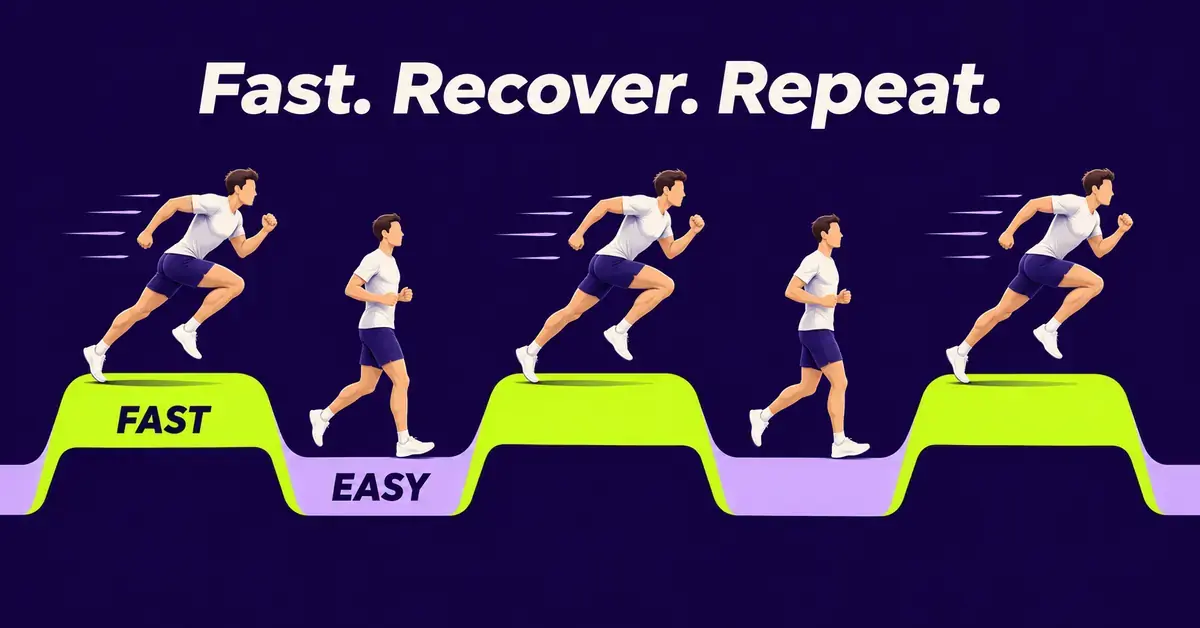
Breathing is the easiest way to judge whether you are honouring it. On your easy 80%, you should be able to hold a conversation in full sentences — if you are gasping, you are going too fast. That comfortable, talkable breathing is the goal for the bulk of your runs; the breathless end of the scale belongs to your hard 20%. The research base is strongest for elite athletes and more mixed for recreational runners, but spending most of your running at an easy, controllable breathing effort is sound advice for almost everyone, and it pairs naturally with sensible half marathon pace targets.
Sources
- RunnersConnect — Breathing While Running: The 3:2 Pattern That Prevents Side Stitches
- Marathon Handbook — How To Breathe While Running: Expert Tips and Techniques
- Marathon Handbook — Mouth Breather vs Nose Breather: Which Is Better for Performance?
- Marathon Handbook — Side Stitch Won’t Go Away? Causes, Fixes and the Physiology
- American Lung Association — Breathing Exercises (pursed-lip and belly breathing)
- Cleveland Clinic — How To Do the 4-7-8 Breathing Exercise
- TrainingPeaks — Does Polarized (80/20) Training Really Work?
Frequently Asked Questions (FAQ)
Why do I get out of breath so quickly when I run?
Usually because you are running faster than your current fitness allows, breathing shallowly from the chest, or both. Slow down until you can speak in short sentences, breathe deeply from your belly, and give your body a few weeks of consistent easy running — breathlessness at a given pace eases as your aerobic fitness improves.
How should I breathe if I have asthma or exercise-induced wheezing?
Warm up gradually rather than starting hard, and breathe in through your nose in cold, dry air so it is warmed before it reaches your lungs — cold air is a common trigger. Carry your reliever inhaler if you have been prescribed one, and ease off at the first sign of chest tightness, coughing or wheeze. If symptoms are frequent or severe, see your doctor before ramping up training; what feels like being badly out of breath can be exercise-induced bronchoconstriction, which usually responds well to treatment.
How should a complete beginner breathe while running?
Keep it simple: breathe through your nose and mouth freely, focus on deep belly breaths rather than counting patterns, and above all slow down enough that you can still talk. Rhythmic patterns like 3:2 are worth learning later, but comfortable, relaxed breathing matters far more at the start.
Does breathing cold air hurt your lungs when running outside?
Cold air can feel harsh and may irritate the airways, especially if you have asthma, but it does not damage healthy lungs. Breathing in through your nose warms and humidifies the air, and a buff or light scarf over your mouth on frosty mornings helps take the edge off.
Should I breathe differently going uphill?
Expect to breathe harder — that is normal, because climbing demands more effort. Shorten your stride, keep an upright posture so your chest stays open, and settle into a quicker pattern such as 2:1 or 2:2 to keep the air moving rather than holding your breath.