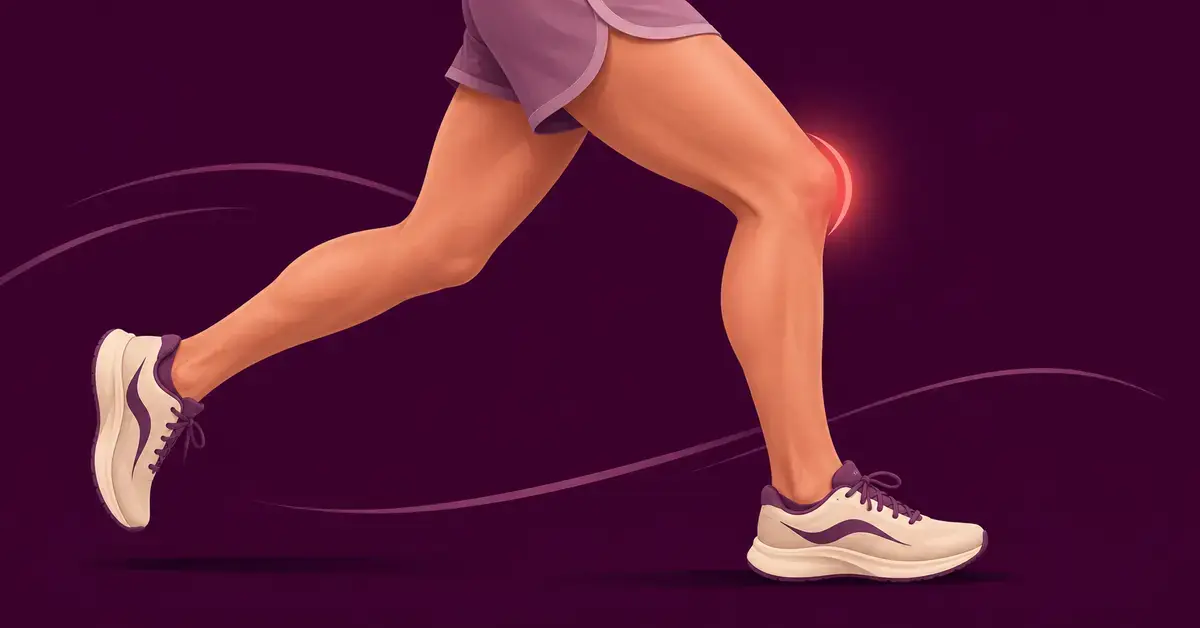
Runner’s knee is a dull ache at the front of the knee, around or behind the kneecap, that flares with running, stairs, squatting and long periods of sitting. Its medical name is patellofemoral pain syndrome (PFPS) — “patellofemoral” simply means the joint between the kneecap (patella) and the thigh bone (femur). It is one of the most common overuse complaints in runners, it usually builds up gradually rather than striking in one moment, and — importantly for anyone with a race on the calendar — it rarely means you have to stop running completely. This guide explains what it feels like, what drives it, how it is treated, and how to keep training sensibly while it settles.
Key Points
- What it is: Runner’s knee is patellofemoral pain syndrome (PFPS) — pain around or behind the kneecap, not a specific tear or fracture.
- How it starts: Usually an overuse problem that builds gradually when training load outpaces what the knee can handle.
- Hallmark symptoms: A front-of-knee ache that is worse going downhill or down stairs, when squatting, and after sitting with the knee bent.
- Main drivers: Training spikes, weak hip and thigh muscles, running mechanics, and worn or unsuitable shoes.
- What fixes it: Load management plus hip-and-knee strengthening — the strongest evidence; rest alone rarely resolves it.
- Keep training: Many runners can keep running at a reduced, pain-guided load while they rehab.
- Recovery: Commonly about a month or two with the right plan; earlier action means faster recovery.
What is runner’s knee?
Runner’s knee describes pain around or behind the kneecap rather than a single, specific injury. The kneecap normally glides in a shallow groove at the end of the thigh bone every time you bend and straighten your knee. In patellofemoral pain, that movement becomes irritating — often because the tissue around the kneecap is overloaded faster than it can adapt. There is usually no tear, no fracture and nothing “out of place”; the structures are simply being asked to do more than they are currently conditioned for.
It is most common in people who run, jump or squat a lot, and it is reported more often in women, teenagers and adults roughly in their twenties to forties. Non-athletes get it too, especially after a sudden jump in activity. Because it is a load problem rather than damage, the outlook is generally good: most people recover well with the right changes to training and a targeted strengthening plan.
What does runner’s knee feel like?
The hallmark is a dull, aching pain at the front of the knee that comes on gradually and tracks with activity. You might notice it in one knee or both. Typical features include:
- Aching around or behind the kneecap during or after a run.
- Pain going down stairs or downhill, which is often worse than going up.
- Discomfort when squatting, kneeling, lunging or standing up from a low chair.
- Stiffness or soreness after sitting for a long time with the knee bent — in a car, at a desk or in a cinema (sometimes called the “theatre sign”).
- Occasional grinding, clicking or a popping feeling when you bend the knee.
Runner’s knee does not usually cause the knee to lock, give way dramatically, swell up tightly or feel hot. Those symptoms point to something else and are a reason to get the knee checked rather than to self-treat.
What causes runner’s knee?
Runner’s knee is almost always a mismatch between how much load you put through the knee and how much it can currently handle. The exact trigger is often a combination of factors rather than one cause.
Training load that climbs too fast
The most common driver is doing too much, too soon: a sudden rise in weekly mileage, a block of hill work, a jump in speed sessions, or stacking hard runs without easy days or rest in between. Repetitive stress from running, squatting and stair climbing adds up, and the tissue around the kneecap does not get time to adapt. Pacing your build-up matters just as much for staying healthy as it does for performance — a structured plan such as a couch to 5k plan exists partly to keep that progression gradual, and a marathon pace chart can stop easy runs drifting too hard.
Weak or imbalanced hip and thigh muscles
How well the kneecap tracks depends partly on the muscles that control the leg. Weak quadriceps (the muscles on the front of the thigh) and, in particular, weak hip muscles that stop the knee collapsing inward are repeatedly linked to patellofemoral pain. When the hip and thigh cannot control the leg well under load, the stress on the kneecap rises. This is why modern rehab targets the hip and core, not just the knee itself.
Biomechanics, footwear and surfaces
Running mechanics play a role — for example knees that drift inward on landing, or a heavy, hard foot-strike. Tight calves, hamstrings or the iliotibial band can contribute, as can the natural shape of your kneecap and its groove. Worn-out or unsuitable shoes, a sudden change of footwear, or a switch of surface (road to track, soft trail to hard pavement) can tip a knee over the edge. Choosing shoes for running that suit your foot and replacing them before they are worn out removes one avoidable risk factor.
How is runner’s knee different from other knee and lower-leg pain?
Front-of-kneecap pain that worsens on stairs and after sitting is the classic signature of runner’s knee, and that pattern helps separate it from other common running complaints. The table below compares the usual suspects. It is a guide, not a diagnosis — overlapping symptoms are common, so a clinician’s assessment is the reliable way to tell them apart.
Comparison
| Complaint | Where it hurts | Typical trigger | Tell-tale sign |
|---|---|---|---|
| Runner’s knee (PFPS) | Around or behind the kneecap, front of knee | Training spikes, weak hips/quads, downhill running | Worse down stairs and after long sitting with knee bent |
| Patellar tendinopathy (jumper’s knee) | Just below the kneecap, on the tendon | Jumping and explosive/strength work | Pinpoint pain and tenderness on the tendon below the kneecap |
| Iliotibial band (ITB) syndrome | Outer (lateral) side of the knee | High mileage, hills, downhill running | Sharp or burning outer-knee pain that builds at a set distance |
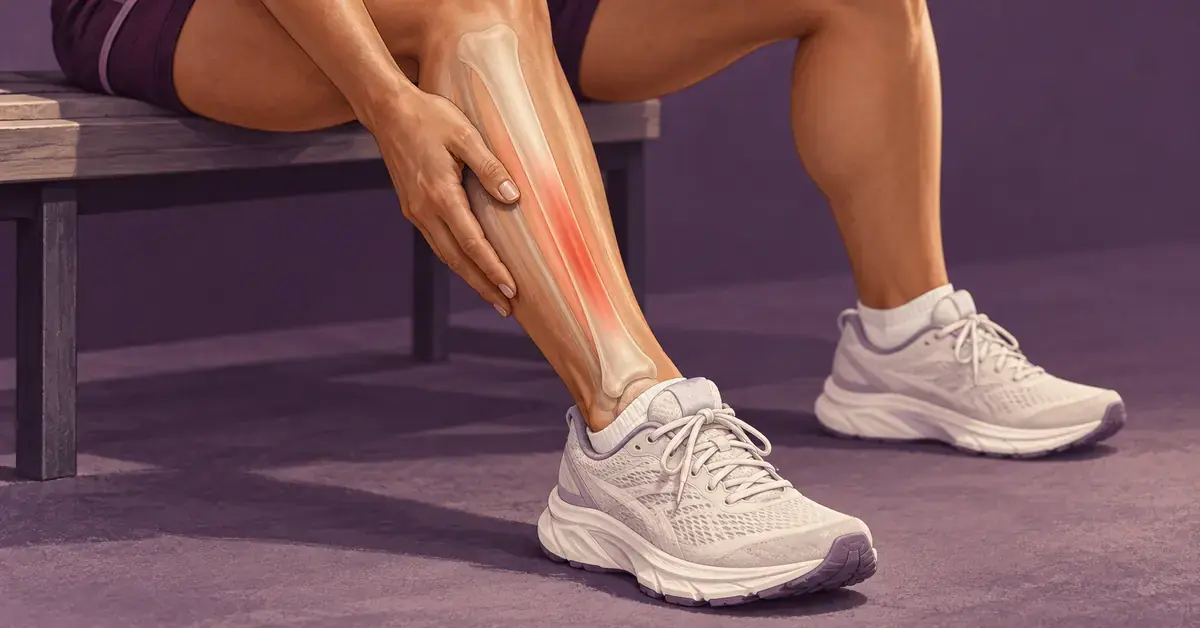
| Shin splints (MTSS) | Along the inner shin bone, not the knee | Rapid mileage increase, hard surfaces | Diffuse ache along the inner shin, sore to touch over a stretch |
| Meniscus or ligament injury | Deep in or across the knee joint | A twist, fall or sudden pivot | Swelling, locking or the knee giving way — needs assessment |
Shin pain in particular is often confused with knee problems when it sits high on the leg; our guide to preventing shin splints when running covers that complaint in detail.
How is runner’s knee diagnosed?
A doctor or physiotherapist usually diagnoses runner’s knee from your history and a physical examination — not from a scan. They will ask how and when the pain started and what makes it worse, then check the knee’s alignment, strength and flexibility and watch how you move through squats, lunges or a single-leg stand. An X-ray may be used to rule out bone problems, and an MRI is generally reserved for pain that does not improve after a proper course of rehab. For most people, no imaging is needed to start treatment.
Can you keep running with runner’s knee?
In many cases you can keep running, but at a reduced, pain-guided load rather than carrying on as before. The aim is “relative rest”: lowering the stress on the knee enough for symptoms to calm down while you keep moving and start strengthening. Complete rest is rarely the best answer, because it does not fix the underlying weakness and you lose fitness — but running straight through sharp, worsening pain is also a mistake. Practical ways to keep training include:
- Use a pain rule. A common guideline is to keep discomfort at a low, tolerable level during a run (say, no worse than mild) that settles within 24 hours and does not build run on run. Pain that climbs during the session, or is worse the next morning, means you did too much.
- Cut the aggravators first. Reduce downhill running, hard speed work and long back-to-back days before you cut total volume — these load the kneecap most.
- Shorten and flatten. Swap one long or hilly run for shorter, flatter efforts, and add easy days between runs.
- Cross-train to hold fitness. Cycling, swimming, the elliptical or pool running keep your aerobic engine ticking over with far less load through the kneecap.
- Watch your load, not just your legs. Tracking weekly distance and how runs felt — on paper or with a running watch — helps you spot the spikes that caused the problem and avoid repeating them.
If pain forces you to limp, alters your stride or keeps getting worse despite these changes, that is the point to stop running and get assessed rather than pushing on.
How is runner’s knee treated and rehabbed?
Treatment has two jobs: calm the current pain, and fix the strength and load problem so it does not come straight back. The second job is the one that actually resolves most cases.
Early relief
In the first sore days, standard self-care helps settle symptoms. Modify or pause the activities that hurt, and use the RICE approach — rest, ice, compression and elevation. Cold packs can be applied for around 20 minutes at a time, several times a day, with a cloth between the pack and your skin. Over-the-counter anti-inflammatory medicines such as ibuprofen can ease pain and swelling for short periods; follow the label and do not take them for more than about ten days in a row without medical advice. None of this is a cure on its own — it buys comfort so you can get on with rehab.
Strengthening — the part that fixes it
Exercise therapy is the mainstay of treatment, and the strongest evidence points to strengthening both the hip and the knee rather than the knee alone. A typical programme builds the quadriceps and the hip muscles that keep the knee aligned, and often adds core and balance work. Examples a physiotherapist may prescribe and progress include:
- Quad-focused moves such as controlled squats and step-downs within a pain-free range.
- Hip-strengthening work such as side-lying leg raises, clamshells, bridges and side-steps with a resistance band.
- Single-leg balance and control drills to improve how the leg handles landing.
Strength takes weeks to build, so consistency matters more than intensity. A tailored plan beats a generic one, which is why assessment by a physiotherapist is worthwhile.
What the evidence says about add-ons
An international expert consensus on patellofemoral pain found that exercise therapy reduces pain in the short, medium and long term, and that combined hip-and-knee exercise should be used in preference to knee exercises alone. Combining exercise with foot orthoses, patellar taping or manual therapy can help in the short to medium term, and foot orthoses (off-the-shelf are fine) may reduce pain in the short term. The same consensus specifically does not recommend knee or lower-back joint mobilisations used on their own, or electrophysical agents (such as ultrasound and similar machine-based treatments), because the evidence does not support them. In short: active treatment first, passive treatments at most as extras.
How long does runner’s knee take to heal?
Most people need in the order of a month or two to recover from runner’s knee, though the range is wide. Mild cases caught early can settle in a few weeks once the training error is fixed and strengthening begins; longer-standing or severe cases can take several months. The biggest single factor is how early you act — catching it when the ache first appears and adjusting your training beats pushing through for weeks and then starting from a deeper hole. Because every case differs, a physiotherapist will set a timeline and progression suited to you rather than a fixed schedule.
How to prevent runner’s knee coming back
Prevention is mostly about load and strength — the same two levers that treat it. To lower the chance of a recurrence:
- Build training gradually. Raise distance, duration or intensity in small steps and keep easy days genuinely easy.
- Keep your hips and thighs strong. A short, regular strength routine is one of the best-supported ways to protect the knee.
- Warm up before running and don’t skip rest days — recovery is when the body adapts.
- Run in supportive, well-maintained shoes suited to your feet, and replace them before they are worn out.
- Don’t train through rising knee pain; back off early and it usually stays minor.
- When you return to events, ease back in — pick a shorter or flatter race first and check the NZ running calendar to give yourself enough lead time to rebuild.
Common mistakes with runner’s knee
Avoiding a few predictable errors speeds recovery and prevents relapse:
- Resting completely and doing nothing else. Rest calms pain but leaves the underlying weakness in place, so the pain returns the moment you run again. Pair relative rest with strengthening.
- Running through sharp or worsening pain. Mild, stable discomfort can be acceptable; pain that climbs during a run or is worse the next day is a signal to back off.
- Only strengthening the knee. Ignoring the hips misses the muscles that most influence how the kneecap tracks.
- Returning to full mileage too quickly. Jumping straight back to pre-injury volume is the fast route to a second episode.
- Relying on painkillers, braces or machines instead of rehab. These can support recovery but do not replace the strengthening and load management that actually resolve the problem.
- Chasing a quick fix. Strength and tissue adaptation take weeks; expecting a few days to do it leads to repeated setbacks.
When should you see a doctor or physiotherapist?
See a health professional if knee pain does not improve after a couple of weeks of rest and sensible self-care, or sooner if the knee swells, locks, gives way, cannot bear weight, or the pain is severe or followed a fall or twist. A physiotherapist can confirm it is runner’s knee, rule out other causes and build a progression tailored to your running goals — which is more effective than a generic routine. In New Zealand, running and sport injuries are commonly managed by physiotherapists, and treatment for an accident-related injury may be covered by ACC; a GP or physio can advise on your options.
Health disclaimer: This article is general information about runner’s knee for a running audience. It is not medical advice and is not a substitute for assessment by a qualified health professional. Knee pain can have several causes, some of which need hands-on examination to tell apart. If your symptoms are severe, persistent or getting worse, see a doctor or physiotherapist. In New Zealand you can contact your GP, a registered physiotherapist, or Healthline on 0800 611 116 for health advice.
Sources
Frequently asked questions (FAQ)
Is it safe to run with runner’s knee?
Often, yes — at a reduced, pain-guided load. Many people can keep running if discomfort stays mild, settles within a day and does not build run on run, while they cut back on hills, speed work and long runs and start strengthening. Stop and get assessed if the pain is sharp, makes you limp or keeps getting worse.
How long does runner’s knee take to heal?
Most people recover in roughly a month or two, but it varies. Mild cases caught early can settle in a few weeks, while long-standing or severe cases may take several months. Acting early and following a proper strengthening plan is the main thing that shortens recovery.
What exercises help runner’s knee?
The best-supported approach strengthens both the hip and the knee. Typical moves include controlled squats and step-downs for the quadriceps, plus clamshells, side-lying leg raises, bridges and banded side-steps for the hips, alongside single-leg balance work. A physiotherapist can tailor and progress these for you.
Does runner’s knee go away on its own?
It can ease if you simply stop the activity that caused it, but the pain often returns once you run again because the underlying weakness and training error are still there. Combining relative rest with hip and knee strengthening gives a more reliable, lasting result than rest alone.
Do I need an X-ray or scan for runner’s knee?
Usually not. Runner’s knee is normally diagnosed from your history and a physical examination. An X-ray may be used to rule out bone problems, and an MRI is generally reserved for knees that do not improve after a proper course of rehabilitation.