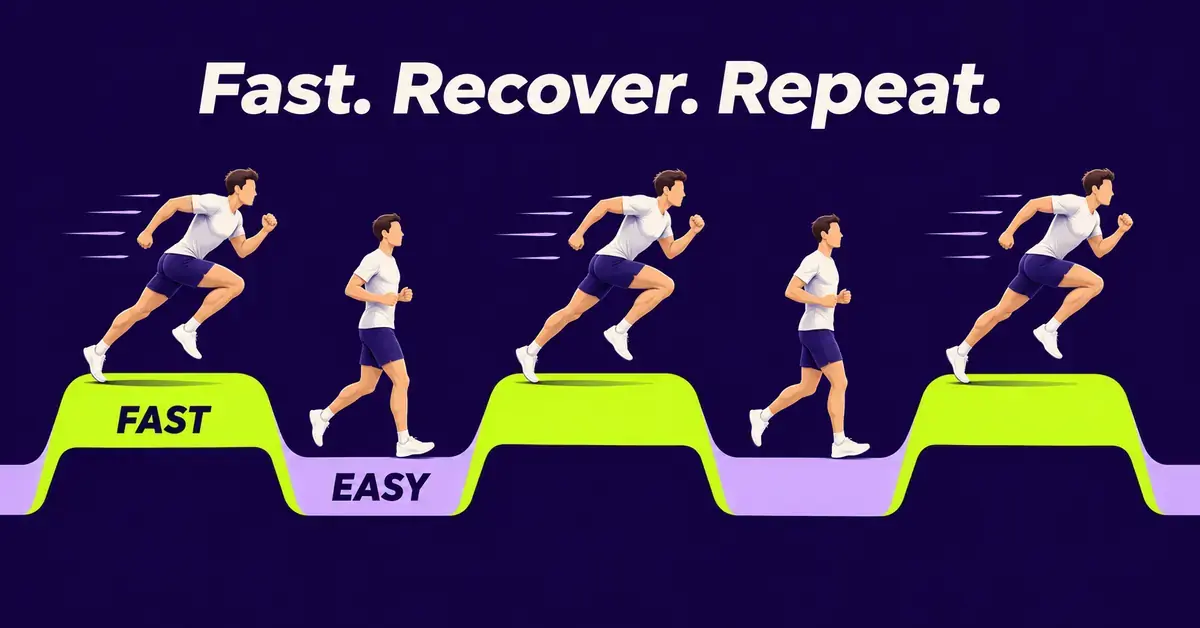
Interval training for runners means alternating short, faster-than-usual efforts with easy recovery jogs or walks, repeated several times in one session. It is the most direct way to get faster, because it lets you spend time at speeds you could never hold for a whole continuous run — and those bursts are what push your body to adapt. This guide explains how intervals work, how to build a session, which workouts suit which goal, how often to do them, and the mistakes that quietly hold most runners back.
Key Points
- What it is: repeated fast efforts separated by easy-jog or walk recovery, measured by distance (e.g. 400 m) or time (e.g. 1 min).
- Why it works: raises your VO2 max, lifts your lactate threshold and improves running economy, so you can hold a faster pace for longer.
- How often: one hard session a week for most runners (two once well-trained); keep the other ~80% of your running easy.
- Session shape: 10–15 min warm-up → main set of hard efforts at 7–9 out of 10 → easy recovery between → 10–15 min cool-down.
- Biggest mistakes: sprinting flat out, cutting recovery too short, skipping the warm-up and doing intervals too often.
What is interval training for runners?
Interval training is any session that splits running into repeated blocks of harder effort separated by recovery. A single "interval" is one hard effort; the easy jog or walk in between is the "recovery". You decide four things: how long each hard effort lasts, how fast you run it, how long you recover, and how many times you repeat the pair.
The efforts can be measured by distance (for example 400 metres or 1 kilometre) or by time (for example 1 minute or 3 minutes). Recovery works the same way — a set number of metres or a set number of seconds. Because you rest between efforts, you can accumulate several kilometres at a pace you could not sustain in one go, which is the whole point.
Intervals sit at the sharp end of a balanced week. The bulk of your running should still be easy, continuous mileage that builds your aerobic base — the kind of steady progression a couch to 5K plan is built around. Intervals are the seasoning on top, not the main meal.
Why interval training makes you faster
Intervals make you faster because running hard, then recovering, then running hard again stresses the systems that limit your speed and teaches your body to cope with more of it. Health authorities note that interval work can deliver a cardiovascular benefit in less time than steady exercise — Harvard Health points out that a short interval session can match the heart benefit of a longer moderate workout. Three things improve in particular.
It raises your VO2 max
VO2 max is the maximum amount of oxygen your body can take in and use per minute — effectively the ceiling on your aerobic engine. Hard intervals of two to five minutes spend time near that ceiling, which is a strong signal to raise it. In one study of 48 highly trained endurance athletes, a polarised programme built around hard intervals improved VO2 max by 11.7% over nine weeks — more than threshold, high-intensity or high-volume training over the same period.
It lifts your lactate threshold
Your lactate threshold is the pace above which fatigue-causing by-products build up faster than your body can clear them — the point where "comfortably hard" tips into "slowing down". Longer, slightly slower intervals run at a controlled, sustainable effort teach your body to clear those by-products faster, so you can hold a quicker pace for longer before it bites.
It improves your running economy
Running economy is how much energy you burn to hold a given pace; a more economical runner goes the same speed for less effort. Repeating faster efforts drills smoother, more efficient form and stride mechanics, so the same pace gradually feels easier. Translating that new fitness into race splits is easier when you know your target times — a marathon pace chart turns a goal finish time into the per-kilometre pace your intervals should sharpen.
Does interval running build endurance?
Yes — interval running builds endurance as well as speed, as long as the recoveries keep the session aerobic. Longer intervals with short jog recoveries spend most of the session at a strong aerobic effort, which develops stamina much like a tempo run while also lifting your top-end speed. Short, very fast intervals lean more towards pure speed, but even these raise the aerobic ceiling that endurance sits under. The one thing intervals do not replace is time on your feet: long easy runs remain essential for marathon and ultra distances.
How to structure an interval session
A good interval session has four parts — warm-up, main set, recovery between efforts, and cool-down — and skipping the first or last is where most runners go wrong.
Warm up properly
Start with 10 to 15 minutes of easy jogging so your heart rate, muscles and joints are ready for speed. Follow it with a few dynamic drills (leg swings, high knees) and two to four short accelerations, called strides, of about 20 seconds each. Going straight into a hard effort cold is the quickest route to a strained calf or hamstring.
Build the main set and set a work-to-rest ratio
The main set is your repeated hard efforts. The key decision is the work-to-rest ratio — how long you recover relative to how long you ran hard. A 1:1 ratio (equal effort and recovery) suits most sessions; shorter, faster efforts often need a longer 1:2 recovery, while longer threshold efforts can get by on a short 60-to-90-second jog. Keep recoveries as easy jogging or walking rather than standing still, so your legs stay loose. Run the efforts at a controlled hard pace — an effort of about 7 to 9 out of 10 — not a flat-out sprint.
Cool down and recover afterwards
Finish with 10 to 15 minutes of easy jogging and some light stretching to bring your heart rate down gradually. Because intervals are demanding, follow the session with an easy or rest day before your next hard effort. Pushing speed work on tired legs is a common path to overuse injuries such as runner’s knee.
Types of interval workouts
There is no single "interval workout" — the length and intensity of the efforts change what the session trains. The five types below cover almost everything a road or trail runner needs.
Workout Types Compared
| Workout type | Effort length | Recovery | Effort (1–10) | What it builds | Example |
|---|---|---|---|---|---|
| Short speed intervals | 200–400 m or 30–60 sec | Equal or longer easy jog (1:1–1:2) | 8–9 | Leg speed, running economy | 10 × 400 m, jog 90 sec |
| VO2 max intervals | 800 m–1 km or 3–5 min | Roughly equal jog (1:1) | 8–9 | VO2 max, aerobic power | 5 × 1 km, jog 2–3 min |
| Tempo / threshold intervals | 1–2 km or 5–10 min | Short 60–90 sec jog | 7–8 | Lactate threshold, stamina | 4 × 1.5 km, jog 90 sec |
| Fartlek | Varied, by feel | Easy running, not a full stop | 5–9 (mixed) | Pacing feel, speed + endurance | 6 × (2 min hard / 2 min easy) |
| Hill repeats | 30–90 sec uphill | Jog or walk back down | 8–9 | Strength, power, economy | 8 × 45 sec hill, jog down |
Short speed intervals
Efforts of 200 to 400 metres, or 30 to 60 seconds, run fast with a full easy-jog recovery. These sharpen leg speed and running economy and feel the quickest. A classic example is 10 repeats of 400 metres with a 90-second jog between each.
VO2 max intervals
Longer efforts of 800 metres to 1 kilometre, or 3 to 5 minutes, run at a strong but controlled pace with roughly equal recovery. These spend the most time near your aerobic ceiling and are the backbone of 5K and 10K training. For example, 5 repeats of 1 kilometre with a 2-to-3-minute jog recovery.
Tempo and threshold intervals
Efforts of 1 to 2 kilometres, or 5 to 10 minutes, run at a "comfortably hard" pace you could just about hold for an hour, broken up by short 60-to-90-second jogs. These lift your lactate threshold and suit half-marathon and marathon runners. A typical set is 4 repeats of 1.5 kilometres with a 90-second jog.
Fartlek
Fartlek is a Swedish term meaning "speed play", developed by Swedish coach Gösta Holmér and spread worldwide in the 1930s as a response to the dominance of Finland’s distance runners. It is unstructured interval running: you vary your pace by feel over a continuous run — pushing to a lamppost, easing to a corner — rather than counting exact distances. It is a relaxed, enjoyable way to introduce speed and practise changing gears.
Hill repeats
Short uphill efforts of 30 to 90 seconds, jogging or walking back down to recover. Running uphill builds strength and power, and the slope naturally caps your speed, so it is a controlled way to add intensity. New Zealand’s hilly terrain makes this an easy one to work in.
Sample interval workouts by goal
Match the workout to the distance you are training for. Each of these includes a 10-to-15-minute warm-up and cool-down on top of the main set.
- Beginner (building to 5K): 4 to 6 repeats of 400 metres at a challenging but steady pace, with 90 seconds of walking or easy jogging between each.
- 5K and 10K: 10 repeats of 1 minute fast / 1 minute easy, building up the number of repeats over several weeks; progress to 5 × 1 km with 2-minute jogs.
- Half marathon and marathon: 800-metre to 1-kilometre repeats (or 3-to-5-minute blocks) run slightly faster than goal race pace, with short 60-to-90-second jogs; 4 to 6 repeats.
- Time-crunched session: a countdown fartlek — hard efforts of 4, 3, 2 then 1 minute with equal easy running between, repeated twice if you have time.
Build up gradually: add one repeat or a little speed each week rather than jumping to a much harder session all at once.
How often should you do interval training?
Most runners should do one hard interval session a week, rising to two only once they have a solid base and are recovering well. The rest of your running stays easy. This echoes the widely cited 80/20 rule — sometimes called the "80% rule" — popularised from sports scientist Stephen Seiler’s study of elite endurance athletes: roughly 80% of your weekly running should be easy, conversational effort, and only about 20% hard.
The logic is that easy running builds the aerobic base and lets you recover enough to hit your hard sessions genuinely hard. The trap is the "grey zone" in the middle — running your easy days too fast, so they are too hard to aid recovery but too easy to drive real gains. Keep easy days easy, and your intervals will be far more productive.
Common interval training mistakes
The fastest way to get more from intervals is to stop making the errors that blunt them or lead to injury.
- Sprinting flat out. Intervals are controlled hard efforts (around 7 to 9 out of 10), not maximal sprints. Going too hard early wrecks your form and the later repeats.
- Cutting recovery too short. Too little rest early on turns a quality session into a slog and raises injury risk. Take the full recovery until you are fit enough to trim it deliberately.
- Running easy days too hard. If every run is moderately hard, you never recover enough to race your intervals or build a base.
- Doing intervals too often. More than two hard sessions a week, for most recreational runners, leads to fatigue, stalled paces and overuse injuries.
- Skipping the warm-up. Cold muscles and a sudden hard effort are a classic cause of calf and hamstring strains.
- No measurable goal. Pick a target time or pace for each effort and hold it, rather than running by vague feel and fading.
Gear and where to run your intervals in New Zealand
You need very little to start, but a couple of things make intervals easier to run well. A GPS running watch with an interval timer takes the mental maths out of a session — you set the work and recovery blocks once and simply run to the beeps. A supportive, well-fitted pair of running shoes matters more at speed, where the forces through your legs are higher.
For the running surface, a local athletics track gives you exact 400-metre splits and a forgiving surface, but any flat, quiet stretch of path, a park loop or a measured section of waterfront works just as well. Many runners find a weekly parkrun or club session a ready-made speed workout. Once your intervals are paying off, point the new speed at a goal — the New Zealand running calendar is full of 5K and 10K events to test it on.
Sources
- Harvard Health Publishing — Interval training for a stronger heart
- Stöggl & Sperlich (2014), Frontiers in Physiology — Polarized training has greater impact on key endurance variables
- Marathon Handbook — A Complete Guide to Interval Running
- Marathon Handbook — Polarized Training for Runners: The 80/20 Method
- Athletics Weekly — Fartlek running: playing with speed
Frequently asked questions
How long before interval training improves my race times?
Most runners notice a difference within a few weeks of consistent weekly sessions. Fitness adaptations take time to build, so patience and consistency matter more than any single hard workout. Keep the easy running going alongside the intervals.
Can complete beginners do interval training?
Yes, but start gently. If you are new to running, build a base of easy running first, then add short, relaxed intervals such as 1 minute faster / 2 minutes easy, walking the recovery if needed. Beginners should keep to one speed session a week.
Is interval training the same as HIIT?
Not quite. HIIT (high-intensity interval training) usually means very short, near-maximal efforts and is often used for general fitness. Running intervals are typically longer and run at a controlled hard pace rather than all-out, with the specific aim of improving your running speed and endurance.
What is the 5-4-3-2-1 running method?
It is a countdown fartlek: after a warm-up, you run hard efforts of 5, 4, 3, 2 then 1 minute, with easy running between each. The descending blocks keep the session varied and let you push the pace a little as the efforts get shorter. Many runners use a shorter 4-3-2-1 version when pressed for time.
Should I run intervals on a treadmill or outside?
Both work. A treadmill lets you set exact paces and is handy in bad weather, while outdoor running on a track or path better matches race conditions and lets you practise pacing by feel. Use whichever you will do consistently and can run safely.