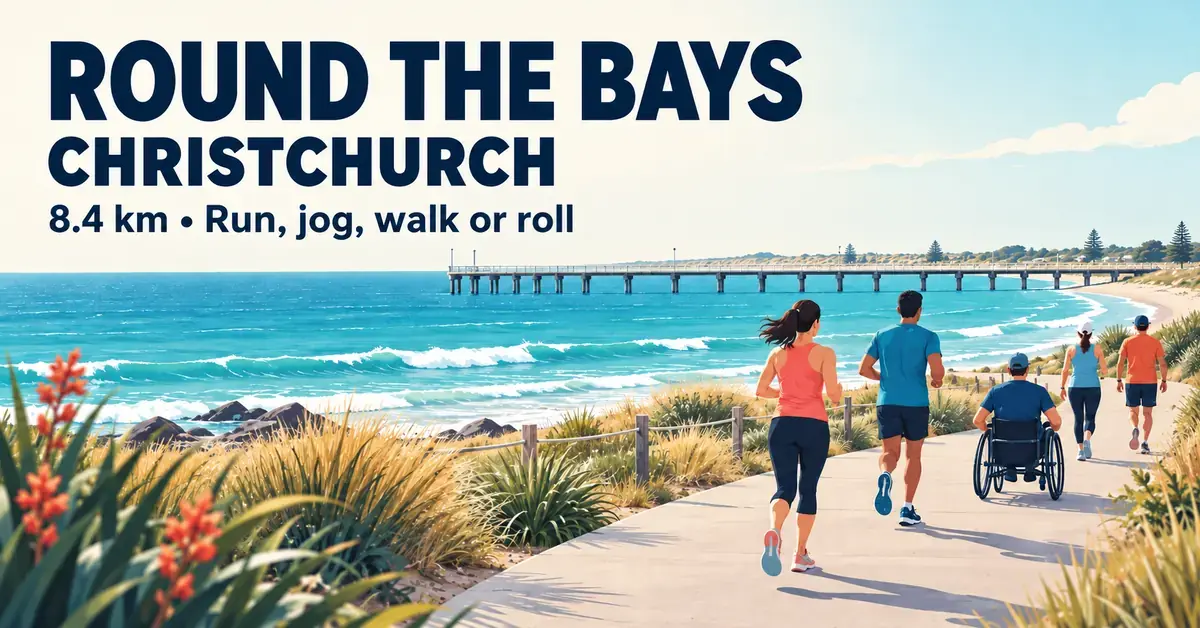
The Southern Cross Round the Bays Christchurch is a flat 8.4-kilometre run, jog, walk or roll along the coast of Ōtautahi, tracing the shoreline from the Avon-Heathcote Estuary (Te Ihutai) at Ferrymead out to Thomson Park in New Brighton. It is the South Island edition of New Zealand’s biggest and oldest mass-participation fun run, and after the 2026 event drew several thousand participants, the next edition is set for Sunday 21 February 2027. This guide explains the course, the start groups, entry fees, training and race-day logistics so you arrive prepared, whether you are chasing a personal best or pushing a buggy along the waterfront.
Key Facts
- Event: Southern Cross Round the Bays Christchurch
- Next date: Sunday 21 February 2027
- Distance: 8.4 km, flat, single point-to-point course
- Start: Corner of Humphreys Drive and Tidal View, Ferrymead
- Finish: Thomson Park, New Brighton
- Format: Run, jog, walk or roll; four self-seeded start groups
- Finish options: ‘Fast’ road along Marine Parade or ‘scenic’ beach route
- 2027 theme: ‘Legendary’ – 55 years since the first Round the Bays (Auckland, 1972)
- Naming partner: Southern Cross Healthcare
- Entry: From about NZ$35 (supersaver) to NZ$65 (late); children less, infants free
What is the Southern Cross Round the Bays Christchurch?
Round the Bays Christchurch is a community fun run over a single 8.4 km course, open to runners, joggers, walkers and wheelchair users of any age or ability. It is the Canterbury leg of the wider Southern Cross Round the Bays series, which also stages events in Auckland and Wellington under the naming partnership of Southern Cross Healthcare.
The series began in Auckland on 17 March 1972, when about 700 people ran along Tamaki Drive. It has since grown into one of the country’s largest events, and remains a fixture of Auckland’s busy summer sporting calendar (Wikipedia). Christchurch joined the family with an inaugural event in 2025, the second edition followed in February 2026, and the 2027 event carries the series theme “Legendary” to mark 55 years since that first Auckland run.
How the Christchurch event fits the national series
All three Round the Bays cities share the same signature 8.4 km distance, so a time set in Christchurch is directly comparable with Auckland. Wellington additionally offers a certified half marathon and a shorter 5.5 km option, while Auckland and Christchurch run the single 8.4 km course only. If you want to see exactly how the Round the Bays distances compare across the three cities, that breakdown is covered separately on the site.
The 8.4 km course from Ferrymead to New Brighton
The Christchurch course is a genuine point-to-point route, meaning the start and finish are in different places and the whole field runs in one direction. The 2027 start is the corner of Humphreys Drive and Tidal View in Ferrymead, on the edge of the estuary. From there the route runs along Linwood Avenue, turns right into Dyers Road, then right onto Bridge Street and up to The Parade, before reaching the coast at New Brighton and finishing at Thomson Park.
The defining feature of the course is how flat it is. There are no hills of any note, which makes it an excellent target for a first-ever event or a fast time, but the open, exposed coastal sections mean an easterly breeze off the Pacific can become the main variable on the day.
| Course segment | Approximate distance | Surface | Pacing focus |
|---|---|---|---|
| Ferrymead start (Humphreys Drive) | 0.0–2.0 km | Wide, flat urban asphalt | Settle your breathing, find open space, resist the fast start |
| Linwood Ave to Dyers Road | 2.0–5.0 km | Smooth sealed road and footpath | Lock into a steady, repeatable rhythm |
| Bridge Street to The Parade | 5.0–7.0 km | Sealed road, more exposed to wind | Run to effort, not the watch, if it is breezy |
| The finish choice to Thomson Park | 7.0–8.4 km | Marine Parade asphalt or soft beach sand | Pick your route, lift the cadence, drive to the line |
The ‘fast’ versus ‘scenic’ finish choice
Near the end of the course, participants choose between two ways to reach Thomson Park. The ‘fast’ option stays on the sealed surface of Marine Parade, running straight past the New Brighton Pier for the quickest line to the finish. The ‘scenic’ option drops onto the beach for a softer, more tactile run on the sand. Both routes rejoin along The Parade for the final stretch, so nobody misses the finish festival whichever they pick. If you are racing for a time, take the road; if you are there for the experience, the sand is part of the fun.
Start groups and how to seed yourself honestly
The event uses self-seeded start groups rather than a chip-timed elite gun start for everyone, so choosing the group that matches your realistic pace is the single most important thing you can do for a smooth morning. Placing yourself too far forward means faster runners have to weave around you; too far back and you spend the first kilometre stuck behind walkers.
The published start groups for the 8.4 km course are:
- Elite Runner and Elite Wheelchair/Disability – for competitive athletes expecting to finish in under 36 minutes.
- CELSIUS Runner – for runners targeting roughly 36 to 50 minutes.
- Jogger – for a continuous, relaxed effort of about 50 to 80 minutes.
- Walker and non-elite Wheelchair/Disability – for walkers, power-walkers and mobility participants expecting 80 minutes or more.
Enter your honest estimated finish time when you register, and aim to be in your assigned assembly area well before your group is called so you are not scrambling at the back.
Walkers, wheelchair users and pushchairs
Walkers, wheelchair users and mobility participants are genuinely welcome and make up a large part of the field. There is one important rule for parents: anyone pushing a pram, buggy or pushchair must enter under the Walker group. Pushchairs are not permitted in the runner or jogger groups, purely so the faster field is not slowed or endangered at the crowded start. Plan your entry around that from the outset if you are bringing a young child.
Entry options and fees for 2027
Entry is cheapest early and rises through a series of pricing windows, so registering during the supersaver or early-bird period is the simplest way to save money. Children pay a reduced fee and infants are free. The table below shows the published 2027 pricing tiers; always confirm the current price on the official entry page before you pay, as dates and amounts can change.
Entry Fees
| Pricing window | Adult | Child | Infant |
|---|---|---|---|
| Supersaver (early Oct 2026) | NZ$35 | NZ$18 | Free |
| Early bird (Oct–Nov 2026) | NZ$40 | NZ$20 | Free |
| Standard (Nov 2026–Feb 2027) | NZ$50 | NZ$25 | Free |
| Late (Feb 2027) | NZ$65 | NZ$29 | Free |
Prices in NZD and correct at the time of writing; confirm the current tier on the official entry page before registering.
Every entry includes a race bib and timing chip, a finisher’s medal for everyone who crosses the line, a downloadable finisher’s certificate, on-course entertainment, water stations and toilets on course, medical assistance, the finishers’ festival with sponsor activations, and free event shuttle buses.
Teams, corporate groups and fundraising
Workplaces, schools, gyms and social clubs can register as a team through the official online portal, which is a popular way to turn the morning into a group outing and to book hospitality space at the finish festival. Many participants also raise money for charity through the event; if you want to fundraise, set up your page through the official channels rather than any third-party link. For a wider view of the region’s racing options, the site’s Christchurch running events calendar is a useful companion.
Training for a flat 8.4 km
A flat course still rewards preparation, and the most common mistake is assuming that “flat” means “easy” and skipping training altogether. Because there are no hills to break up your rhythm, your legs absorb a steady, repetitive load on hard surfaces, so conditioning your calves, shins and Achilles tendons matters. Build your volume progressively over roughly six to eight weeks rather than cramming long runs into the final fortnight.
A sample training week
A reliable week blends two easy mid-week runs with one longer weekend session and enough rest to absorb the work. The table gives a simple template you can scale to your fitness.
| Session | Purpose | Frequency | Practical tip |
|---|---|---|---|
| Easy aerobic run | Build endurance and running economy | 2–3 times a week | Keep it conversational – you should be able to talk in full sentences |
| Intervals or strides | Add leg speed and turnover | Once a week | On Hagley Park paths, alternate one minute quick with one minute easy |
| Long run | Confidence and durability | Once a week | Build gradually until 7–9 km feels comfortable |
| Rest and mobility | Recovery and injury prevention | 2–3 days a week | Prioritise sleep and avoid hard days back to back |
Handling coastal wind and beach sand
The biggest race-day variable in Christchurch is the wind, not the terrain. The exposed sections near the estuary and coast can catch an easterly breeze that quietly drains your energy if you fight it, so the goal is to spend as little effort as possible battling the elements. The beach finish adds a second challenge if you choose the scenic route, because soft sand asks more of your calves and hips than sealed road does.
Simple adjustments for headwind and sand
- Tuck in behind others. Sitting a step behind a small group moving at your pace lets them break the wind for you.
- Shorten your stride and lift your cadence on sand. Quick, light steps stop you sinking and sliding.
- Run to effort, not pace. Accept that a headwind will slow your splits; chase a steady effort instead of a number.
- Stay relaxed. Drop your shoulders and unclench your jaw; every other runner is facing the exact same breeze.
Gear and clothing for a Canterbury summer morning
Late February in Canterbury usually means warm, high-UV conditions, so the priorities are breathable clothing, sun protection and, above all, kit you have already tested. Never debut new shoes or an unwashed technical top on race morning – an event expo purchase worn for the first time is a classic route to blisters and chafing. Because the main course is hard road and shared path, a cushioned road shoe is the sensible choice whether you finish on tarmac or sand.
| Item | What to look for | Why it matters |
|---|---|---|
| Cushioned road shoes | A pair broken in over training runs | Absorbs the repetitive impact of flat, hard surfaces |
| Technical socks | Moisture-wicking synthetic or merino, seamless toe | Cuts friction and blisters; the site’s guide to choosing running socks explains the fabrics |
| Running cap and sunscreen | Breathable mesh cap, high-SPF sunscreen | New Zealand’s UV is intense even on cloudy mornings |
| Anti-chafe balm | Sweat-resistant stick or gel | Prevents raw spots on underarms, thighs and seams |
Hydration and race-morning fuel
For an 8.4 km event, hydration is about arriving well-topped-up rather than drinking heavily on the run. Sip water steadily the day before instead of gulping large amounts on the morning, and eat a simple, familiar breakfast two to three hours before your start. There are water stations on the course and at the finish, but the organisers ask participants to bring their own drink bottle, so carry a small one if you like to sip regularly or the morning is warm.
A simple pre-race breakfast
- Keep it familiar and light. Toast with honey, a banana or a small bowl of porridge are all easy, low-fibre choices.
- Avoid high-fat or high-fibre foods. They can cause stomach cramps once you start moving.
- Don’t carb-load. An 8.4 km run does not need pasta mountains; eat normal, balanced meals in the days before.
- Bring your bottle. Top up at the on-course stations, especially if it is warm.
Race-day logistics: shuttles, parking and gear drop
Because the start and finish are in different suburbs and roads around Ferrymead are closed, public transport and the free event shuttles are the easiest way to get to the line. The event runs free shuttle buses from the Christchurch Bus Exchange (corner of Lichfield and Colombo Streets) out to the start, and return shuttles from Bowhill Road near Thomson Park back into the city after you finish. Driving directly to the start is not recommended.
Getting there and dropping your bag
Plan to arrive with time to spare, use the start-village facilities early, and attach the gear tag from your bib to any bag you check. Valuables, backpacks and handbags are not accepted at the gear truck, so keep your drop-bag to a change of warm clothes for the finish.
| Phase | Where | Advice |
|---|---|---|
| Getting to the start | Free shuttle from Christchurch Bus Exchange | Leave early; road closures make driving to Ferrymead impractical |
| Gear drop | Event trucks at the start village | Attach your bib gear tag; no valuables or backpacks accepted |
| Start line | Your assigned start group on Humphreys Drive | Move into your group early rather than joining at the back |
| Getting home | Return shuttle from Bowhill Road/Thomson Park | Bring a warm layer for the wait after you cool down |
Pacing and the mental game in a big field
The most reliable way to enjoy a mass-participation run is to run your own race, not the crowd’s. Adrenaline and thousands of moving bodies make it easy to shoot off far too fast in the first kilometre, so start conservatively and let the pace come to you. Break the course into thirds: an easy, controlled opening, a steady rhythm through the middle, and a progressive push over the final couple of kilometres to the finish.
Use the on-course entertainment and cheer points as natural checkpoints, run alongside someone at a comfortable, steady pace, and keep your form relaxed. The table below is a simple effort guide on a scale of one to ten.
| Section | Portion of course | Target effort (1–10) | Mindset |
|---|---|---|---|
| Estuary start | 0–25% | 4–5 (relaxed) | Find space, settle breathing, check posture |
| Dyers Road to Bridge Street | 25–75% | 6–7 (steady) | Hold a constant rhythm; ignore the wind |
| The Parade to Thomson Park | 75–100% | 8–10 (progressive) | Lift the cadence and drive to the line |
After the finish line at Thomson Park
Crossing the line is the start of a short recovery routine that will help you feel better the next day. Keep walking for a few minutes rather than stopping dead, so your heart rate settles gradually, then pull on a dry, warm layer before the coastal breeze cools you down. Rehydrate with water or an electrolyte drink and have a light snack from the finish festival before the celebratory coffee.
Thomson Park turns into a finishers’ festival with live music, food vendors and family entertainment, so it is worth staying to soak it up. When you are ready, you can track down your race images – the site’s guide to finding your official Round the Bays photos explains how. And if the flat waterfront format suits you, the City to Surf coastal fun run and the road-based Christchurch Marathon are natural next steps in the local calendar.
Sources
Frequently Asked Questions (FAQ)
When is Round the Bays Christchurch 2027?
The next Southern Cross Round the Bays Christchurch is on Sunday 21 February 2027. It is the third annual Christchurch edition, following the inaugural 2025 event and the second edition held in February 2026. Confirm exact start times on the official event website closer to the day, as they can be finalised late.
Where does the Christchurch course start and finish?
The course is a point-to-point route of 8.4 kilometres. It starts on the corner of Humphreys Drive and Tidal View in Ferrymead, on the edge of the Avon-Heathcote Estuary, and finishes at Thomson Park in New Brighton after running along Linwood Avenue, Dyers Road, Bridge Street and The Parade.
How much does entry cost?
Entry is tiered, so it is cheapest during the supersaver and early-bird windows and most expensive in the final week. Published 2027 adult prices range from about NZ$35 in the supersaver period up to NZ$65 for late entries, with reduced fees for children and free entry for infants. Always check the current amount on the official entry page before paying.
Can I walk the course or push a pushchair?
Yes. Walkers, power-walkers and wheelchair users are welcome, and the event has a dedicated Walker start group for finishers expecting to take about 80 minutes or more. Anyone pushing a pram or buggy must enter under that Walker group, as pushchairs are not permitted in the runner or jogger groups.
How do I get to the start, and where do I park?
The organisers run free event shuttle buses from the Christchurch Bus Exchange in the city centre out to the Ferrymead start, with return shuttles from near Thomson Park after the finish. Because roads around the start are closed on the morning, the shuttles and public transport are the recommended option rather than driving directly to Humphreys Drive.