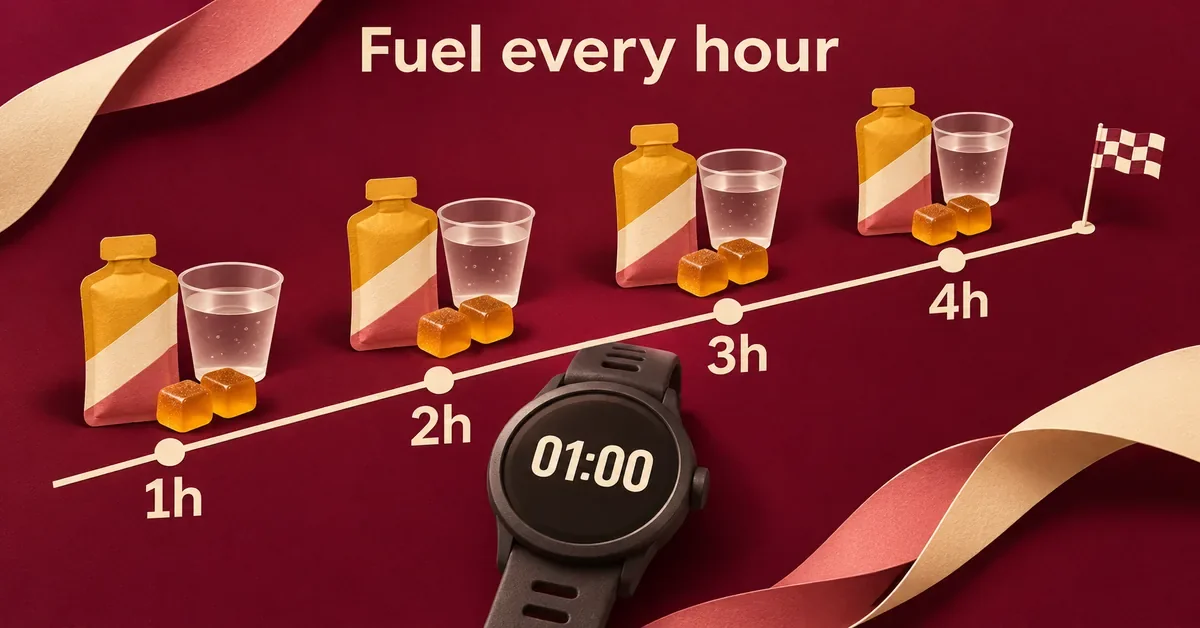
The short answer to what to eat during a marathon is straightforward: fast-digesting carbohydrate and fluid, taken in small amounts from early in the race and topped up steadily all the way to the finish. Most runners do this with energy gels, chews and sports drink rather than solid meals, because your stomach can digest very little while you run hard. This guide sets out how many carbohydrates to aim for, what that looks like hour by hour, how much to drink, and the mistakes that leave people walking the last few kilometres. It covers only what happens between the start and the finish line; getting your stores full beforehand is a separate job of carb loading before a marathon in the final week.
Why you need to eat at all during a marathon
You fuel during a marathon because your body simply cannot store enough carbohydrate to cover the whole distance. Carbohydrate is kept as glycogen, a storage form of sugar held in your muscles and liver, and even a well-fed runner only carries enough for roughly 90 minutes to two hours of hard effort. The marathon distance of 42.195 km takes most people three to five hours, so without topping up you run the tank dry.
When glycogen runs low, runners describe a sudden, heavy fatigue known as “hitting the wall” or bonking. Experts put the odds at roughly two in five runners meeting it during a marathon, and it tends to set in once you have been pushing hard for about 90 minutes to two hours. Starting too fast makes it more likely because it burns glycogen quicker. Eating on the move keeps your blood glucose steady and spares your remaining stores, so the point of in-race fuelling is prevention: you eat before you feel empty, not after.
How many carbohydrates do you need per hour?
For most marathon runners the target is around 60 to 90 grams of carbohydrate per hour. Slower finishers who are out on the course for four hours or more can do well on roughly 45 to 60 grams an hour, while faster runners benefit from the top of the range. These figures are driven mainly by how long you are running, and reaching the upper end takes a gut you have trained to handle it.
The reason the top of that range needs care is absorption. Your gut can only move so much glucose per hour through one transport route, so above about 60 grams per hour you need a blend of glucose and fructose, which uses a second pathway and lets you absorb more without it sitting heavily in your stomach. Below 60 grams per hour, a single-source glucose or maltodextrin product works perfectly well.
In practice, many runners fall short. When sports scientists measured carbohydrate intake across a field of marathon runners, the average came out at only around 35 grams per hour – about a gel every two hours – which is one reason the wall is so common. The fix is not to force a big number on race day but to build intake up gradually on your long training runs. This “gut training” lets you tolerate more carbohydrate over time, and it is the single most important thing to rehearse.
How many gels is that?
Most energy gels contain about 23 to 27 grams of carbohydrate, though some larger or “dual-fuel” gels pack 30 to 40 grams. At around 25 grams each, reaching 60 to 90 grams an hour works out to roughly three gels an hour – the figure sports scientists often use as shorthand for marathon fuelling. Over a three-hour race that is on the order of nine gels if you leaned on them alone, though most runners take fewer and make up the rest with a carbohydrate sports drink. Count your gels before the start and know exactly when you plan to take each one.
What to eat during a marathon, hour by hour
The best way to use those numbers is to spread them evenly rather than eating in big lumps. Start early, within the first 30 to 45 minutes, and then settle into a steady rhythm of small doses. The table below turns the targets above into a simple by-the-hour plan you can adapt to your own pace and gut.
Fuelling by the Hour
| Stage of the race | Carbohydrate to aim for | What that looks like | Fluid |
|---|---|---|---|
| Start to ~30 min | 0–15 g | A few sips of sports drink, or nothing if you fuelled well beforehand | Water to thirst |
| 30–60 min (first hour) | Build toward ~60 g | Your first gel around the 30–45 min mark, backed up by sports drink | Small sips at each aid station |
| Hour 2 | 60–90 g | A gel every 20–30 min, or gels plus chews and sports drink | Sip to thirst; add electrolyte in heat |
| Hour 3 | 60–90 g | Keep the rhythm; switch flavours to beat the sweetness | Keep sipping; avoid over- or under-drinking |
| Hour 4+ / final 10 km | Whatever you can stomach | Caffeinated gel or flat cola for a lift; chews if gels feel sickly | Small, regular sips |
Targets are general ranges; build your own up gradually in training and adjust for heat and pace.
Two habits matter more than the exact grams. The first is starting before you feel you need it: by the time you notice fatigue, you are already behind. The second is switching flavours or textures as the race goes on, because sweet gels become hard to stomach after two hours. Many runners keep one savoury or caffeinated option for the final stretch for exactly this reason.
Gels, chews, sports drink or real food?
No single fuel is “best”; the right mix is whatever delivers your carbohydrate target without upsetting your stomach. Gels give you precise, portable carbs but are concentrated and need water. Chews let you pace intake in small bites. Sports drink delivers carbohydrate, fluid and sodium in one go, but you can only carry so much. Solid food such as a banana or pretzels gives a welcome break from sweetness but digests more slowly. The table compares the common options.
Fuel Options Compared
| Fuel | Typical carbohydrate | Needs water? | Best for | Watch out for |
|---|---|---|---|---|
| Energy gel | 23–27 g (some 30–40 g) | Yes, it is concentrated | Precise, portable carbs | Can upset the stomach taken dry or too often |
| Energy chews / gummies | ~20–30 g per serving | A little | Pacing intake in small bites | Fiddly to open and chew at speed |
| Sports drink | ~30–60 g per litre | No, it is the fluid | Carbs, fluid and sodium together | Hard to carry enough; do not over-concentrate |
| Banana or solid snack | ~25 g (a medium banana) | A little | A real-food break from sweetness | Slower to digest; bulky to carry |
| Flat cola | ~35 g per 330 ml | Optional | A late-race sugar and caffeine hit | Fizz can bloat; mostly found at aid stations |
In New Zealand you will find gels from brands such as PURE Sports Nutrition, Neversecond, GU, SiS and Maurten in running and bike shops, usually for a few dollars each depending on the brand and size. Whatever you choose, read the carbohydrate figure on the sachet rather than guessing, and make sure what you carry adds up to your hourly plan. Carrying it is easier with a no-bounce running belt, and for longer trail events a running hydration pack lets you carry fluid and several gels at once.
How much should you drink, and do you need electrolytes?
Drink to thirst in small, regular sips rather than gulping large volumes at each aid station. Because no fixed fluid schedule has been shown to prevent problems, the current guidance for avoiding exercise-associated hyponatremia is simply to drink in response to thirst. How much that adds up to swings widely with the weather, your size and how much you sweat, so there is no single millilitre figure that fits every runner.
Over-drinking is the real danger at the other extreme. Loading up on fluid – plain water or sports drink – beyond what you need can dilute your blood sodium to dangerously low levels, a condition called hyponatremia, which is why sipping to thirst beats forcing fluids. Electrolytes, chiefly sodium, help here: a sports drink or electrolyte tablet replaces some of what you lose in sweat and makes the fluid easier to absorb. On a hot Kiwi summer race you will want sodium in your drink; on a cool morning, plain water alongside your gels is often enough. If you take a gel, wash it down with water rather than more sports drink, so the sugar hitting your gut is not too concentrated.
Caffeine, and the “flat cola at 35K” trick
Caffeine is the one extra that has strong evidence behind it: a modest dose of about 2 to 3 milligrams per kilogram of body weight – roughly 200 mg, the amount in a couple of strong coffees – can improve endurance performance and reduce how hard the effort feels. Many runners get this from caffeinated gels, saving them for the second half when fatigue bites. It works best if you know you tolerate it, so test it in training rather than trying it for the first time on race day.
This is also why cola appears at the sharp end of so many marathons. A cup of flat cola delivers both quick sugar and a modest caffeine hit in one swallow, and letting it go flat means less fizz to bloat your stomach. The caffeine in a small cup is modest, well short of a full performance dose, so treat cola as a late-race lift rather than your main fuel. As with everything else, only reach for it on race day if you have practised with it first.
Common fuelling mistakes to avoid
The biggest mistake, as the hour-by-hour plan above stressed, is starting too late and then spending the rest of the race playing catch-up.
The other classic errors are easy to fix:
- Trying new products on race day. A gel your stomach has never met can cause cramps or an urgent toilet stop. Rehearse the exact brands and flavours in training.
- Taking gels dry or too close together. Concentrated gels need water, and doubling up to chase a number your gut cannot handle backfires.
- Ignoring fluid and sodium in the heat. On a warm day, carbs alone are not enough; you need fluid and electrolytes too.
- Relying only on aid stations. Check whether your event actually provides gels – many do not – and remember on-course drinks may not match what you trained with. Carry what you need.
- Letting pace wreck your fuelling. Going out faster than your marathon pace chart target drains glycogen sooner and makes your stomach less willing to take food.
Practise your race-day fuel in training
Treat fuelling as a skill to rehearse, not an afterthought. On your longer runs, take the same gels, chews and drink, at the same times and at close to goal pace, so your gut is used to them and you know your plan works. This is exactly where the long runs in a structured beginner marathon training plan earn their keep: they are your dress rehearsal for race-day nutrition as much as for the distance. By race morning, what to eat during the marathon should feel automatic.
A note on this guide
This article is general information about sports nutrition, not medical or dietary advice. Fuelling needs vary with your size, your pace, the weather and your health. If you have diabetes, a digestive condition, are pregnant, or take medication, speak with a doctor or a registered sports dietitian before changing what you eat and drink on the run. Remember too that drinking far more fluid than you lose can cause dangerously low blood sodium, so sip to thirst rather than forcing water.
Sources
- Precision Fuel & Hydration – How much carbohydrate per hour (60–90 g/h for most marathoners; carb content of gels, chews, drinks, banana and cola)
- Asker Jeukendrup, mysportscience – 3 gels per hour for the marathon (average intake ~35 g/h; carb targets)
- Cleveland Clinic – Energy gels: 23–27 g of carbohydrate per gel and taking them with water
- Cleveland Clinic – How to avoid bonking: around 2 in 5 runners hit the wall
- American Family Physician – Exercise-associated hyponatremia: drink in response to thirst
- Australian Institute of Sport – Caffeine (2–3 mg/kg, ~200 mg, for endurance performance)
- RunnersConnect – The 10-10-10 marathon pacing method
- Breadless – Athlete nutrition: the 4-2-1 daily macronutrient rule explained
Frequently Asked Questions
What is the 10-10-10 rule for marathons?
The 10-10-10 rule is a pacing strategy, not a fuelling one. It splits the race into three blocks: ease off slightly for the first 10 miles (about 16 km), settle into goal pace for the next 10 miles, then run the final 10 km on whatever you have left. It pairs well with steady fuelling because holding back early protects your glycogen for the finish, but the numbers refer to pace and distance, not to how much you eat.
What is the 4-2-1 eating rule for athletes?
The 4-2-1 rule is an informal daily-eating shorthand rather than a during-the-race plan. It describes a rough split of about 4 grams of carbohydrate, 2 grams of protein and 1 gram of fat per kilogram of body weight across the day. It is a general template for everyday training nutrition, so it sits alongside your overall diet rather than replacing the hour-by-hour fuelling above; on the run itself, the carbohydrate targets earlier in this guide are what matter.
Can I run a marathon on just a sports drink?
You can for a shorter, slower marathon if the drink supplies enough carbohydrate, but it is hard to carry or drink enough to hit 60 grams an hour from fluid alone, especially in cooler weather when you are not thirsty. Most runners combine a sports drink with gels or chews so they can reach their carbohydrate target without drinking uncomfortable volumes.
What should I do if gels upset my stomach?
First, take each gel with water rather than sports drink, and do not double up to catch a missed one. If gels still trouble you, spread smaller amounts more often, switch to an isotonic gel that does not need extra water, or get more of your carbs from chews, a sports drink or a banana. The key is to find what your gut tolerates during training, long before race day.