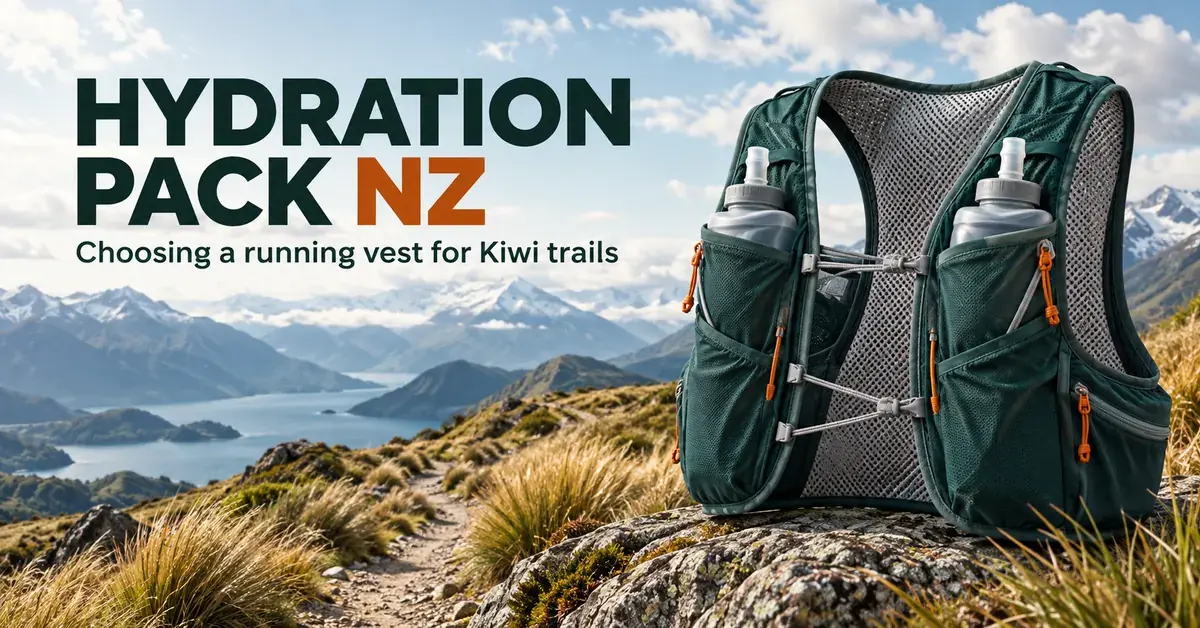
A hydration pack is the piece of gear that lets you carry water, food and safety equipment on the run without slowing to a walk, and choosing the right one matters as much for a Saturday trail loop as for a remote mission like the Kepler Challenge. In New Zealand the choice is shaped by two things in particular: fast-changing mountain weather that forces you to carry layers, and event rules that make certain gear compulsory.
This guide explains what a running hydration vest is, how much water and storage you actually need, the difference between soft flasks and a bladder, how to get a bounce-free fit, what packs cost in New Zealand, and the mandatory gear you must carry for Kiwi trail and ultra events. Every figure below has been checked against manufacturer and event sources.
Key Points
- Fit first: vests are sized to chest circumference, not clothing size — measure and trial with water in before buying.
- Litres = total storage, not water: most Kiwi trail runners are best served by a 5–8 litre vest.
- Two hydration systems: front soft flasks (fast, balanced) or a rear bladder (more volume, hands-free) — many vests take both.
- NZ prices: roughly NZ$150 for a minimalist vest up to about NZ$320 for a large ultra vest.
- Event gear: check each race’s compulsory list — Tarawera is cupless and requires a taped-seam jacket, thermals, phone and a survival bag.
What is a running hydration vest?
A running hydration vest is a lightweight, clothing-style pack worn on the torso that carries fluids on the chest and gear on the back. Unlike a hiking rucksack, it is sized to your chest measurement and made from stretch mesh so it moves with you rather than swinging on your shoulders. The term “hydration pack” covers both these vests and larger fast-packing packs, but for running the vest style dominates because it keeps weight high and close to your centre of gravity.
Vests differ from a plain running vest (which may be a windproof top with no storage) and from a running belt (which carries a small amount of fluid at the waist). A hydration vest is the middle ground: more capacity than a belt, far more comfort at speed than a rucksack.
How a vest carries the load
The point of a vest is weight distribution. Water is heavy — one litre weighs a kilogram — so where you carry it changes how you run. A vest splits fluid across two front pockets and keeps any spare weight flat against your upper back, so the load sits over your natural centre of gravity instead of pulling backwards on your shoulders and lower spine. Four-way stretch panels let the pack expand as your ribcage does on a climb, which is why a well-fitted vest can be worn for hours without chafing.
How much water and storage do you need in New Zealand?
The right storage volume depends on how long you are out, how remote the route is, and what an event forces you to carry. Pack size is quoted in litres, which describes the total combined capacity of every pocket and compartment — not the amount of water it holds. A 6-litre vest, for example, might carry 1 litre of fluid and 5 litres of gear.
Getting the volume right matters in both directions. Overstuff a small vest and you strain the zips and lose the close fit; wear a large vest half-empty and the spare fabric flaps and rubs. Choose the size around your longest regular outing, not your shortest.
Volume categories explained
- 2–4 litres (minimalist): road marathons, parkruns and short summer trail sessions where you need a phone, a key, a gel or two and up to about 500 ml of fluid.
- 5–8 litres (all-round): the sweet spot for most Kiwi trail runners. Enough room for a standard event gear list plus roughly 1–1.5 litres of fluid, without feeling bulky.
- 10–15 litres (long/alpine): self-supported alpine days, hot back-country routes with sparse water, and long ultras such as the longer Tarawera distances where you carry more layers and food.
- Over 15 litres (fast-packing): hybrid packs blending vest ergonomics with hiking volume for multi-day hut trips; heavier and less race-focused.
Soft flasks versus a bladder: which hydration system?
The two main systems are front-mounted soft flasks and a rear reservoir (bladder), and most modern vests accept both so you can mix them by season. Soft flasks sit on the chest, collapse as you drink so they do not slosh, and are quick to refill at an aid station or a river. A bladder holds more water in one central unit against your back and lets you sip through a hose without reaching for anything, but it is slower to refill and hides how much you have left.
A common set-up is one flask of plain water and one of electrolyte or carbohydrate drink; for long efforts a purpose-made sports drink is a smarter choice than a sugary caffeinated energy drink such as Prime (Wikipedia), which is not formulated for endurance hydration.
Flask and bladder at a glance
| System | Typical volume | Refill speed | Best for |
|---|---|---|---|
| Front soft flasks | 250–600 ml each (usually 2) | Fast — unscrew and fill | Racing, frequent aid stations, tracking intake at a glance |
| Rear reservoir (bladder) | 1.5–2.0 litres | Slower — unpack to refill | Long, remote routes with few water sources; hands-free sipping |
| Flask + straw/valve extension | Varies | Neutral | Drinking without tilting your head or breaking stride |
How much water should you carry and drink?
As a rough working guide, endurance runners lose and need to replace somewhere around 400–800 ml of fluid per hour, with the higher end in the heat or on hard efforts — but sweat rates vary widely between individuals, so treat this as a starting point and adjust to thirst and conditions. This is what decides your flask-versus-bladder choice: a two-hour summer trail run in Canterbury might need a litre carried, while a long, hot back-country day between distant streams can call for two litres or more plus a plan to refill.
Two practical habits help. First, know where the water is: on supported events, note the aid-station spacing so you carry enough to reach the next one without over-loading; off-grid, identify reliable streams and consider a lightweight filter. Second, replace salts, not just water — on long, sweaty efforts, plain water alone can leave you low on sodium, so alternate with an electrolyte drink or take salt capsules. Weighing yourself before and after a long run is the simplest way to learn your own sweat rate: roughly one kilogram lost equals one litre of fluid you were short.
Getting a bounce-free fit
A vest that fits correctly does not move, so sizing is the most important buying decision. Running vests are sized to chest circumference (roughly XS–XL), not one-size-fits-all, and men’s and women’s cuts differ in the shoulder and chest shaping. Measure around the widest part of your chest with a soft tape while wearing the layers you would normally train in, then compare against the specific brand’s size chart — Salomon, Osprey and Ultimate Direction all size slightly differently. If you are between sizes, size down for racing (a snugger vest bounces less) and up only if you routinely carry a full winter load.
Checking the fit at home
- Load it first: fill the flasks or bladder with water before you judge the fit — an empty vest tells you nothing.
- Jump on the spot: a few hops should produce little or no vertical bounce; movement means the size or the cinch is wrong.
- Check the shoulders: straps should lie flat over your collarbones without riding into your neck.
- Check the ribs: side panels should wrap firmly but let you take a full deep breath on a climb.
- Use the sternum straps: as you drink and eat, the pack gets lighter and looser — re-tension the elastic sternum links on the move to keep it snug.
What hydration packs cost in New Zealand
Running hydration vests sold in New Zealand generally run from about NZ$150 for a small minimalist pack to NZ$320 for a large ultra vest, with most all-round 5–8 litre vests around NZ$170–230. The comparison below lists popular models stocked by New Zealand retailers, with capacity, the hydration included and an approximate recommended price. Prices change with sales and stock, so treat them as a guide and confirm on the retailer’s page.
Comparison
| Vest | Total capacity | Hydration included | Approx. NZ price | Best for |
|---|---|---|---|---|
| Salomon Active Skin 8 | 8 L | 2 × 500 ml soft flasks (bladder optional) | ~NZ$170–200 | All-round trail training |
| Salomon ADV Skin 12 | 12 L | 2 × 500 ml soft flasks | ~NZ$300–320 | Long mountain ultras |
| Osprey Duro 6 | 6 L | 1.5 L reservoir included | ~NZ$220 | Runners who prefer a bladder |
| Ultimate Direction Ultra Vest 6.0 | ~10 L | 2 × 500 ml soft flasks | ~NZ$220–280 | Front-flask fans on all-day efforts |
| CamelBak Zephyr Pro | 11 L | 2 × 500 ml Quick Stow flasks | Check retailer | Body-mapped fit, hot-weather airflow |
| Raidlight Responsiv 12 | 12 L | Flasks included | ~NZ$280 | Value long-distance option |
You will find these brands at specialist stores such as Outside Sports, Bivouac Outdoor, Gearshop and FuelMe, as well as the brands’ own New Zealand sites. Trying a vest on with weight in it before you buy is worth the trip, because fit is personal and hard to judge online.
Mandatory safety gear for New Zealand trail and ultra events
For remote events your vest is also your survival kit, and organisers publish a compulsory gear list you must be able to produce at kit checks. Requirements vary by event and by distance, so the golden rule is to read the specific race’s list rather than assume — carrying the wrong item can mean a time penalty or a start-line refusal. A hydration pack is chosen partly on whether it can swallow that list and still run well.
The Tarawera Ultra-Trail (UTMB) list is a good reference point and shows how the details matter. It is a cupless event, so you must carry your own cup, bottle or flask to use at aid stations. For the longer distances the compulsory items include a waterproof jacket with fully taped seams and a hood, a long-sleeve thermal top and thermal pants in synthetic or wool fabric, a working mobile phone able to make calls in New Zealand, and an emergency survival bag (a sealed bag you can climb into) — note this is a survival bag, not a foil blanket. A whistle is not on the current Tarawera list, so do not assume one is universally required; check each event.
Where this gear gets used
You will meet these rules across the country’s big trail events — the Tarawera Ultra-Trail near Rotorua, the Kepler Challenge in Fiordland, and the Taupō Ultramarathon on the Great Lake Trail. If you are new to the distance, our guide to running an ultramarathon in New Zealand covers gear, fuelling and training in more depth, and the broader safety habits in our outdoor sports guide apply to any solo back-country run.
Carrying trekking poles on a vest
Collapsible poles save your legs on steep South Island climbs, but you need somewhere to stow them when the trail flattens out. Most vests offer at least one carry option: front bungee loops down the chest straps for the fastest access, a rear horizontal or diagonal quiver to keep the chest clear on long climbs, or elastic loops along the lower ribcage. Choose the layout around how often you expect to deploy and store the poles during a run — frequent swaps favour front access; store-and-forget favours the rear.
Cleaning and caring for your vest
Sweat leaves salt crystals that stiffen fabric, corrode zips and grow odour, so a simple rinse routine keeps a vest usable for years. Do not machine wash on a hot cycle, and never use fabric softener — it coats the fibres and destroys the mesh’s ability to breathe and wick.
- Rinse after big runs: soak the vest in cool fresh water soon after a long, sweaty session to dissolve salt before it dries in.
- Hand-wash the hot spots: gently work the shoulder and underarm zones with a technical wash or a fragrance-free soap.
- Flush the zips and flasks: run water through the zip tracks to clear grit and drink powder, and rinse flasks and bladders, drying them open to prevent mould.
- Air-dry in the shade: hang it out of direct sun and never use a dryer or heater, which can warp the plastics and elastic.
Common mistakes to avoid
Most vest problems come down to a handful of avoidable errors rather than the gear itself.
- Buying on volume alone: a 12-litre vest is not “better” than a 6-litre one — it is heavier and looser when half-empty. Match the litres to your real outings.
- Guessing the size: ordering by clothing size instead of measuring your chest is the number-one cause of bounce and chafing.
- Testing it empty: a vest that feels perfect in the shop can bounce badly once loaded; always trial it with water in.
- Ignoring the event list: turning up without the exact mandatory gear, or with the wrong version (an untaped jacket, a blanket instead of a survival bag), risks a penalty or a refused start.
- Skipping the rinse: leaving salt and drink residue in the fabric and bladder shortens the vest’s life and breeds odour.
Which hydration pack suits which runner?
Match the pack to the running you actually do. Road marathoners and parkrunners are best served by a 2–4 litre minimalist vest or a belt. All-round trail runners doing anything from an hour to a full day want a 5–8 litre vest with front flasks. Long-course ultra and alpine runners need a 10–15 litre vest that fits the full mandatory list and, often, a bladder for the dry stretches between water sources. If you rarely run beyond an hour and carry little, a belt may be all you need.
Sources
Frequently Asked Questions (FAQ)
What size hydration pack do I need for a New Zealand trail ultra?
For most New Zealand trail ultras a 5–8 litre vest is the sweet spot, giving room for the compulsory gear list plus flasks and food. Step up to a 10–15 litre vest for the longest distances or self-supported alpine routes where you carry extra layers and more water between aid stations.
How do I stop my hydration vest bouncing?
Buy the correct chest size rather than guessing, load the vest with water before judging it, and keep the sternum straps cinched. Soft flasks collapse as you drink so they do not slosh; if you use a bladder, squeeze the air out after filling. Bounce almost always means the vest is too big or too loose.
Are soft flasks better than a bladder?
Neither is universally better — they suit different runs. Front soft flasks refill fast, balance weight across the chest and let you see how much you have left, which suits racing and frequent aid stations. A rear bladder carries more water hands-free, which suits long, remote routes. Many vests take both, so you can switch by season.
What gear is mandatory for events like the Tarawera Ultra-Trail?
It varies by event and distance, so always read the specific race list. The Tarawera Ultra-Trail is cupless and, for its longer distances, requires items such as a taped-seam waterproof jacket, a thermal top and pants, a working mobile phone and an emergency survival bag. A whistle is not on its current list, so do not assume one is required everywhere.
How do I wash a running hydration vest?
Rinse it in cool fresh water soon after a sweaty run, then hand-wash the shoulder and underarm areas with a mild technical wash — never fabric softener, which clogs the mesh. Flush the zips, flasks and bladder, and air-dry in the shade. Avoid hot machine cycles, dryers and heaters, which damage the elastic and plastics.