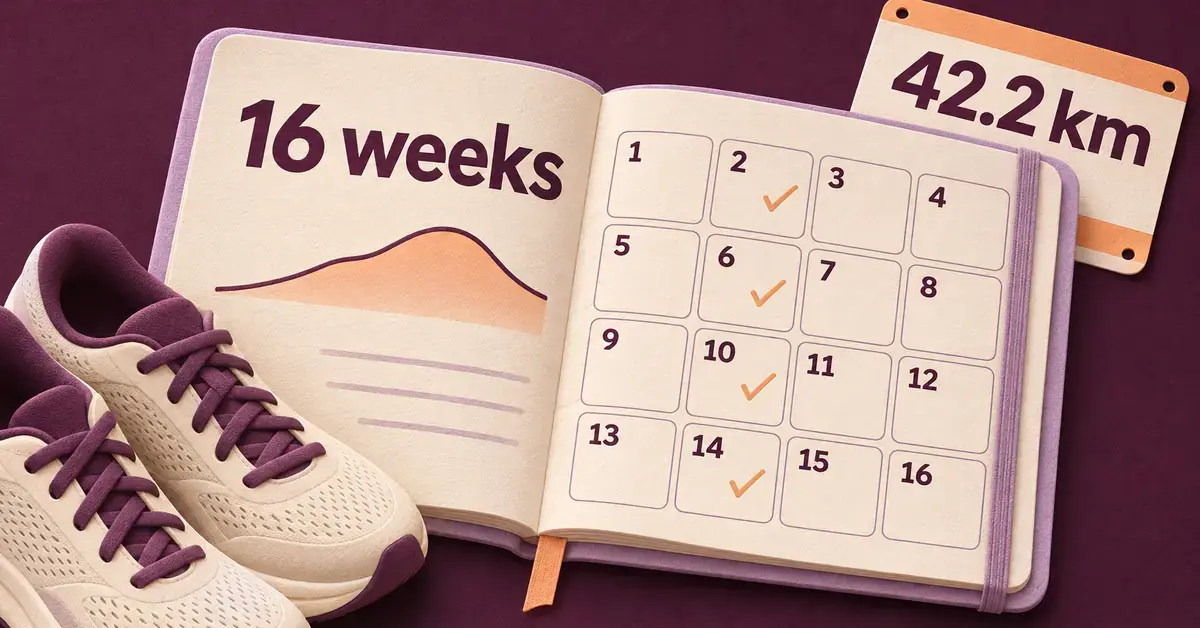
Running your first marathon is less about raw talent and more about patient, consistent preparation. This beginner marathon training plan lays out a realistic 16-week schedule that takes you from comfortable short runs to the start line of a full 42.2 km race, with the long runs, easy days, rest and taper mapped out week by week. It is built for first-timers who can already jog a few kilometres without stopping and want a clear, safe path to the finish line rather than a fast time. If you are still getting your head around how long a marathon really is, the full 42.2 km is a serious distance — which is exactly why a steady, structured build-up matters so much.
Quick Facts
| Plan length | 16 weeks |
|---|---|
| Goal | Your first full marathon (42.2 km) |
| Starting fitness needed | Able to run about 5 km / 30 minutes non-stop |
| Running days | 3–4 per week (two short midweek runs + one weekend long run) |
| Peak long run | About 32 km (around Week 13) |
| Taper | Final 3 weeks |
| Rest / cross-training | 2–3 days a week |
| Main intensity | Easy, conversational pace |
Are you ready to start? The base fitness you need first
You should be able to run about 5 km, or 30 minutes non-stop, before you begin a 16-week marathon plan. This schedule assumes that base; it is not a programme for someone starting from the couch. Jumping straight to marathon mileage without that foundation is the single most common way beginners get hurt.
If you are not there yet, build that base first. A structured couch to 5K plan will get a complete beginner running 30 minutes continuously — the popular NHS Couch to 5K programme takes about nine weeks, or longer if you go at your own pace — after which you can slot into Week 1 below. Ideally you have also been running three times a week for a month or two, so your legs, tendons and feet are used to the repeated impact.
Who this plan suits
- Recreational runners who can already cover 5 km and want to finish, not race for a time.
- People with 16 clear weeks before their goal event and a flexible enough week for three to four runs.
- Anyone who would rather build slowly and arrive at the start line healthy than chase big mileage.
How the 16-week plan works
The plan is built around one weekend long run that grows steadily, supported by two shorter midweek runs and plenty of rest. Everything else — pace, cross-training, recovery weeks — exists to let that long run keep building without breaking you down.
Three to four runs a week, not seven
Beginners improve fastest on three to four runs a week with rest days in between, not daily mileage. The core week here is two easy midweek runs plus one long run, with an optional third easy run or a cross-training session if you feel strong. Rest days are part of the training, not a failure to train: that is when your body actually adapts and gets stronger.
Keep most of your running easy
The large majority of your running should be at an easy, conversational pace — slow enough that you could hold a full conversation or say a sentence out loud without gasping. Most first-timers run their easy days far too fast, which leaves them tired for the long run and raises the injury risk. Easy running still builds the aerobic engine a marathon demands; it just does it without the wear and tear of constant hard efforts.
The long run is the key session
The weekend long run is the most important workout in the plan. It teaches your body to burn fuel efficiently, hardens your legs to time on feet, and rehearses the mental side of going long. Run it slowly — comfortably slower than you expect your race pace to be. You do not need to run the full 42.2 km in training; this plan peaks at about 32 km, and the race-day adrenaline, taper and crowd carry you through the final stretch.
Build gradually and take recovery weeks
Increase your running load gradually rather than in big leaps. A widely used guideline is to lift your weekly volume by no more than roughly 10% from one week to the next; the exact percentage matters less than the principle — avoid “too much, too soon” — which is why beginners get injured when they rush. This plan also builds in a lighter recovery week every third or fourth week, where the long run steps back so your body can absorb the work before the next push.
Cross-training and strength
On non-running days, low-impact cross-training such as cycling, swimming, walking or an easy spin keeps your aerobic fitness ticking over without the pounding. One or two short strength sessions a week — squats, lunges, calf raises, core work — help your legs cope with the repeated impact and are especially worth it for first-timers. Neither is compulsory, but both reduce your injury risk.
The 16-week beginner marathon schedule (in km)
Below is a complete week-by-week schedule in kilometres. The two midweek runs are easy-paced; the weekend run is your long run. Monday, Wednesday and Friday are rest or optional cross-training days, and you can move sessions around to fit your week as long as you keep an easy day or rest between hard efforts. Treat the numbers as a guide, not a contract: if a week feels like too much, repeat it or trim the long run rather than pushing into pain.
| Week | Phase | Tue (easy) | Thu (easy) | Weekend long run | Core weekly total |
|---|---|---|---|---|---|
| 1 | Base | 5 km | 5 km | 10 km | ~20 km |
| 2 | Base | 5 km | 6 km | 12 km | ~23 km |
| 3 | Base | 6 km | 6 km | 14 km | ~26 km |
| 4 | Recovery | 5 km | 5 km | 11 km | ~21 km |
| 5 | Build | 6 km | 7 km | 16 km | ~29 km |
| 6 | Build | 6 km | 8 km | 18 km | ~32 km |
| 7 | Build | 7 km | 8 km | 21 km | ~36 km |
| 8 | Recovery | 6 km | 6 km | 16 km | ~28 km |
| 9 | Build | 7 km | 9 km | 23 km | ~39 km |
| 10 | Build | 8 km | 9 km | 26 km | ~43 km |
| 11 | Peak build | 8 km | 10 km | 29 km | ~47 km |
| 12 | Recovery | 7 km | 8 km | 23 km | ~38 km |
| 13 | Peak | 8 km | 10 km | 32 km | ~50 km |
| 14 | Taper | 7 km | 7 km | 26 km | ~40 km |
| 15 | Taper | 6 km | 5 km | 19 km | ~30 km |
| 16 | Race week | 5 km | 4 km | Race day: 42.2 km | — |
The peak long run lands in Week 13 at about 32 km, followed by a three-week taper to Race Week. If you can only manage three sessions in a given week, keep the long run and one midweek run, and drop the other. Missing the odd run will not undo months of training; stringing together consistent weeks is what counts.
Pacing your training and your race
For a first marathon, aim to finish comfortably rather than hit a specific time, and start the race slower than feels necessary. The most common race-day mistake is going out too fast in the first 10 km and paying for it badly after 30 km. A good rule of thumb is to run the first half at a pace you could hold for a chatty training run, then reassess.
To turn a goal finish time into per-kilometre splits, a marathon pace chart shows exactly how fast each kilometre needs to be. Rather than fixing on a time, let your training long runs set a realistic target — they give you a far more honest estimate than any calculator.
Gear you actually need
You do not need much to train for a marathon, but a few items genuinely matter — above all your shoes. Everything else is comfort and convenience.
Shoes
A properly fitted pair of cushioned running shoes is the one piece of kit worth getting right, ideally fitted at a specialist store that watches you run. Most running shoes last roughly 560 to 800 km (about 350 to 500 miles) before the midsole loses its cushioning, so a plan this long may use up most of one pair — and your race-day shoes should already have 60 to 150 km on them, never be brand new.
Carrying fuel and water
Once your long runs pass about 90 minutes, you will want to carry water, an energy gel and perhaps your phone. A no-bounce running belt or a small hydration vest keeps everything secure without chafing. A GPS watch is useful for tracking pace and distance but is optional; a phone app does the same job for free.
Fuelling and hydration for the long stuff
On runs longer than about 90 minutes, take in carbohydrate to keep your energy up — most runners use energy gels, chews or a sports drink, aiming for roughly 30 to 60 grams of carbohydrate per hour once runs get long. Practise your fuelling on training long runs, not for the first time on race day, so your stomach learns to handle it.
Drink to thirst rather than forcing fluids, and take on a little more in New Zealand’s warmer summer months. The golden rule of race day is simple: nothing new. Wear the socks, shoes and clothing you have trained in, and eat only foods and gels you have already tested over long runs.
Tapering and race week
The taper is the final three weeks, when you deliberately cut your mileage so your body arrives at the start line fresh and fully recovered. It feels counterintuitive — you will worry you are losing fitness — but the hard work is already banked, and the taper is what lets it show up on race day. Keep running during these weeks, just shorter and easier, and resist the urge to cram in one last big long run.
In the final week, prioritise sleep, hydration and familiar meals, and get your kit and logistics sorted early so race morning is calm.
Race-Week Checklist
- Lay out your bib, timing chip and race kit the night before.
- Eat only foods and fuel you have already tested on long runs.
- Wear shoes with 60–150 km on them — never brand new.
- Charge your watch and decide on a realistic pacing plan.
- Sort transport and arrive early for the start.
- Pack weather-appropriate layers you can discard before the gun.
- Apply anti-chafe balm and sunscreen.
- Check the course map for aid-station and toilet locations.
Common beginner mistakes to avoid
Most first-marathon problems come from a handful of avoidable errors, not from a lack of ability.
- Running easy days too fast. If every run is a hard effort, you will be too tired for the long run and more likely to break down.
- Adding mileage too quickly. Skipping the gradual build and recovery weeks is the fastest route to the physiotherapist.
- Ignoring niggles. Sharp or persistent pain is a signal to back off; pushing through it is how a minor issue becomes a lay-off. Learning to prevent shin splints and similar overuse injuries early keeps your training on track.
- Skipping rest and cross-training. Recovery is when you get stronger, not time wasted.
- Trying new gear or food on race day. New shoes, a new gel or an unfamiliar breakfast can derail months of training in a single morning.
Choosing your first marathon in New Zealand
For a first marathon, pick a flat, well-supported course and give yourself a clear 16-week run-up to the date. Flat loops with frequent aid stations and crowd support are far more forgiving than hilly or remote events. The NZ running calendar lists the country’s major events by date so you can count back 16 weeks and start at the right time.
The Christchurch Marathon — whose 2027 edition is set for 18 April 2027 — runs a flat, multi-lap city course, which makes it a popular first-timer choice for exactly these reasons. Whichever race you choose, entering early gives you a fixed date to train toward — one of the strongest motivators there is.
Before you start: a health note
Marathon training is a significant physical undertaking. If you are new to exercise, are over 40, are pregnant, or have a heart condition, high blood pressure, diabetes, a joint problem or any other ongoing health concern, it is sensible to see your GP for a check-up before beginning. This article is general information for healthy recreational runners and is not medical advice; stop and seek professional help if you experience chest pain, dizziness, breathlessness out of proportion to your effort, or sharp joint pain.
Sources
- Hal Higdon — Novice 1 Marathon Training Program
- ACTIVE.com — Avoid a Running Injury With the 10 Percent Rule
- NHS Better Health — Get running with Couch to 5K
- Marathon Handbook — How Long Do Running Shoes Last?
- Berry Street — Nutrition for Endurance Athletes: A Registered Dietitian’s Fueling Guide
- Christchurch Marathon — official event website
Frequently Asked Questions
Can a complete beginner train for a marathon in 16 weeks?
Yes, provided you can already run about 5 km, or 30 minutes non-stop, before you start. Sixteen weeks is enough to safely build from that base to the full distance. A true beginner starting from no running should first build a base with a programme like Couch to 5K, which takes about nine weeks or longer; added to the 16-week plan, that pushes the total to roughly six months.
How many kilometres a week will I be running?
This plan starts at around 20 km a week and peaks at roughly 50 km in the hardest week before the taper. That is a moderate, beginner-appropriate volume — enough to finish comfortably without the high mileage that competitive runners log.
Do I have to run the full 42.2 km in training?
No. The longest run in this plan is about 32 km. Running the full marathon distance in training adds a lot of fatigue and injury risk for little benefit; the taper, race-day adrenaline and crowd support carry you through the final 10 km on the day.
What should I do if I miss a week of training?
Do not try to make it up by cramming the missed runs into the next week. Pick the plan back up where you would have been, and if you missed two weeks or more through illness or injury, drop back a week or two and rebuild gradually. Consistency over the whole block matters far more than any single session.
Is it okay to walk during my long runs and the marathon?
Absolutely. A run-walk approach — for example, running for several minutes then walking briefly — is a proven, sensible strategy for first-timers and can lead to a stronger finish than trying to run every step. Many beginners walk through aid stations to drink and fuel, then settle back into their rhythm.