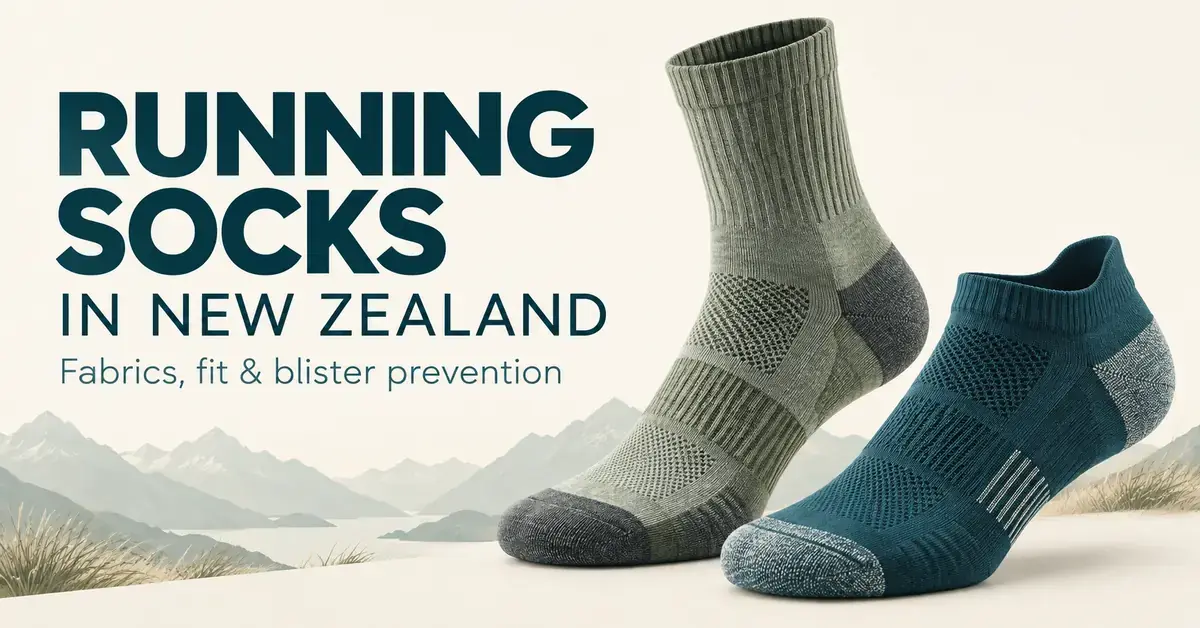
Running socks do more work than most runners give them credit for. Sitting directly between your skin and the inside of your shoe, they manage moisture, dampen friction and help regulate temperature over every kilometre — whether you are building road mileage for a spring marathon or picking your way along wet, rooty trails. Choosing the right pair is a smaller decision than choosing shoes, but it is often the difference between a comfortable long run and one cut short by blisters.
This guide explains how running socks actually work and how to choose them in New Zealand conditions: why fabric matters, how merino compares with synthetics, which cuff height and cushioning level suits which run, the construction features worth checking before you buy, and how to wash socks so they last. It is written for beginners as well as experienced runners, with every technical term explained on first use.
Key Points
- Skip cotton. It traps sweat against the skin, softening it and driving blisters; choose moisture-wicking fibres instead.
- Merino vs synthetic. Merino regulates temperature and resists odour; synthetics dry fastest and cost less; blends balance both.
- Fit beats features. Look for an anatomical left/right shape, a flat toe seam, an arch band and a shaped heel.
- Match cushion and height to the run. Thin and low for hot road racing; cushioned crew or quarter for trails and cold weather.
- Care extends life. Wash inside out on a cool, gentle cycle, skip fabric softener and air-dry out of direct sun.
Why cotton socks cause blisters on the run
The main reason to avoid everyday cotton socks for running is moisture. Cotton fibres are hydrophilic — they attract and hold water — so they soak up sweat and keep it against your skin instead of moving it away. A cotton sock behaves like a sponge: it becomes heavy, stays damp for a long time and turns coarse as it dries, exactly the conditions in which blisters form.
Blisters are caused by a combination of friction, heat, pressure and moisture. When sweat is trapped inside the shoe, the skin softens through a process called maceration (waterlogged skin that becomes fragile and tears easily). Soft, damp skin has a higher coefficient of friction than dry skin, so the repeated shearing forces of your foot moving inside the shoe peel the skin’s layers apart and a blister forms. Dry, low-friction skin slides more cleanly and blisters far less — which is why moisture-wicking fabrics matter.
Pairing technical running shoes with cheap multipack cotton socks undoes a lot of what the shoes are designed to do. The fix is simple: choose socks made from fibres that move sweat outward rather than store it.
How the main sock fabrics compare
The table below summarises how the common sock materials behave under the heat and sweat of a run. “Wicking” means pulling moisture away from the skin so it can evaporate through the shoe.
| Fabric | Moisture behaviour | Drying speed | Blister risk | Best suited to |
|---|---|---|---|---|
| 100% cotton | Absorbs and holds sweat against the skin | Slow | High | Casual wear only — not running |
| Merino wool | Absorbs moisture vapour, then releases it; feels dry longer | Moderate | Low | Trails, cold or variable weather, long and multi-day efforts |
| Synthetic (nylon, polyester, olefin) | Absorbs very little; wicks and repels moisture | Fast | Low to moderate | Hot-weather road runs, track work and racing |
| Merino / synthetic blend | Combines merino comfort with synthetic durability and quick drying | Fast to moderate | Low | Most runners as a versatile all-rounder |
Merino wool running socks explained
Merino wool is a popular choice for running socks because its fine fibres regulate temperature and manage moisture well without the itch of coarse traditional wool. New Zealand is a major merino producer, and the fibre’s structure gives it several properties that are hard to fully replicate in synthetics.
The key advantage is moisture handling. Merino can absorb roughly a third of its own weight in moisture as vapour before it feels wet, moving sweat away from the skin while it is still in its vapour state. The fibre is also naturally crimped (wavy), which traps small pockets of air — this is what lets it insulate on cold mornings yet breathe on warm afternoons.
What makes merino work
- Thermoregulation: merino works with your body heat, helping keep feet warmer in the cold and cooler in the heat across a wider temperature range than synthetics alone.
- Odour resistance: merino’s natural structure resists odour-causing bacteria, so many runners can wear a pair two or three times between washes without noticeable smell.
- Comfort when damp: unlike some synthetics that turn slick or abrasive when saturated after a stream crossing, merino keeps much of its soft feel and warmth when wet.
- Renewable fibre: wool is a natural, biodegradable material, which appeals to runners who want a lower-impact option.
The trade-offs are that pure merino socks generally cost more, dry a little slower than pure synthetics and wear out faster on their own — which is why most running-specific merino socks are actually blends with nylon and a little elastane for durability and stretch. For very long and technical ultramarathons, a cushioned merino-blend sock is a common default.
Sock height: no-show, quarter, crew and knee
Cuff height is mostly about protection and personal preference, not speed. The right height keeps debris out and stops the shoe collar rubbing your Achilles, without trapping unnecessary heat. Most brands offer four broad heights.
- No-show / tab: sits below the ankle bone, usually with a small knit tab at the heel that stops the sock sliding into the shoe and cushions the Achilles. Popular for road running and warm weather.
- Quarter / ankle: sits just above the ankle bone. A low-profile barrier against stones, grit and low trail brush — a good all-purpose height.
- Crew: sits mid-calf. Offers the most coverage against scratchy trailside vegetation and is currently the most common style for everyday running.
- Knee-high compression: extends to below the knee and applies graduated pressure (see below). Often used for recovery and longer road efforts rather than a specific height need.
A cuff that is too low can slip under the heel and bunch, while a thick crew sock can feel hot on a summer road run — so match the height to the run rather than owning one style for everything.
Cushioning: how much padding you need
Cushioning refers to the loops of thicker yarn knitted into the sole of the sock to absorb impact. More cushion means more shock absorption but a warmer, bulkier feel and a slightly looser shoe fit; less cushion means better ground feel, airflow and a snugger fit. Your choice should match your shoe volume, the surface you run on and the distance.
| Cushion level | Feel | Main benefit | Best suited to |
|---|---|---|---|
| No cushion / ultralight | Thin, single-layer knit | Maximum airflow and a responsive, close shoe fit | Track, hot-weather racing and tight-fitting racing shoes |
| Light / targeted | Thin overall with padding under the heel and forefoot | Impact protection at stress points without bulk | Everyday training, tempo runs and parkrun |
| Medium / trail | Cushioning across the whole footbed | Deeper shock absorption and a friction buffer | Trail runs and mountain ultras |
| Maximum | Thick, full-foot padding | Most protection for tired feet over long durations | Multi-day and self-supported efforts |
Fit and construction features to check before buying
A good running sock is shaped to the foot rather than a plain tube. When comparing pairs, look for the following construction features, which are the ones that most affect comfort and blister prevention over distance.
- Anatomical left/right fit: many performance socks are knitted specifically for the left and right foot (often marked L and R) so the fabric follows the sloping line of the toes instead of bunching at the corners.
- Seamless or linked toe: a flat, hand-linked toe seam removes the ridge of fabric that otherwise rubs the tops of the toes and nails.
- Arch band: a band of tighter, stretchy knit across the midfoot holds the sock in place so it cannot shift sideways as you run.
- Heel pocket: a shaped, cupped heel (sometimes called a Y-heel) keeps the sock seated and stops it slipping down at the back.
- Mesh venting: open-knit panels across the top of the foot let heat and moisture escape faster.
Fit should be snug but not tight: too loose and the fabric folds and rubs; too tight and it can restrict circulation. Try socks on with the shoes you actually run in, since sock thickness changes how a shoe fits.
Toe socks and compression socks: are they worth it?
Two specialist styles come up often, and both suit specific situations rather than every runner.
Toe socks (such as those made by Injinji) wrap each toe in its own sleeve of fabric. By putting material between the toes, they remove the skin-on-skin friction that causes blisters between the toes — a common problem on long descents and technical trails. The formal evidence base is limited, and studies suggest sock thickness matters as much as the toe design, but many runners who get recurring inter-toe blisters find them genuinely helpful. They take longer to put on and can feel unusual at first.
Compression socks apply graduated pressure — tightest at the ankle, easing towards the knee — to support blood flow back up the leg. The research on whether they improve performance during a run is mixed and mostly inconclusive. The stronger evidence is for recovery: wearing below-knee compression socks after a hard effort such as a marathon has been linked to reduced muscle soreness and better functional recovery in the days afterwards. If you want them mainly for the run itself, treat any performance gain as modest and personal.
How to wash and care for running socks
Technical socks are an investment, and how you wash them determines how long they keep their stretch, cushioning and wicking. Dried sweat leaves salt crystals in the fibres that grind them down over time, so a consistent post-run routine matters as much for socks as for the rest of your kit. New Zealand’s outdoor and sporting culture is broad — from running to codes covered on Wikipedia — but the care basics are the same for any performance sock.
- Skip fabric softener: it leaves a film that coats the fibres and reduces their ability to wick moisture. Use a mild liquid detergent instead.
- Turn them inside out: this lets the wash flush skin cells, grit and salt out of the interior loops where they collect.
- Wash cool and gentle: a cool, gentle cycle protects the elastane and the merino. Very hot water and harsh cycles shorten a sock’s life.
- Air-dry out of direct sun: line-dry rather than tumble-dry on high heat, which can melt the elastic fibres; strong direct sun can also weaken them over time.
Common mistakes runners make with socks
Most sock problems come from a handful of avoidable errors rather than the socks themselves.
- Running in cotton: the single most common cause of preventable blisters.
- Wearing socks that are the wrong size: too big and the fabric wrinkles and rubs; too small and the toe seam pulls across the toes.
- Racing in brand-new socks: test new socks on training runs first, exactly as you would new shoes, before a half marathon or longer event.
- Keeping worn-out pairs: once the cushioning has flattened and the arch band has gone loose, a sock no longer protects the foot.
- Ignoring damp: on long or wet runs, carrying a spare pair and changing socks can head off blisters before they start.
How to choose the right running socks for you
Start with where and how far you run. For hot road runs and racing, a lightweight synthetic or thin merino blend keeps feet cool and dry. For trails, cold mornings or long days out, a cushioned merino-blend crew or quarter sock adds warmth, protection and odour control. If you get blisters between the toes, try toe socks; if recovery is your priority, add a pair of compression socks for afterwards.
Two or three quality pairs in rotation will outlast and outperform a drawer of cheap cotton socks. Match them to the rest of your setup — well-fitted shoes and, on longer outings, a running hydration pack — and your feet will be one less thing to think about on the start line. The table below compares widely available options to help you narrow the choice; it is a starting point, not a ranking.
Running Sock Comparison
| Option | Type / fibre | Typical strength | Best for |
|---|---|---|---|
| Icebreaker | Merino blend (NZ brand) | Thermoregulation and odour resistance | Trails, cold and variable weather |
| Norsewear | NZ-made merino blend | Durable, traceable NZ wool | Everyday and cold-weather running |
| Darn Tough | Merino blend | Hard-wearing with a lifetime guarantee | High-mileage road and trail runners |
| Feetures | Synthetic, anatomical fit | Targeted cushioning and snug fit | Road running and racing |
| Injinji | Toe socks (synthetic or merino) | Reduces friction between the toes | Runners prone to inter-toe blisters |
| Wrightsock | Double-layer synthetic | Two layers shift friction off the skin | Blister-prone feet, long distances |
| CEP | Graduated compression | Calf and lower-leg support | Recovery and longer road efforts |
Whichever pair you land on, the priorities are the same: a non-cotton fabric that wicks moisture, a snug anatomical fit with a flat toe seam, and a cushioning level and cuff height matched to your run. Get those right and you can turn your attention to the training — including the many Christchurch running events and races around the country.
Sources
- Blister Prevention Pro — Sock fibres and moisture management
- Feetures — How to prevent blisters when running
- Injinji — The benefits of merino wool socks
- Injinji — How toe socks help prevent blisters
- Journal of Strength & Conditioning Research — Compression socks and functional recovery
- Norsewear — NZ-made merino wool socks
Frequently asked questions
What are the best running socks for preventing blisters?
The socks least likely to cause blisters are made from moisture-wicking fibres — synthetics such as nylon, polyester or olefin, or merino wool and merino blends — rather than cotton. Look for a flat, seamless toe, an anatomical left/right fit and a snug arch band so the fabric cannot shift against your skin. Correct sizing and keeping feet dry matter just as much as the brand.
Are merino wool running socks better than synthetic ones?
Neither is universally better; they suit different conditions. Merino regulates temperature across a wide range, resists odour and feels comfortable even when damp, which makes it ideal for trails, cold weather and long efforts. Synthetics dry faster, cost less and last longer, which suits hot-weather road running and racing. Merino/synthetic blends aim to combine the strengths of both and are a good all-round choice.
Can I wear cotton socks for a long run or race?
It is best avoided. Cotton absorbs sweat and holds it against the skin, which softens the skin and sharply raises the risk of blisters over distance. For anything beyond a short, easy jog, a moisture-wicking synthetic or merino sock is a much safer choice, and it is well worth switching before a long run or race.
What sock height should I choose for road versus trail?
For road running, no-show, tab or quarter heights are popular because they are cool and low-profile. For trails, a quarter or crew height gives better protection against stones, grit and scratchy vegetation. There is no performance penalty either way, so choose the height that keeps debris out and stops your shoe collar rubbing your Achilles.
Do compression socks actually help runners?
The evidence is mixed for performance during a run and stronger for recovery afterwards. Studies have linked wearing below-knee graduated compression socks after hard efforts, such as a marathon, to less muscle soreness and better functional recovery in the following days. If you try them for the run itself, treat any benefit as modest and individual rather than guaranteed.