The London Marathon is the most sought-after 42.195 km (26.2 mile) road race on earth: a flat, fast, crowd-lined loop from Blackheath to The Mall that doubles as the world’s biggest charity fundraiser. It is one of the seven Abbott World Marathon Majors, and demand is so intense that its public ballot has become the first in history to pass one million applications. This guide explains, in plain terms, how to get a place, what the course actually feels like, how to pace and fuel it, and how to handle race-day logistics in London — whether you are a New Zealander planning an overseas Major or a first-timer aiming simply to finish.
Quick Facts
| Event | TCS London Marathon |
|---|---|
| Distance | 42.195 km (26.2 miles) |
| Route | Blackheath / Greenwich Park to The Mall, central London |
| First held | 1981 (founded by Chris Brasher & John Disley) |
| Typical date | A Sunday in late April (2027: two days, Sat 24 & Sun 25 April) |
| Status | Abbott World Marathon Major (one of seven) |
| 2026 finishers | 59,830 — a Guinness World Record for the largest marathon |
| 2026 ballot entries | 1,133,813 — a world record; first marathon past one million |
| Men’s course record | Sabastian Sawe — 1:59:30 (2026), the first official sub-two-hour marathon |
| Women’s course record | Paula Radcliffe — 2:15:25 (2003) |
| Finish cut-off | Around 8 hours from the mass start |
| Official website | londonmarathonevents.co.uk |
What is the London Marathon?
The London Marathon is an annual mass-participation road marathon held in central London, founded in 1981 by former Olympic athletes Chris Brasher and John Disley after they were inspired by the New York City Marathon. It has grown from a few thousand runners into one of the seven Abbott World Marathon Majors, alongside Tokyo, Boston, Berlin, Chicago, New York City and — since 2025 — Sydney. Completing the six longest-standing Majors earns the coveted Six Star Medal.
Beyond the elite racing, the event is defined by charity. Runners have raised more than £1.3 billion for good causes since 1981, and around half of every year’s finishers run for a charity. The 2026 edition set a Guinness World Record with 59,830 finishers, making it the largest marathon ever staged. For a sense of how that distance is defined and measured, see our explainer on how long a marathon is.
How the mass race became a global event
The jump from a small field of enthusiasts to a start list of tens of thousands demanded huge logistical change: staggered start zones, wave starts, and a virtual option that lets people run the distance on their own route and still earn a medal. Today the race is broadcast to hundreds of countries and its start-line pens stretch across Greenwich Park and Blackheath.
When is the London Marathon?
The London Marathon is traditionally held on a Sunday in late April. The 2025 race (the 45th edition) was run on 27 April 2025, and the 2026 race on 26 April 2026. The 2027 event is a historic first: a two-day “double” held across Saturday 24 and Sunday 25 April 2027, with roughly 100,000 runners split over the two days — the organisers’ response to unprecedented demand.
If your calendar does not line up with an April trip to the UK, the same training will serve you at closer Southern Hemisphere Majors; our guide to the Sydney Marathon covers the newest addition to the Majors series.
How do you enter the London Marathon?
Getting a place is famously hard because the public ballot is heavily oversubscribed. The 2026 ballot received 1,133,813 entries — a world record and the first time any marathon passed one million applicants — and around 1.3 million people entered the 2027 draw. If the ballot does not come through, several guaranteed-entry routes exist, and most international runners use one of them.
- Public ballot: open to everyone worldwide; entry is by random draw with results emailed months ahead.
- Charity place: the most reliable route — you commit to a fundraising target (commonly £2,000 or more) in return for a guaranteed bib.
- Good for Age: a limited pool of places (around 6,000, first-come-first-served) for UK residents who have run a qualifying time within the set window.
- Championship entry: reserved for high-performing club athletes who meet the fast qualifying standards published by the organisers each year.
- International tour operator: official overseas partners bundle a guaranteed entry with travel and accommodation — usually the simplest path for New Zealand-based runners.
You can check the current ballot dates and terms on the official London Marathon ballot page.
What does a charity place involve?
A charity place is a commitment, not a shortcut. You agree to raise a set minimum — often £2,000 or more — and most charities in return give you a training plan, a fundraising mentor and a dedicated cheer point on the course. Start fundraising the moment you accept the place; leaving it late is the most common source of race-week stress.
What is the London Marathon course like?
The course is a point-to-point route celebrated as “flat and fast,” which is why it produces world records. It starts in Greenwich Park and Blackheath across three colour-coded start lines (Red, Green and Blue) that merge by around the three-mile mark. From there runners head east through Woolwich before turning back west past the historic Cutty Sark sailing ship at roughly mile 6. The middle third winds through Rotherhithe and Bermondsey to Tower Bridge, then loops out through the Isle of Dogs and Canary Wharf before rejoining the river.
The finish is one of sport’s great sights: along the Embankment, past the Houses of Parliament and Big Ben, along Birdcage Walk and a sharp final turn onto The Mall in front of Buckingham Palace. The narrow streets around Greenwich and the wind exposure along the Thames are the two features that most affect pacing.
Crossing Tower Bridge
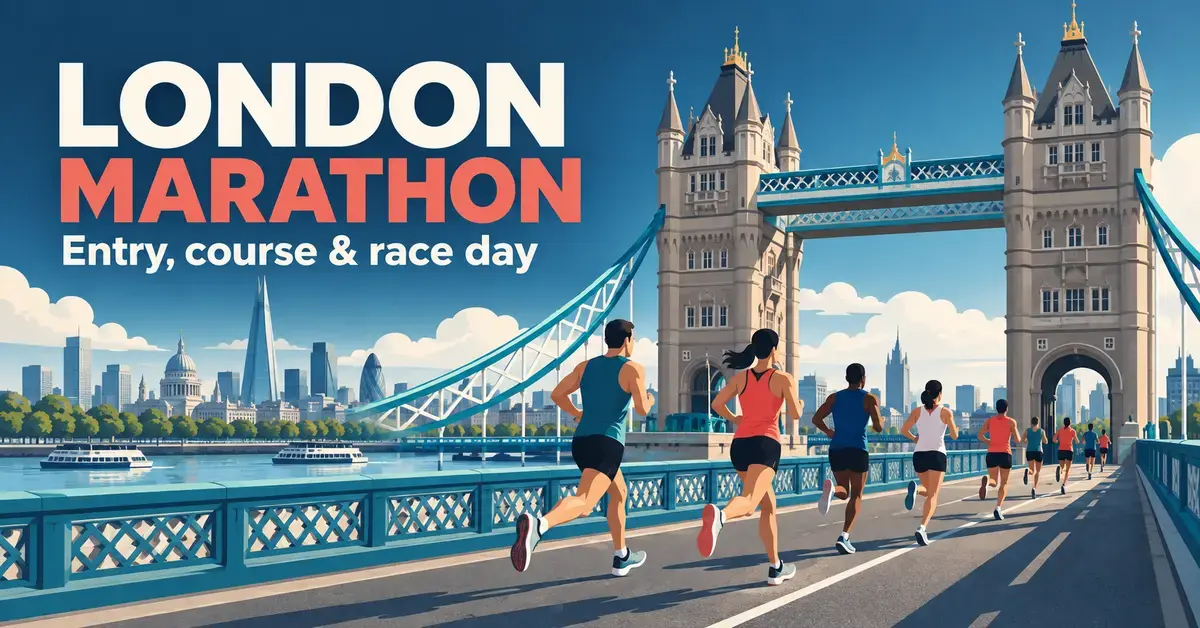
Tower Bridge, at roughly the halfway point, is regularly named the most emotional moment of the race. The wall of crowd noise gives a genuine adrenaline lift — the trap is to speed up here and pay for it later in the quieter miles through Docklands.
The Isle of Dogs and Canary Wharf
Between about miles 14 and 21 the route twists through Canary Wharf. The tall towers can disrupt GPS watches, so run these miles on perceived effort rather than trusting an erratic pace reading, and expect several sharp turns that break your rhythm.
Is the London Marathon course flat?
The London Marathon is largely flat but not completely level, and understanding its small changes is key to pacing it well. The biggest feature is a net downhill over the first three miles as the route drops from the Blackheath plateau toward the river. Banking time on that descent is the classic London mistake — it feels free but shreds your quads for the second half. The middle miles around Canary Wharf add a few short “lumps and bumps” and tight corners. The smart approach is to run a steady effort rather than a rigidly steady pace. For a sense of how other classic city marathons handle their own undulations, this overview of the Stockholm Marathon on Wikipedia is a useful comparison.
How should you train for London?
Train for tarmac and for changeable weather. Late-April conditions in London swing from cold drizzle to unseasonable sun, so rehearse running in layers you can shed at the start. Because the course is almost entirely on hard road, your build-up must be road-heavy to condition your joints and muscles for the repetitive impact of 42.195 km.
- Surface: prioritise road running over soft trail so your legs are ready for pavement.
- Progressive long runs: finish your last few miles at goal-marathon effort to prepare for the Embankment run-in.
- Strength work: even on a flat course, strength training delays late-race fatigue.
- Taper: cut volume noticeably in the final two to three weeks so you reach the start line fresh.
New runners should build a base first; a structured plan and a pace target help enormously. See our marathon pace chart to set realistic splits, and if you are training at home, our guide to running in Wellington is a useful starting point for routes and clubs.
What should you eat and drink during the race?
London offers a world-class fuelling setup, with frequent water stations and an official on-course sports drink, plus energy gels at set points. The golden rule is to practise with the exact products offered on the day so nothing surprises your stomach. Take on carbohydrate early and regularly — roughly 30–60 g per hour — rather than waiting until you feel empty, and drink “little and often” instead of gulping large volumes that cause bloating.
How do you avoid hitting the wall?
“The wall” — the sudden collapse in pace usually felt around mile 20 — is primarily caused by depleted glycogen. The only reliable defence is early, consistent fuelling from the first few miles, long before you feel the need. Combine that with conservative early pacing and the late miles become manageable.
What gear do you need for London?
The hard London pavements reward well-cushioned shoes; many runners now choose carbon-plated “super shoes” for their energy return and muscle protection over the distance. Whatever you wear, obey the “nothing new on race day” rule — every item should be tested on long runs first.
- Shoes: carbon-plated or high-cushion road shoes broken in during training — see our running shoes guide.
- Apparel: lightweight, breathable singlet and shorts, plus anti-chafe balm for thighs and underarms.
- Accessories: a GPS watch and a comfortable gel belt or pockets.
- Socks: quality moisture-wicking, blister-prevention socks are worth the money.
- Start-line layer: old, warm clothes you can donate at the start pens.
Race-day logistics: the Expo, transport and cut-off
Your race begins days early at the TCS London Marathon Running Show (the Expo) at ExCeL London, where every participant must collect their race pack and bib in person — there is no race-day pickup, so build the visit into your travel plans and go early in the week to skip the worst queues. On race morning, runners with a valid bib travel free on Transport for London services (Underground, Overground, DLR and buses), which is essential given the road closures.
Aim to reach your colour-coded start zone at least an hour before your wave to clear security and bag drop. The official cut-off is around eight hours from the mass start; after that, roads reopen progressively and slower participants may be asked to continue on the pavement.
Where can spectators watch?
Spectating London is its own logistical puzzle, so pick one or two spots rather than chasing your runner around the city. Greenwich (mile 6) is vibrant but very crowded; Tower Bridge (mile 12) is the iconic photo but demands arriving hours early; the Isle of Dogs and Embankment stretches often give a better, less-packed view and a chance to see runners twice.
Meeting your runner after the finish
The finish area on The Mall is tightly controlled. Use the alphabetical meeting points near Horse Guards Parade to reunite once your runner has collected their medal, and agree a plan in advance because mobile networks are often overloaded.
Common mistakes to avoid
Most London disappointments come from a short list of avoidable errors rather than fitness:
- Banking time on the downhill start: the first three miles feel easy and tempt you into a pace you cannot hold.
- Sprinting past the Cutty Sark and Tower Bridge: the crowd energy spikes your effort exactly where restraint matters most.
- Under-fuelling early: waiting until you feel tired to take a gel is already too late.
- Trying something new on the day: untested shoes, kit or gels are the usual cause of blisters and stomach trouble.
- Leaving the Expo to the last day: Saturday queues are long and eat into rest; collect your bib midweek if you can.
- Ignoring the weather forecast: a warm London day changes hydration needs and goal pace.
How does London compare to the other Majors?
London sits among the fastest and most spectator-friendly of the Abbott World Marathon Majors. Berlin is generally regarded as the flattest and quickest, Boston is the only one requiring a qualifying time for standard entry, and New York City is famously large and hilly. The comparison below shows where London fits; you can read our recap of past finishing times and elite results on the London Marathon results page.
Marathon Majors Comparison
| Major | City | Typical month | Known for |
|---|---|---|---|
| London | London, UK | April | Flat, fast; record-breaking ballot demand |
| Chicago | Chicago, USA | October | Flat, record-friendly course |
| Berlin | Berlin, Germany | September | Widely seen as the fastest course |
| Boston | Boston, USA | April | Requires a qualifying time; hilly finish |
| New York City | New York, USA | November | Very large field; five-borough, hilly route |
| Tokyo | Tokyo, Japan | March | Fast, highly organised city course |
| Sydney | Sydney, Australia | August/September | Newest Major (joined 2025); harbour scenery |
Wherever it ranks, London’s combination of a fast course, world-class organisation and relentless crowd support makes it one of the most rewarding marathons to finish — the closing turn onto The Mall places you inside more than four decades of the sport’s history.
Sources
Frequently Asked Questions (FAQ)
When is the next London Marathon?
The London Marathon is normally held on a Sunday in late April. The 2027 event is a historic two-day “double,” run across Saturday 24 and Sunday 25 April 2027, with around 100,000 runners split over the two days.
How hard is it to get a London Marathon ballot place?
Very hard. The 2026 ballot drew a world-record 1,133,813 entries and the 2027 draw around 1.3 million, so the odds of a ballot place are low. Many runners instead take a guaranteed place through a charity, a Good for Age time, a Championship standard or an official tour operator.
How long do you have to finish the London Marathon?
The official cut-off is around eight hours from the mass start. After that the roads reopen in stages and any remaining participants may be directed onto the pavement to complete the distance.
Is the London Marathon course flat?
It is largely flat and one of the world’s fastest courses. There is a net downhill over the first three miles and a few short undulations and tight turns around Canary Wharf, but no significant climbs, which is why it regularly produces world records.
Do runners get free transport on race day?
Yes. Runners displaying a valid race bib travel free on Transport for London services on race day, including the Underground, Overground, DLR and buses, which is the practical way to reach the start given the widespread road closures.