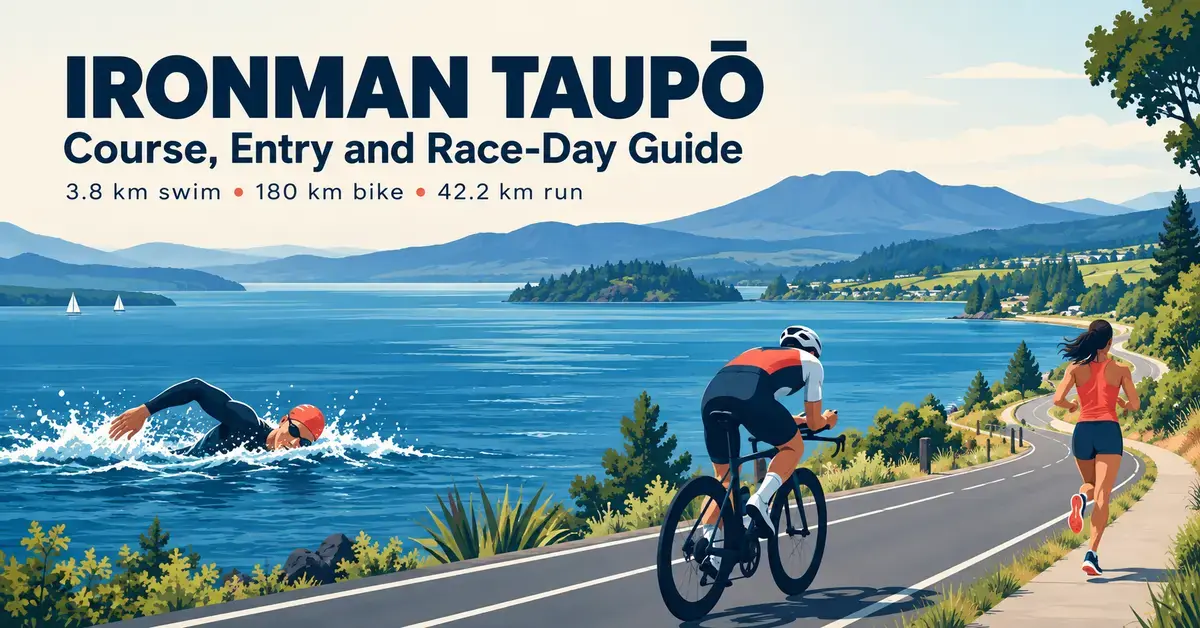
Ironman New Zealand is the full-distance triathlon staged each March on the shores of Lake Taupō, in the centre of the North Island. In a single day athletes complete a 3.8-kilometre freshwater swim, a 180-kilometre two-lap bike ride through the rural Waikato, and a 42.2-kilometre marathon along the lakefront. Known locally as “Ironman Taupō”, it is one of the longest-running races on the global Ironman circuit and a fixture on the New Zealand endurance calendar. This guide explains what the event is, how each leg works, what the course demands, and the practical detail of entering, qualifying, pacing, fuelling and recovering — written for first-time age-groupers and returning athletes alike.
A race with deep roots in New Zealand triathlon
Ironman New Zealand is one of the oldest Ironman-branded races in the world, and that heritage is central to its identity. The first edition was held in 1985 at Mission Bay in Auckland, only a few years after the very first Ironman in Hawaii. In 1999 the race moved to Taupō, where a clear freshwater lake, quiet rural roads and a compact lakeside town proved an almost perfect fit. It has been raced there ever since, which makes it the second-longest-running full-distance Ironman event anywhere. You can read more about the origins of the format on Wikipedia, or explore the wider history of the Ironman distance in a dedicated guide.
From Mission Bay to the shores of Lake Taupō
Moving the race to Taupō in 1999 turned a city event into a destination race. Lake Taupō is the largest lake in Australasia, covering roughly 616 square kilometres inside the caldera of an ancient volcano, and its water is clean enough to drink. The town wraps around the northern edge of the lake, so the swim, transition and finish all sit within a short walk of each other at the Tongariro Domain precinct — a rare piece of simplicity in long-course racing.
Where the race sits on the calendar
Ironman New Zealand traditionally opens the international Ironman season in early autumn. The 2027 edition is scheduled for Saturday 6 March 2027, and the half-distance Ironman 70.3 New Zealand is now staged on the same Taupō weekend rather than as a separate December fixture. The full race is also a season opener for the professional Ironman Pro Series, so the elite field is often unusually deep for a race this early in the year. If you are planning a season around it, the wider New Zealand running calendar shows how it fits alongside the country’s marathons and trail events.
Quick Facts
| Event | Ironman New Zealand (Ironman Taupō) |
|---|---|
| Discipline | Full-distance triathlon |
| Location | Taupō, Waikato, North Island, New Zealand |
| Start & finish | Tongariro Domain lakefront precinct |
| Distances | 3.8 km swim, 180 km bike, 42.2 km run (~226 km) |
| Founded | 1985 in Auckland; moved to Taupō in 1999 |
| 2027 date | Saturday 6 March 2027 |
| Time limit | 17 hours |
| Half-distance option | Ironman 70.3 New Zealand, same March weekend |
The three legs at a glance
Ironman Taupō follows the standard full-distance format: a 3.8 km swim, a 180 km bike and a 42.2 km run, totalling roughly 226 km. Everything is completed in one day under a 17-hour time limit, with age-group athletes starting in the morning and the final finishers welcomed home late into the night. Because the town is compact, the race precinct at the Tongariro Domain hosts the swim start, both transitions and the finish line, which keeps race-morning logistics unusually calm compared with big-city Ironman events. The event is a good stepping stone up from other multisport and running challenges, and shares much of its training base with the broader world of triathlon.
Key Points
- Second-longest-running Ironman: raced continuously in Taupō since 1999, after starting in Auckland in 1985.
- Freshwater swim: a single 3.8 km loop in clear Lake Taupō, usually 18–21°C and wetsuit-legal.
- Two-lap bike on chip-seal: rolling 180 km with roughly 1,100–1,300 m of climbing and coarse road surfaces.
- Multi-lap lakefront marathon: 42.2 km through the town centre with strong crowd support.
- A World Championship qualifier: age-group slots set by field size each year; the 2026 pro race offered four per gender.
- Compact host town: swim, transitions and finish all cluster at the Tongariro Domain.
The Lake Taupō freshwater swim
The 3.8 km swim takes place in fresh, clear water rather than the sea, which changes how it feels. There is no salt to add buoyancy, so athletes rely on their wetsuit and a strong body position to sit high in the water. The upside is visibility: on a calm morning you can often see well below the surface, which removes much of the anxiety that comes with murky open-water starts. The course is a single large loop that heads out from the lakefront before turning back for a long stretch parallel to the shore.
Water temperature and wetsuit rules
Lake Taupō typically sits between about 18°C and 21°C in early March, which is comfortably within the wetsuit-legal range for age-group athletes. Most competitors choose a full-sleeved wetsuit for both warmth and buoyancy in the fresh water, though sleeveless suits are permitted. Whatever you wear, rehearse getting it off quickly — fumbling in transition after 3.8 km of swimming is a common time-waster.
Sighting in clear water
Clear water does not remove every navigation problem. On the return leg the low morning sun can throw heavy glare across the surface, so tinted or polarised goggles help you pick out the turn buoys and the exit markers. Many swimmers use the silhouette of nearby Mount Tauhara as a fixed reference point rather than lifting their head to hunt for small buoys on every stroke.
The bike leg and New Zealand’s chip-seal roads
The 180 km bike course is a two-lap route that heads out from Taupō into the rural Waikato before returning to town. It is best described as rolling rather than mountainous: there are no long alpine climbs, but the constant undulations mean there is very little genuine flat where you can rest. The defining feature is the road surface. Much of New Zealand’s rural network is finished in “chip-seal” — a coarse layer of stone chips rolled into bitumen. It is durable and cheap to maintain, but it vibrates and grips far more than the smooth tarmac many overseas athletes are used to, so the roads feel “heavy” and can quietly drain the legs.
Elevation and how to pace it
Total climbing over the two laps is moderate but relentless, with published course data putting it at roughly 1,100 to 1,300 metres depending on the exact route used in a given year. Because there is so little flat, it is easy to over-ride the first lap and pay for it badly on the second, especially if an afternoon headwind builds on the return into town. Riding to a steady power or perceived effort, rather than chasing speed on the short punchy rises, is the single most reliable way to protect the marathon that follows.
Tyres and equipment for rough tarmac
To take the sting out of the chip-seal, many athletes fit slightly wider 25 mm or 28 mm tyres and run marginally lower pressures than they would on smooth roads. This adds compliance, cuts the buzz coming up through the frame, and reduces the low-back and quad fatigue that the surface tends to cause. It is a small change that pays off over six or more hours of riding.
The lakefront marathon
The 42.2 km run is a multi-lap course that hugs the lakefront and repeatedly passes through the town centre, so athletes are never far from the crowds. The terrain mixes sealed paths and road with a few short, sharp rises near the harbour and the transition area. The multi-lap format is as much a mental test as a physical one: passing the finish area several times before you are allowed to turn in takes discipline. Because cumulative fatigue from the swim and bike is already high, and New Zealand’s UV is intense even on mild days, the smart move is to start conservatively for the first 10–14 km. The full marathon distance at the end of a long day is where most races are won or lost.
Making the aid stations work
Aid stations sit roughly every 2 km along the run, which makes them useful markers for breaking the distance into manageable blocks. Many finishers deliberately walk through each station to be sure they actually swallow fluid and electrolytes rather than wearing them, then settle straight back into a running rhythm. Treating the stations as planned checkpoints, not emergencies, is a proven way to hold pace late in the race.
Fuelling: nutrition and hydration
Fuelling Ironman Taupō is a balancing act between calories and electrolytes. The Central North Island air can be dry, so athletes lose more fluid through breathing than they realise even when they do not feel especially sweaty. A common target on the bike is 60–90 grams of carbohydrate per hour, shifting toward more easily digested gels and liquids on the run. The event provides water and an electrolyte drink at aid stations; whatever brand is on course, practise with the same style of product in training so nothing surprises your stomach on race day. Adequate sodium matters in fresh water too, where over-drinking plain water can dilute the blood and cause problems.
Training your gut before race day
The stomach is trainable. In the final couple of months of build, dedicating at least one long ride a fortnight to consuming your full race-day fuelling plan teaches the gut to absorb calories under stress. Athletes who skip this step and try to eat aggressively for the first time on race morning are the ones most likely to end up walking with stomach distress.
Choosing gear for Central North Island conditions
Taupō weather in early March swings widely, from a cool start around 10°C to a warm, high-UV afternoon that can reach the mid-20s°C. Gear needs to cover that range. A sleeved tri-suit with sun protection has become the standard to guard against sunburn over a long bike leg, cushioned road shoes handle the hard lakefront surfaces on the run, and generous anti-chafe balm on the neck and inner thighs prevents wetsuit and seam rub. Polarised sunglasses cut the glare coming off the lake and the pale road markings. Choosing the right running shoes for the marathon leg is worth as much thought as your bike setup.
Entry, pricing and qualifying
Entries for Ironman Taupō tend to open shortly after each year’s race and are sold in tiers, so the earliest buyers pay the least and prices step up as the field fills and the date approaches. Relay teams and a half-distance pathway through Ironman 70.3 New Zealand give newcomers a lower-commitment way in. Enter through the event’s official registration platform, keep your medical details and emergency contacts current well before race week, and check the current deferral and transfer rules if your plans might change.
How World Championship slots work
Ironman New Zealand is a designated qualifier for the Ironman World Championship. Under Ironman’s current system, the number of age-group qualifying slots is set by the size and make-up of the field each year and is confirmed at the pre-race athlete briefing, rather than being a fixed figure — so treat any specific slot count as provisional until it is announced. For context, the 2026 professional race offered four World Championship qualifying slots per gender. If your goal is simply to qualify, the age-group allocation and how it is split across categories is the number to confirm on site.
Race week: transition and logistics
Taupō’s small size makes Ironman week refreshingly simple. Registration, the expo and transition all cluster around the Tongariro Domain within walking distance of the town centre. Athletes rack their bikes and drop colour-coded transition bags the day before the race, then get a short window on race morning for final checks. Staying within walking distance of the domain removes the stress of road closures and race-morning parking, and is the single easiest way to sleep better the night before.
Recovery after you cross the line
The 48 hours after the finish do most of the repair work. Taupō is a geothermal district, and many athletes soak tired legs at local hot pools such as the AC Baths or DeBretts. Gentle active recovery — an easy walk along the lakefront or a light swim — tends to ease stiffness better than lying still all day. Because long-haul flights carry a raised clotting risk after extreme exertion, it is sensible to avoid flying long distances for a couple of days and to keep moving, hydrating and refuelling in the meantime. For a different kind of Taupō challenge once you have recovered, the region also hosts a well-known Taupō ultramarathon.
Common mistakes at Ironman Taupō
Most disappointing days at Taupō come down to a handful of avoidable errors rather than a lack of fitness.
- Over-riding the first bike lap. The rolling course and chip-seal make it easy to burn matches early, leaving nothing for the marathon.
- Under-fuelling on the bike. Waiting until you feel hungry or flat is already too late; fuel to a schedule from the start.
- Ignoring the sun. New Zealand’s UV is severe; skipping sunscreen and sun-protective clothing costs athletes late in the day.
- Running the wrong tyres and pressures. Racing narrow, rock-hard tyres on chip-seal adds fatigue for no aerodynamic gain.
- Treating clear water as easy. Glare, buoyancy and the single long loop still demand practised sighting and pacing.
Who Ironman Taupō suits
Ironman Taupō rewards patient, well-prepared endurance athletes rather than pure speed. It suits first-time long-course racers who want a friendly, walkable host town and a supportive crowd, age-groupers chasing a World Championship slot at a respected qualifier, and experienced athletes who enjoy a rolling, honest course early in the season. It is less forgiving for anyone who has not rehearsed nutrition, practised open-water swimming, or trained on rougher road surfaces. If a full distance feels like too much for now, the half-distance Ironman 70.3 on the same weekend is a sensible first step.
Sources
- IRONMAN — Official Ironman New Zealand event page
- Running Calendar NZ — Ironman New Zealand 2027 date and details
- Slowtwitch — What you need to know about the 2026 Ironman New Zealand
- Endurance Sportswire — 2026 Ironman Pro Series season opener in Taupō
- NIWA — Lake Taupō facts and size
- Love Taupō — Lake Taupō visitor information
Frequently asked questions (FAQ)
When is Ironman New Zealand held?
Ironman New Zealand is raced in Taupō in early autumn each year. The 2027 edition is scheduled for Saturday 6 March 2027, and it usually opens the international full-distance Ironman season.
How cold is the Lake Taupō swim?
The lake typically sits between about 18°C and 21°C in March, which is wetsuit-legal for age-group athletes. Most swimmers choose a full-sleeved wetsuit for warmth and buoyancy in the fresh water.
What is “chip-seal” and why does it matter?
Chip-seal is a coarse road surface made of stone chips rolled into bitumen, common on New Zealand’s rural roads. It vibrates and grips more than smooth tarmac, so riders often fit slightly wider tyres at lower pressure to reduce fatigue.
Is there a half-distance race in Taupō?
Yes. Ironman 70.3 New Zealand covers a 1.9 km swim, 90 km bike and 21.1 km run, and is now staged on the same Taupō weekend as the full race rather than as a separate December event.
How many World Championship slots does the race offer?
The number of age-group qualifying slots is set by the field size each year and confirmed at the athlete briefing, so it is not a fixed figure. The 2026 professional race offered four qualifying slots per gender.