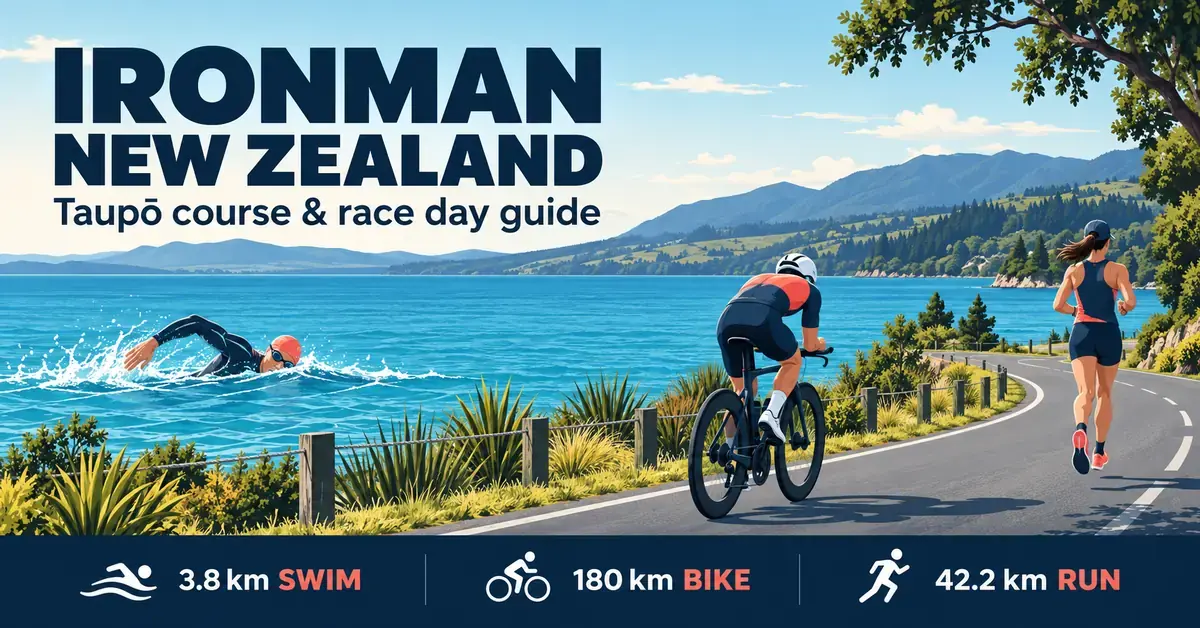
IRONMAN New Zealand is the full-distance triathlon held every March in Taupō, in the centre of the North Island, and it is one of the oldest races of its kind anywhere in the world. Over a single day, athletes complete a 3.8 km swim in Lake Taupō, a 180 km bike ride through the surrounding Waikato countryside and a 42.2 km run along the lakefront — a total of 226 km. This guide explains the event’s history, when and where it is held, how to enter, what each leg of the course is like, how hard the terrain really is, and how to prepare for New Zealand’s unique conditions. It is written for first-time age-group athletes and curious spectators as much as for seasoned competitors.
Quick Facts
| Event | IRONMAN New Zealand (full distance) |
|---|---|
| Location | Taupō, central North Island |
| Race base | Tongariro North Domain, on the lakefront |
| Distances | 3.8 km swim, 180 km bike, 42.2 km run (226 km total) |
| Also on the day | IRONMAN 70.3 New Zealand (1.9 / 90 / 21.1 km) |
| First held | 1985 in Auckland; in Taupō since 1999 |
| 2026 edition | 7 March 2026 — IRONMAN Pro Series opener |
| 2027 edition | 6 March 2027 |
| Swim venue | Lake Taupō (freshwater) |
| World Championship | Kona-qualifying race |
| Volunteers | Around 1,800 |
| Cut-off | 17 hours from the swim start |
What is IRONMAN New Zealand?
IRONMAN New Zealand is a long-distance triathlon and a Kona qualifier — a race that awards qualifying slots for the IRONMAN World Championship. “Full-distance” or “IRONMAN” means the classic 3.8 km / 180 km / 42.2 km format that a competitor must finish inside a 17-hour cut-off, from the mass swim start in the morning to the final “midnight” finishers. It is the second-oldest IRONMAN race in the world and the longest-running outside the original World Championship in Kona, Hawaiʻi.
The event began in 1985 in Auckland, based around Mission Bay, and moved to Taupō in 1999 as the field outgrew its city home and needed a larger natural arena. Taupō — a lakeside town built beside New Zealand’s biggest lake — has hosted it ever since and treats the race as a local institution. Around 2,000 athletes and roughly 1,800 volunteers turn the town into a temporary endurance-sport capital for the weekend. IRONMAN sits within the wider family of endurance and multisport events, a lineage that also includes disciplines such as adventure racing covered on Wikipedia, and the New Zealand race has long been part of that tradition.
In 2026 the race took on a new role as the opening event of the IRONMAN Pro Series, the season-long professional points competition. That edition, held on 7 March 2026, was also the first run under the sport’s new 20-metre draft zone for professionals, and it produced a women’s course record of 8:28:55 by Britain’s Kat Matthews, with American Trevor Foley taking the men’s title. If you want a shorter overview of the same race, the site’s IRONMAN Taupō page is a good companion to this in-depth guide.
When and where does IRONMAN New Zealand take place?
IRONMAN New Zealand is held in early March each year in Taupō, with the race base at Tongariro North Domain on the lakefront. The 2026 edition took place on Saturday 7 March 2026, and the 2027 edition is scheduled for Saturday 6 March 2027 at the same venue. Autumn timing means generally settled, dry weather, cool mornings and long daylight hours — useful for a race that can run past midnight for the slowest finishers.
One of the event’s practical strengths is its compact, single-transition layout. Both T1 (swim-to-bike) and T2 (bike-to-run) sit in the same area at the Domain, so athletes, gear and spectators are concentrated in one walkable hub rather than spread across the region. The swim starts and finishes on the town waterfront, the bike heads out into the countryside and returns, and the marathon loops the lakefront — all radiating from the same central point. For anyone planning a season around it, the event slots neatly into the wider New Zealand running and endurance calendar.
How do you enter IRONMAN New Zealand?
Entry to IRONMAN New Zealand is online through the official IRONMAN website, and the race commonly sells out well before race day, so early commitment matters. Entries open roughly a year ahead and are priced in tiers: the earliest “early bird” places are the best value, prices step up as the field fills, and late places — if any remain — are the most expensive. Charity entries and, in some years, foundation or travel-partner packages that bundle a race place with Taupō accommodation are also available.
Crucially, the IRONMAN 70.3 New Zealand (the half-distance race: 1.9 km swim, 90 km bike, 21.1 km run) is staged on the same day and out of the same venue. Athletes who are not ready for the full 226 km often enter the 70.3 first, then step up in a later year. The tiers below are a general guide to how entry timing tends to work rather than fixed dates or prices, which the organiser confirms each season.
| Entry tier | Typical window | What to expect |
|---|---|---|
| Early bird | Around race day, a year ahead | Lowest price, best availability |
| Standard | Mid-year | Full price, moderate availability |
| Late / final | Weeks before the race | Premium price, limited or sold out |
| Charity place | Varies | Fundraising commitment, often includes support |
The first-timer pathway
A large share of the age-group field each year is racing its first-ever IRONMAN. The event runs dedicated first-timer briefings and athlete guides that walk newcomers through transition-bag colour coding, the rolling swim start and pacing for a day that can last 12 hours or more. If you are still building toward this distance, the site’s triathlon section explains the sport’s basics before you commit.
What is the Lake Taupō swim like?
The 3.8 km swim takes place in Lake Taupō, a clear freshwater lake and the largest in New Zealand. The water is often clean enough to see the lake floor, which makes it one of the more scenic swims on the IRONMAN circuit. Because the lake is so large, the surface can turn choppy if the wind rises, but on a calm morning it is fast and calm. The start is organised as a rolling age-group start behind the professional field to reduce congestion.
- Water: clear freshwater, typically around 18–22°C, usually wetsuit-legal for age-groupers.
- Course: a single large loop starting and finishing on the town waterfront.
- Sighting: the surrounding hills and shoreline landmarks make it easier to swim straight over the long return leg.
Adjusting to freshwater buoyancy
Freshwater is slightly less buoyant than the sea, so swimmers who train mostly in the ocean sit marginally lower in the water at Taupō. The practical fix is a well-fitted, full-sleeve wetsuit, which restores buoyancy and keeps you streamlined across the full 3.8 km. It is worth doing at least one open-water session in a wetsuit before race day rather than discovering the difference on the start line.
How difficult is the 180 km bike course?
The 180 km bike leg is a two-lap ride into the rural Waikato that is best described as “rolling” rather than mountainous: constant short undulations instead of long sustained climbs. There is rarely a stretch flat enough to fully rest, so the challenge is rhythm and gear management over six or more hours rather than a single big ascent. From 2026 the professional race has been run under a 20-metre draft zone, reinforcing IRONMAN’s status as an individual time-trial-style effort.
| Course feature | Terrain | Key challenge |
|---|---|---|
| Rural highway sections | Rolling | Exposure to crosswinds |
| Flatter farmland loops | Mostly flat | Holding an aero position |
| Approaches to town | Undulating | Technical turns near transition |
| Whole leg | ~1,200–1,300 m gain | Frequent gear changes |
Managing the chip-seal road surface
New Zealand’s rural roads are largely surfaced with “chip-seal” — a layer of stone chips bonded with bitumen — rather than smooth asphalt. It is durable and grippy but noticeably coarse, so it transmits more vibration and can feel “heavy” under the wheels. Many athletes fit slightly wider tyres (25–28 mm) with a puncture-protection layer and run marginally lower pressures to soak up the buzz and protect their legs for the run. Tracking your ride with a GPS sports watch or bike computer helps you hold steady power rather than surging over every rise.
What is the lakefront marathon like?
The closing 42.2 km run is a multi-lap marathon that hugs the shoreline of Lake Taupō, and its defining feature is the crowd. The looped course runs through the town centre and back along the lake, so it is lined with families, street parties and volunteers, and athletes pass the finish area several times before they are allowed to turn in. That repetition is a mental test as much as a physical one. The terrain is mostly flat with a few short, punchy rises that feel far bigger after 180 km of cycling.
- Format: several laps of a lakefront loop, exact number set by the year’s layout.
- Aid stations: regularly spaced, offering water, electrolyte drink and race nutrition.
- Support: dense spectator crowds through the town centre and along the waterfront.
- Finish: the IRONMAN red carpet at Tongariro North Domain and the traditional “You are an IRONMAN” call.
Success here comes down to discipline: start the run conservatively, hold your nutrition plan, and keep something in reserve for the final few kilometres to the red carpet. For context on the distance itself, see the explainer on how long a marathon is.
How much climbing is there?
IRONMAN New Zealand is not a mountain course, but the cumulative climbing is real. The bike leg totals roughly 1,200–1,300 m of ascent spread across countless small rises, while the run adds only a few hundred metres. The figures below are approximate and vary slightly with the exact course used each year, but they show why the day rewards steady effort over hard surges.
| Leg | Distance | Approx. total ascent |
|---|---|---|
| Swim | 3.8 km | — |
| Bike | 180 km | ~1,200–1,300 m |
| Run | 42.2 km | ~200–300 m |
Why rolling hills are deceptively hard
On a long, steady climb you settle into one gear and one effort. On Taupō’s rolling terrain you never get that luxury: the road keeps tipping up and down, tempting you to push over each small rise. Athletes who “mash” big gears on the bumps often arrive at the marathon with empty legs. Smooth, patient gear changes and an even power output are what carry through to a strong run.
How IRONMAN New Zealand Compares
| Full-distance race | Location | Month | Swim water | Character |
|---|---|---|---|---|
| IRONMAN New Zealand | Taupō, NZ | March | Freshwater lake | Rolling bike, chip-seal roads, freshwater swim, huge crowds |
| IRONMAN World Championship | Kona, Hawaiʻi (and Nice) | Sept–Oct | Ocean | Championship field, heat, wind and lava fields |
| IRONMAN Australia | Cairns, Australia | June | Ocean | Warm, scenic coastal ride to Port Douglas |
| IRONMAN Western Australia | Busselton, Australia | December | Ocean | Very flat and fast, iconic long jetty swim |
| IRONMAN Wales | Tenby, Wales | September | Sea | Cold, hilly and technical, famously tough |
| IRONMAN Austria | Klagenfurt, Austria | Summer | Freshwater lake | Clear lake swim, fast, another freshwater option |
Nutrition, hydration and the New Zealand sun
Fuelling correctly is as decisive as fitness at IRONMAN New Zealand, and the local climate makes it trickier than the mild March temperatures suggest. Taupō days are often dry with moderate heat, but New Zealand’s ultraviolet levels are among the highest in the world, so athletes lose fluid and salt steadily without feeling especially hot. A typical plan targets 60–90 g of carbohydrate per hour on the bike, shifting toward gels and liquids on the run.
- Sodium: deliberate electrolyte intake helps stave off cramp late in the marathon.
- Sun protection: high-SPF, water-resistant sunscreen and covered shoulders are essential.
- Fuel mix: liquid calories on the bike, easily digestible gels and drink on the run.
- Timing: know the gap between aid stations so you never run dry between them.
Avoiding hyponatremia in dry air
Because the air is dry, sweat evaporates fast and athletes underestimate how much salt they are losing. Drinking only plain water over a long day can dilute blood sodium — a dangerous condition called hyponatremia. Salt tablets or a proper electrolyte drink, rather than water alone, are standard practice for experienced Taupō finishers.
How should you train and what gear do you need?
Preparing for IRONMAN New Zealand realistically takes six to nine months of structured training, depending on your starting fitness. Athletes coming from a Northern Hemisphere winter also need to plan for heat and sun exposure they will not have trained in. The course rewards durability more than raw speed, so the priorities are long aerobic sessions, race-specific practice and enough strength work to hold an aero position for hours.
- Long rides: 5–6 hour sessions, ideally on coarse or rolling roads to mimic the surface.
- Brick runs: short runs straight off the bike to adapt to heavy-legged transitions.
- Open-water swims: practise sighting across long, featureless stretches.
- Strength work: core and posterior-chain stability to absorb road vibration.
Gear should be chosen for comfort and reliability over a very long day rather than pure speed. A full-sleeve wetsuit, tyres with puncture protection to cope with chip-seal, secure on-bike nutrition storage and polarised sunglasses to cut lake glare are all common choices. Shoes with good cushioning and energy return help the legs survive repetitive lakefront pavement. Sun cover — a high-neck tri-suit or arm sleeves — matters even on cloudy days given the intense UV.
Race week and post-race recovery in Taupō
Race week in Taupō follows a set rhythm, and getting the logistics right removes stress before the start. Athletes collect their race pack and bib in person at the event expo in the days before the race, then rack the bike and drop colour-coded transition bags (one for the bike, one for the run) the afternoon beforehand. Race morning is reserved only for final checks — tyre pressure, nutrition and a last look over the bike.
| Activity | Where | When |
|---|---|---|
| Bib and pack collection | Event expo | Days before the race |
| Bike racking and bag drop | Transition, Tongariro North Domain | Afternoon before |
| Swim start | Town waterfront | Early race morning |
| Finish line | Tongariro North Domain | From afternoon until the midnight cut-off |
Taupō is also one of the best possible places to recover, because it sits on an active geothermal field. Once the race is done, many athletes spend the following day easing stiff legs in natural hot pools such as the Otumuheke Stream or a commercial thermal spa, or take a gentle walk around a geothermal reserve. The immediate priorities after the finish are simpler: rehydrate with electrolytes, eat a proper meal, and let the recovery area do its job before any hot-pool soak. Taupō itself is a hub for outdoor sports, so recovery days rarely lack for a gentle activity.
What are the most common mistakes at IRONMAN New Zealand?
The most common mistakes at IRONMAN New Zealand come from underestimating the conditions rather than the distance. Knowing them in advance is the cheapest performance gain available.
- Overcooking the bike: pushing hard over every rolling rise and arriving at the run with nothing left.
- Drinking only water: ignoring salt in the dry air and risking cramp or hyponatremia.
- Neglecting sun cover: assuming a cool, cloudy day means low UV — it does not in New Zealand.
- Ignoring the surface: racing narrow, hard tyres on chip-seal and paying for it with fatigue and punctures.
- Chasing the finish too early: being lured in by the multi-lap course that passes the finish line before your final lap.
Sources
- IRONMAN — official IRONMAN New Zealand event page
- Taupō District Council — Things to know for IRONMAN New Zealand
- 220 Triathlon — IRONMAN New Zealand 2026 winners and records
- Running Calendar NZ — IRONMAN New Zealand 2027 date and venue
- Te Ara, the Encyclopedia of New Zealand — Ironman history
- Pro Triathletes Organisation — 2026 IRONMAN New Zealand pro results
Vanliga frågor (FAQ)
When is IRONMAN New Zealand 2027?
IRONMAN New Zealand 2027 is scheduled for Saturday 6 March 2027 in Taupō, with the race base at Tongariro North Domain. The IRONMAN 70.3 New Zealand is held on the same day. The 2026 edition took place on 7 March 2026 and opened the IRONMAN Pro Series.
Is the Lake Taupō swim freshwater or saltwater?
It is a freshwater swim, which is unusual among major IRONMAN events. Lake Taupō is New Zealand’s largest lake and its water is often clear enough to see the bottom. Freshwater is slightly less buoyant than the sea, so a good wetsuit is especially helpful.
Is IRONMAN New Zealand a Kona qualifier?
Yes. IRONMAN New Zealand awards qualifying slots for the IRONMAN World Championship and is the second-oldest IRONMAN race in the world, having been held since 1985. It is the longest-running IRONMAN outside the original World Championship in Hawaiʻi.
Is there a shorter race on the same day?
Yes. The IRONMAN 70.3 New Zealand — a half-distance race of 1.9 km swim, 90 km bike and 21.1 km run — is staged from the same venue on the same day. Many athletes race the 70.3 first and step up to the full distance in a later year.
What is “chip-seal” and why does it matter?
Chip-seal is a common New Zealand road surface made of stone chips bonded with bitumen. It is durable but coarser than smooth asphalt, so it transmits more vibration and can feel heavy on the bike. Slightly wider, puncture-protected tyres at moderate pressure help reduce fatigue over the 180 km.