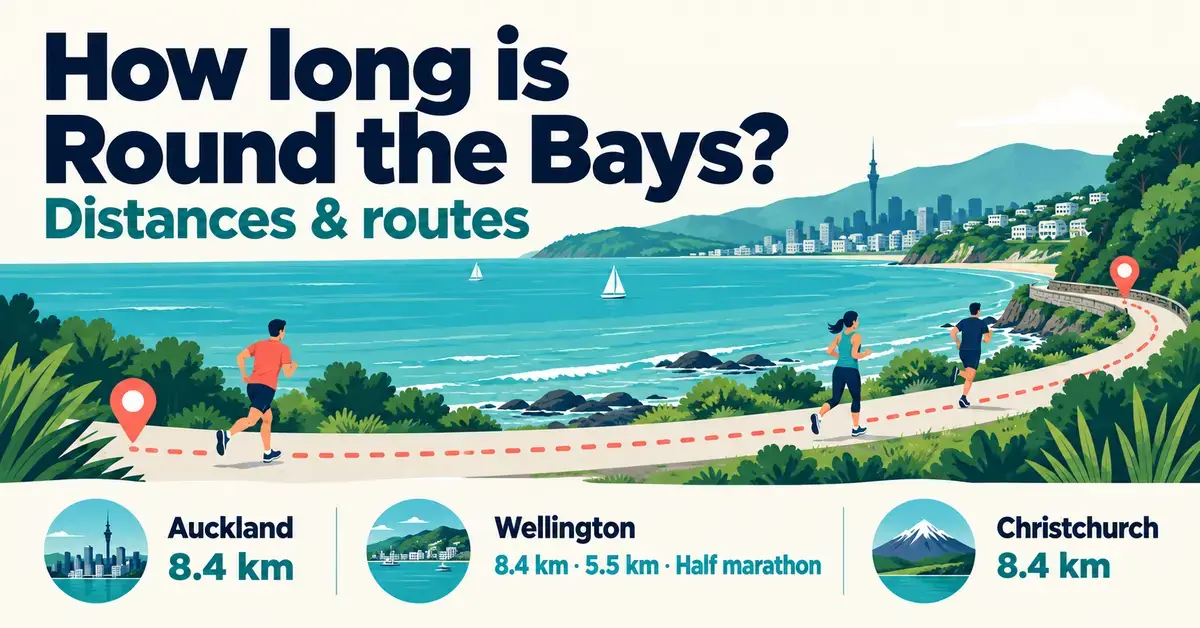
If you are lining up for New Zealand’s biggest fun run and wondering exactly how far you will be running, the short answer is that Round the Bays is 8.4 kilometres in Auckland and Christchurch, while Wellington offers an 8.4 km fun run, an optional 5.5 km family shortcut and a certified half marathon. The distance depends entirely on which city you enter, because each Southern Cross Round the Bays event is measured to fit its own stretch of coastline.
This guide sets out the precise distance for every version of the event, walks the point-to-point route in each city, and adds practical training, pacing and race-day detail so you know what to expect from the start line to the finish village. Every figure below was checked against the official event organiser and Southern Cross for the 2026 and 2027 editions.
Key Points
- Auckland: 8.4 km, Quay Street to Vellenoweth Green (St Heliers) along Tamaki Drive; 2026 edition on 8 March 2026.
- Christchurch: 8.4 km, Ferrymead to Thompson Park (New Brighton), with a road-or-sand finish; 2026 edition on 22 February 2026.
- Wellington: an 8.4 km fun run, an optional 5.5 km family shortcut and a certified half marathon (21.1 km); Waitangi Park to Kilbirnie Park; next edition 14 February 2027.
- All courses are flat, coastal, point-to-point routes run under the Southern Cross Round the Bays banner.
- The 5.5 km Wellington option is a shortcut off the 8.4 km field, not a separate start.
How long is Round the Bays in each city?
Round the Bays is not a single fixed distance — it is a series of three separate events, each with its own certified length. Auckland and Christchurch share the classic 8.4 km distance, while Wellington runs a slightly different programme built around an 8.4 km fun run plus shorter and longer options. All three are flat, coastal, point-to-point courses, meaning you start in one place and finish in another rather than running laps.
The table below compares the current distances, start and finish points, and typical dates for each city. Use it to work out which event you are training for before you read the detailed route descriptions.
Distance Comparison
| Event | Distance(s) | Start | Finish | Typical date |
|---|---|---|---|---|
| Round the Bays Auckland | 8.4 km | Quay Street, central city | Vellenoweth Green, St Heliers | March (8 March 2026) |
| Round the Bays Wellington | 8.4 km, 5.5 km shortcut, half marathon (21.1 km) | Waitangi Park | Kilbirnie Park | February (14 February 2027) |
| Round the Bays Christchurch | 8.4 km | Ferrymead (Humphreys Drive) | Thompson Park, New Brighton | February (22 February 2026) |
A quick word on terminology: “point-to-point” simply means the course runs in a line along the coast, so your finish is not where you started. That matters for planning transport, because you cannot leave a car at the finish and jog back to it. It is worth reading each city’s route in full before entering, and comparing the distance to how long a marathon is if you are using Round the Bays as a stepping stone to longer races.
Round the Bays Auckland: the 8.4 km Tamaki Drive course
The Auckland event is 8.4 kilometres long and is the original, and by far the largest, Round the Bays. Tens of thousands of runners, walkers and families take part each year, and it is regularly described as one of the world’s biggest fun runs. The 2026 edition is set for Sunday 8 March 2026.
The course is a true point-to-point route. It starts on Quay Street in the central city, near the waterfront and Spark Arena, then follows the curve of Tamaki Drive along the edge of the Waitemata Harbour before finishing at Vellenoweth Green in St Heliers. The road is closed to traffic, the surface is smooth city asphalt, and the total elevation change is minimal, which is why so many runners use it to chase a personal best over the distance.
Landmarks along the Auckland route
The Auckland course is easy to break into thirds, which helps with pacing when the field is dense at the start.
- Start to about 2.5 km: the field leaves Quay Street and moves past the port area; crowds are thick here, so expect to spend the opening minutes finding clear space rather than racing.
- Roughly 2.5 km to 5.5 km: the route opens out past Okahu Bay and into Mission Bay, the busiest spectator zone, where the harbour views and the crowd noise pick up.
- About 5.5 km to the finish: a flat run through Kohimarama leads into the finish at Vellenoweth Green, St Heliers.
For entry options, wave times and results, the dedicated Round the Bays Auckland guide covers the event in more depth than this distance-focused article.
Round the Bays Wellington: 8.4 km, a 5.5 km shortcut and the half marathon
Wellington is the one city where Round the Bays offers more than a single distance, and the line-up has changed in recent years, so older guides are often wrong. The current programme has three options: an 8.4 km fun run, an optional 5.5 km family shortcut, and a certified half marathon (21.1 km). The next edition is scheduled for Sunday 14 February 2027, marking 55 years since the very first Round the Bays.
All distances run along the capital’s waterfront, from Waitangi Park (near the corner of Cable Street and Oriental Parade) out along the bays to finish at Kilbirnie Park. Because the harbour is exposed, wind is the single biggest variable in Wellington — the course is flat, but a stiff southerly can make the return leg feel much harder than the numbers suggest.
Choosing your Wellington distance
Wellington’s options are designed so that runners of very different abilities can start together and still find the right challenge.
- 8.4 km Fun Run: the classic distance and the most popular choice, linking two of the city’s best-loved green spaces along Oriental Parade and the eastern bays.
- 5.5 km family shortcut: not a separate event with its own start — you line up with the 8.4 km field and simply peel off onto the shorter route on the day if you need to. This makes it ideal for families and first-timers.
- Half marathon (21.1 km): a certified distance for more experienced runners who want a longer waterfront challenge; it has a minimum age of 16.
If you are based in the capital, the Round the Bays Wellington event page and our guide to running in Wellington cover local clubs and training routes that suit these courses. Anyone eyeing the half marathon should also read our dedicated half marathon guide for pacing and preparation.
Round the Bays Christchurch: the 8.4 km estuary-to-pier course
Christchurch is the newest event in the series and uses the same 8.4 km distance as Auckland. The 2026 edition runs on Sunday 22 February 2026. It is a flat, point-to-point course branded as an “estuary to pier” run, taking in the shoreline of the Avon-Heathcote Estuary (Te Ihutai) before finishing near the coast.
The route starts on the corner of Humphreys Drive and Kite Lane in Ferrymead, then heads along Linwood Avenue, turns into Dyers Road and Bridge Street, and reaches The Parade before the final stretch to the finish at Thompson Park in New Brighton. As in the other cities, there are no significant hills.
The road-or-sand finish
What makes the Christchurch 8.4 km course distinctive is a choice near the end. Around The Parade the route splits, and you pick your own way to the line before the two options rejoin for the final push to Thompson Park.
- The fast road option: stay on the sealed surface of Marine Parade past the New Brighton Pier for the quickest, firmest run to the finish.
- The scenic beach option: divert onto the sand for a slower but more memorable finish alongside the pier.
- Wind and open water: the early kilometres wrap around exposed estuary edges, so an easterly breeze can affect your effort — something to watch if you are pacing for a target time.
For dates, entries and how Round the Bays fits the wider Canterbury calendar, see the Round the Bays Christchurch page and our round-up of Christchurch running events.
A short history of Round the Bays
Round the Bays began in Auckland on 17 March 1972, when a little over 700 people turned out for a jog organised by the Auckland Joggers Club. It grew rapidly from that first event into a national institution, and today the series draws tens of thousands of participants across its three cities each year, ranking among the largest mass-participation running events anywhere in the world. Its long-running reputation is well documented in New Zealand media and reference sources, including Wikipedia.
The event is now presented as Southern Cross Round the Bays, and while the branding and some course details have shifted over the decades, the core idea has not changed: an accessible, flat, coastal course that welcomes serious runners, walkers, families and first-timers on the same start line.
How to train for an 8.4 km or 5.5 km fun run
You do not need a marathon build-up to enjoy Round the Bays, but a flat course is not the same as an easy one — running 8.4 km on hard road still asks something of legs that are not used to it. A common mistake is to assume that because the course has no hills, it needs no preparation. Six to eight weeks of consistent, gradual training will let you cross the line comfortably rather than sore.
A reliable week combines two easy mid-week runs with one longer weekend run, plus rest. Beginners can build up with a structured plan such as a couch to 5K training plan before extending to the full 8.4 km. The table below outlines the balance of a typical week.
| Session type | What it builds | How often | Practical tip |
|---|---|---|---|
| Easy aerobic run | General endurance and running economy | 2–3 times a week | Keep it slow enough to hold a conversation in full sentences. |
| Intervals | Speed and leg turnover | Once a week | Alternate 1 minute faster with 1 minute walking on a flat park path. |
| Weekend long run | Confidence and lower-body resilience | Once a week | Build gradually until you can cover 6–9 km at an easy pace. |
| Rest and mobility | Recovery and injury prevention | 2–3 days a week | Prioritise sleep and avoid hard back-to-back sessions. |
What to wear and pack for a coastal fun run
Comfort matters more than kit on a fun run, and the biggest gear mistake is wearing something new on race day. Test your shoes, socks and clothing on your long training runs so nothing rubs. New Zealand’s coastal weather can swing from a crisp start to strong sun, so plan for both.
Footwear and clothing checklist
Because the main courses are almost entirely on sealed road, a cushioned road shoe is the sensible choice.
- Cushioned road-running shoes: broken in over several training runs, with enough foam to absorb repeated impact on asphalt.
- Technical socks: synthetic, moisture-wicking and seamless; avoid thick cotton, which traps sweat and causes blisters.
- A lightweight cap and sunscreen: New Zealand’s UV is intense even on cloudy mornings, and there is little shade on an exposed coast. See our guide to running shoes if you are buying fresh.
- Anti-chafe balm: apply to underarms, inner thighs and any seams before the start.
Pacing strategy for a strong finish
The most common race-day error is starting too fast. A big mass start, closed roads and thousands of runners create an adrenaline surge that makes an unsustainable early pace feel easy — and then you fade badly in the final kilometres. The fix is to hold back at the start and finish strong.
Divide any of the distances into three phases: a controlled, comfortable opening; a steady middle where you lock into your target rhythm; and a progressive push to the line. Use the on-course kilometre markers to check your effort objectively.
| Phase | Share of course | Effort (1–10) | Focus |
|---|---|---|---|
| Controlled start | First 25% | 4–5 (very easy) | Settle your breathing, find clear space, let faster runners go. |
| Steady cruise | Middle 50% | 6–7 (working) | Hold your target pace and relaxed form; do not fight the wind. |
| Final push | Last 25% | 8–10 (hard) | Lift the effort gradually and use the crowd to carry you home. |
Common mistakes to avoid
A few recurring errors catch people out on an otherwise friendly course, and all of them are easy to prevent with a little planning.
- Assuming flat means effortless: a level 8.4 km still needs a few weeks of training if you rarely run.
- Ignoring the wind: in Wellington especially, an exposed waterfront can turn a gentle pace into hard work — pace by effort, not just by the clock.
- Forgetting the point-to-point layout: your finish is not your start, so plan transport and where you will meet friends in advance.
- New gear on race day: untested shoes or clothing are the classic cause of blisters and chafing.
- Skipping warm dry clothes: you cool down fast on the coast once you stop moving.
Race-day logistics: transport, gear drop and recovery
Because every Round the Bays course finishes away from its start, plan how you will get to the start and home from the finish before the day. For the large Auckland event, the race number often doubles as a free travel pass on event shuttles and public transport on the morning — check the official entry details for the current year, as this varies by city and event.
Most events run a gear-drop service: you pack warm layers into the official bag from your race pack, hand it in at the start, and collect it at the finish village. After you cross the line, keep walking gently for a few minutes rather than sitting down, change into dry clothes to hold your body temperature, and rehydrate with water or an electrolyte drink before enjoying the food stalls. If Round the Bays is your first step into organised running, our New Zealand running calendar lists events to aim for next.
Sources
Frequently Asked Questions (FAQ)
How long is Round the Bays in Auckland?
Round the Bays Auckland is 8.4 kilometres. It is a flat, point-to-point course that starts on Quay Street in the central city and follows Tamaki Drive along the Waitemata Harbour to finish at Vellenoweth Green in St Heliers.
How many distances does Round the Bays Wellington offer?
Wellington offers three options: an 8.4 km fun run, an optional 5.5 km family shortcut that peels off the main field, and a certified half marathon of 21.1 km. All start at Waitangi Park and finish at Kilbirnie Park along the waterfront.
How far is Round the Bays in Christchurch?
Round the Bays Christchurch is 8.4 kilometres, the same distance as Auckland. The flat course runs from Ferrymead, around the Avon-Heathcote Estuary, to a finish at Thompson Park in New Brighton, with a choice of a road or beach finish near the end.
Can I walk Round the Bays or take part with a pram?
Yes. Walkers, families and people pushing prams or buggies are welcome in the fun-run distances. For safety and smooth flow, walkers and pram users are usually asked to start in the later waves at the back of the field.
Which Round the Bays distance is best for beginners?
The 5.5 km Wellington shortcut or an 8.4 km fun run in any city are the most beginner-friendly options, as all courses are flat. With six to eight weeks of easy training, most first-timers can comfortably complete the 8.4 km distance.