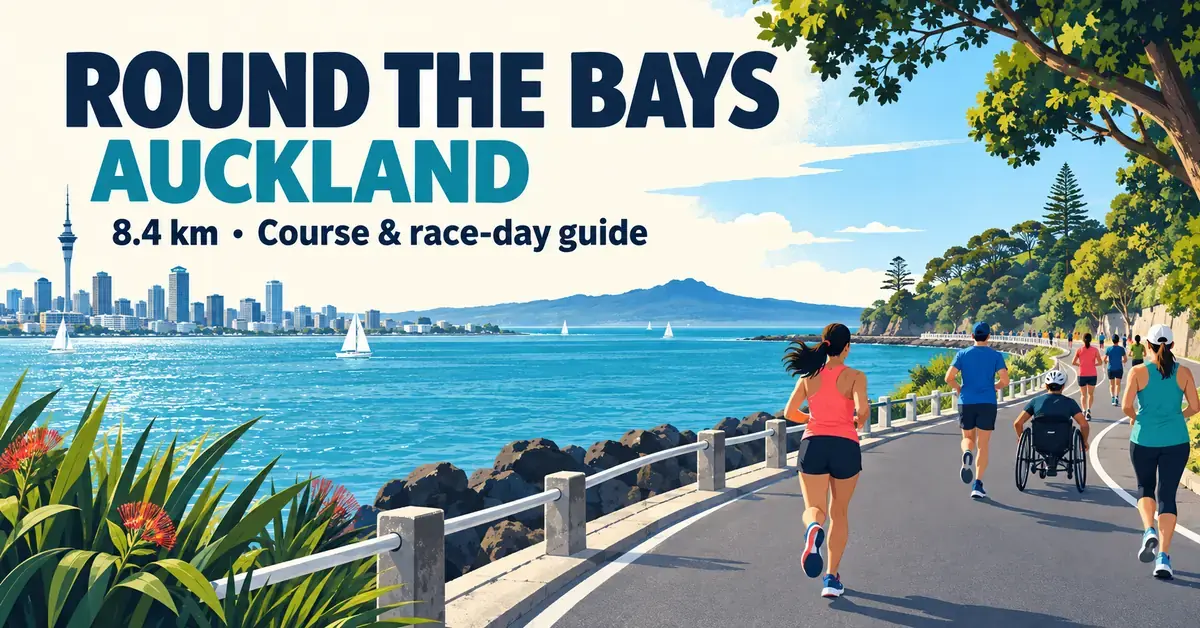
Southern Cross Round the Bays is Auckland’s largest fun run: a flat 8.4-kilometre journey along the Waitemata Harbour that turns the city’s eastern waterfront into a car-free festival of runners, joggers, walkers and wheelchair users. It has been held every year since the early 1970s and now draws tens of thousands of people to the shoreline between the central city and St Heliers.
This guide is for the Auckland edition specifically. It covers the course bay by bay, the next event date, how the staggered start works, what to wear and pack, transport and gear drop, hydration, pacing and post-race recovery — all checked against the official event information. If you only want to compare distances across the country’s three editions, see the separate guide to how long Round the Bays is in each city.
Key Facts
- Event: Southern Cross Round the Bays — Auckland
- Next edition: Sunday 7 March 2027 (annual, usually early March)
- Distance: 8.4 km, point-to-point
- Route: Quay Street (CBD) to Vellenoweth Green, St Heliers, along Tamaki Drive
- Elevation: essentially flat
- Fun-run start: from about 9:00 am; entertainment and formalities earlier in the morning
- Who it is for: all ages and abilities — run, jog, walk or roll; prams and wheelchairs welcome
- Transport: your race bib is a free pass on Auckland Transport buses and trains on event morning
- First held: 1972; now one of the world’s largest fun runs
- Official site: roundthebays.co.nz
The story behind New Zealand’s biggest fun run
Round the Bays began in Auckland in 1972 as a small community jog and has grown into one of the world’s largest mass-participation running events. The inaugural run drew fewer than 1,000 people and was organised by members of the Auckland Joggers’ Club, including jogging pioneer Don Walker and former Auckland mayor Colin Kay. Within a few years the start had to be moved to cope with the crowds, and by its 40th anniversary in 2012 the field had swelled to an estimated 70,000 participants.
Today the event runs under the Southern Cross Round the Bays banner in three cities — Auckland, Wellington and Christchurch — and fundraising sits at its heart, with the 2027 series aiming to bring together more than 45,000 participants and raise upwards of $300,000 for charity. The Auckland edition, celebrated as “legendary” for 55 years in 2027, remains the flagship and the biggest of the three. Every finisher receives a medal, and the organiser’s own description sums up the spirit: run, jog, stroll or roll.
Racing under the silhouette of Rangitoto
The scenery is the reason this course is so loved. As you follow the inner-harbour bays, the volcanic cone of Rangitoto Island sits on the horizon almost the whole way, and the route hugs beaches, marinas and the open water of the Hauraki Gulf. Because the roads are closed to traffic, you run in the middle of Tamaki Drive with an uninterrupted view across the harbour — a very different experience from the same stretch on a normal weekday.
The 8.4 km Auckland course, bay by bay
The Auckland course is 8.4 kilometres, point-to-point and almost completely flat, with only a few metres of elevation change across the whole distance. It starts on Quay Street in the central business district, runs east past the port and Spark Arena, then follows Tamaki Drive around Okahu Bay, Mission Bay and Kohimarama before finishing near Vellenoweth Green in St Heliers.
The early section around the city and port is where the crowd is tightest, so expect slow, shuffling steps for the first few hundred metres before the field spreads out. The table below shows the main landmarks in order; distances are approximate and are best used as motivation markers rather than exact split points.
| Course landmark | Approx. distance | What to expect | Pacing focus |
|---|---|---|---|
| Quay Street start | 0.0 km | Very congested; slow rolling start | Stay patient, find open space, do not sprint |
| Okahu Bay | ~3.5 km | Field thins, open harbour views | Settle into your target effort and breathing |
| Mission Bay | ~5.5 km | Big spectator crowds and entertainment | Hold form, use the energy, stay relaxed |
| Kohimarama | ~7.0 km | Waterfront run-in toward St Heliers | Keep cadence quick, prepare for the finish |
| St Heliers finish | 8.4 km | Festive finish area and medals | Lift the pace, smile for the finish-line camera |
What the flat profile means for your pace
A flat course is fast, but it is also relentless: there are no hills to break up your rhythm or force a natural change of muscles, so the same stride repeats for the whole distance. That makes even pacing more important, not less. Beginners often treat a flat course as “easy” and skip preparation, then find their calves and feet fatigue over the final kilometres from the constant hard-surface impact.
Start times and how the staggered start works
The Auckland fun run sets off mid-morning — the 2027 event starts at around 9:00 am, with entertainment and formalities on Quay Street beforehand. Rather than everyone leaving at once, the event uses a staggered start based on your estimated pace, so faster runners head off first and walkers, families and those with prams or wheelchairs follow in later groups. This keeps the course flowing safely and reduces bottlenecks at the tight city end.
When you enter, you select the group that honestly matches how you plan to move. Line up in your allocated area in good time; arriving early is the single easiest way to avoid pre-race stress, because the start precinct becomes very crowded close to the horn. Check your confirmation and the official race-day page for the exact start arrangements in the year you enter, as the organiser fine-tunes the format from season to season.
Building fitness for a flat 8.4 km
You do not need a marathon build-up for 8.4 kilometres, but a short, structured plan makes race morning far more enjoyable. A six-to-eight-week block that mixes two easy midweek runs with one slightly longer weekend run is enough for most first-timers to cover the distance comfortably. The goal is to condition your feet, shins and calves for continuous running on hard asphalt.
Structuring your weekly runs
Progress the volume gradually and keep most of your running easy. The table below shows a simple weekly framework that builds endurance while leaving enough recovery to avoid shin splints and other overuse niggles.
| Session type | What it builds | Frequency | Practical tip |
|---|---|---|---|
| Easy aerobic run | Endurance and running economy | 2–3 times a week | Run slow enough to hold a conversation |
| Intervals or fartlek | Speed and turnover | Once a week | On a flat path, alternate 1 min brisk / 1 min easy |
| Weekend longer run | Confidence and durability | Once a week | Build until 7–9 km feels comfortable |
| Rest / active recovery | Repair and adaptation | 2–3 days a week | Prioritise sleep; avoid hard days back-to-back |
Handling wind and weather on Tamaki Drive
The exposed waterfront means wind is the main variable on this otherwise easy course. A breeze off the Waitemata can slow an unprepared runner noticeably along the open stretches near the bays, and early March in Auckland can also be warm and humid with strong sun. Neither is a problem if you plan for it.
Simple tactics for a headwind
Do not fight a headwind with brute force. Lower your effort slightly, lean gently forward from the ankles, relax your shoulders and shorten your stride. These small adjustments save a surprising amount of energy over a kilometre or two.
- Tuck in behind others: sit just behind a group moving at your pace and let them break the wind for you.
- Keep cadence high: quick, light steps hold momentum better than long, heavy strides into a breeze.
- Run by effort, not the watch: accept slightly slower splits into the wind and even out on the sheltered sections.
- Stay relaxed: everyone on the road faces the same conditions, so focus on smooth form rather than the clock.
What to wear and pack
Comfort and chafe prevention matter more than anything fancy for a fun run. Choose lightweight, breathable clothing you have already worn on training runs, and never debut new shoes or an unwashed race shirt on the day. A cap and sunscreen are sensible given New Zealand’s strong UV, and it is worth reading up on choosing running socks because the wrong pair is the fastest route to blisters.
Choosing the right shoes
Because the entire route is on hard asphalt and concrete, a cushioned road-running shoe with plenty of midsole protection is ideal. Whatever you pick, make sure it has been broken in over training runs — aim for at least 50 km in the shoes before race day.
| Item | What to look for | Why it matters | Tip |
|---|---|---|---|
| Road shoes | Cushioned, broken-in road trainers | Shock absorption on hard surfaces | Log 50+ km in them before the event |
| Technical socks | Moisture-wicking, seamless toe | Blister and friction prevention | Avoid thick cotton socks |
| Running cap | Breathable mesh with a brim | Sun and glare protection | Fit it snugly against coastal gusts |
| Anti-chafe balm | Sweat-resistant stick or gel | Stops skin-on-skin rubbing | Apply before you start, not mid-run |
Hydration and race-morning fuel
Fuelling for 8.4 kilometres is simple: arrive well hydrated and eat a familiar, easy-to-digest breakfast a couple of hours before your start. There are a handful of water stations along the course, so most people do not need to carry their own drink. If you prefer to run with fluid on longer efforts, a light running hydration pack is an option, but it is rarely necessary at this distance.
- Hydrate the day before: sip steadily rather than gulping large amounts on the morning.
- Keep breakfast simple: toast with honey, a banana or porridge are reliable choices.
- Use the on-course water: take a few sips if it is warm, especially in the second half.
- Do not over-eat: there is no need to carb-load for a distance this short.
Getting there: transport, gear drop and shuttles
With tens of thousands of people converging on the central city, public transport is by far the best way to reach the start — parking near Quay Street is very limited. On event morning your race bib doubles as a free travel pass on Auckland Transport buses and trains, so plan to ride in and show your bib to board.
Gear drop and getting home
The gear drop is at Britomart Place, opposite Les Mills, near the start. You tear the numbered tag from your bib and attach it to your bag, and the service closes strictly at 8:30 am — arrive with time to spare. Valuables, backpacks and handbags are not accepted, so pack light. After the finish in St Heliers, free shuttle buses run back to Britomart in the city; historically these operate from late morning through the early afternoon from stops near the finish precinct such as Long Drive and the Melanesia Road hospitality zone.
| Stage | Where | Timing | Advice |
|---|---|---|---|
| Arrive early | Quay Street start precinct | Well before your start group | Use facilities early to beat the queues |
| Gear drop | Britomart Place (opposite Les Mills) | Closes strictly 8:30 am | Tear the tag from your bib; no valuables |
| Line up | Your allocated start group | Check your confirmation | Move into your area early |
| Get home | Free shuttles from St Heliers to Britomart | Late morning to early afternoon | Bring a warm layer for the wait |
Pacing and the mental game
On a flat, crowded course the biggest risk is starting too fast. Adrenaline and the surge of the crowd make the opening kilometres feel easy, and it is common to bank time you cannot hold. Big-crowd events elsewhere, from stadium sport to mass runs, show the same pattern of collective energy — you can read more on Wikipedia. Split the run into three parts — a controlled opening, a steady middle along the bays, and a progressive push to the line — and run to effort rather than being a slave to your watch. Use the official kilometre markers to check in.
| Section | Portion of course | Target effort (1–10) | Mindset |
|---|---|---|---|
| City to port | 0–25% | 4–5 (easy) | Find space, settle breathing, check form |
| Tamaki Drive bays | 25–75% | 6–7 (steady) | Hold rhythm, manage the wind, stay focused |
| Run-in to St Heliers | 75–100% | 8–10 (strong) | Lift turnover and drive to the line |
The waterfront is lined with live music, cultural performers and cheer squads. Use them to break the course into chunks — run from one bay to the next rather than fixating on the full distance — and consider finding a pacing buddy to keep you honest. If you want a memento afterwards, you can look up your official Round the Bays photos by bib number or name.
At the finish: recovery at St Heliers
The finish area around Vellenoweth Green becomes a large community festival with food stalls, hospitality sites and entertainment. Look after yourself once you cross the line: keep moving gently for a few minutes so your heart rate settles, then change out of damp gear before the coastal breeze cools you down.
- Keep moving: walk for five minutes rather than sitting straight down to avoid cramping.
- Layer up: pull on a dry top quickly, as you cool fast once you stop.
- Rehydrate first: take water or an electrolyte drink before celebratory coffee or food.
- Enjoy it: grab a finisher photo, find your team and soak up the atmosphere.
Round the Bays beyond Auckland
Auckland is the original and largest edition, but the same fun run now takes place in Wellington and Christchurch earlier in the summer, each with its own coastal course. If you are building a running season, both cities have their own guides worth reading — see the wider Christchurch running events calendar and the guide to running in Wellington. Aucklanders chasing a bigger challenge often pair Round the Bays in autumn with the Auckland Marathon later in the year.
Round the Bays Events Compared
| City | Distance(s) | 2027 date | Character |
|---|---|---|---|
| Auckland | 8.4 km | Sunday 7 March 2027 | The original and largest; flat Tamaki Drive waterfront |
| Wellington | 8.4 km and Half Marathon | Sunday 14 February 2027 | Waterfront course with a half-marathon option |
| Christchurch | 8.4 km | Sunday 21 February 2027 | Newer coastal edition of the series |
Common mistakes to avoid
Most race-morning problems at Round the Bays are avoidable and come down to logistics, not fitness. Knowing the frequent pitfalls in advance is the easiest way to have a smooth day.
- Assuming a flat course needs no training: the constant hard-surface impact tires undertrained feet and calves over the final kilometres.
- Missing the gear-drop cut-off: it closes strictly at 8:30 am, well before the run starts, so drop your bag early.
- Driving in: parking is scarce and roads are closed; use the free bus and train travel your bib provides.
- Wearing brand-new kit: new shoes or an unwashed shirt bought at the expo are a common cause of blisters and chafing.
- Starting too fast: the crowd energy tempts a quick opening that leads to fading along the exposed bays.
- Ignoring the sun and wind: a cap, sunscreen and a wind-smart pacing plan matter on the open waterfront.
Sources
Frequently Asked Questions (FAQ)
When is the next Round the Bays Auckland event?
The next Southern Cross Round the Bays in Auckland is on Sunday 7 March 2027, the event’s 55th year. It is held annually, usually on a Sunday in early March, with entertainment and formalities on Quay Street in the morning and the fun run setting off from around 9:00 am. Always confirm the exact date and start time for the year you enter on the official event website.
How long is the Auckland Round the Bays course?
The Auckland course is 8.4 kilometres. It is a point-to-point, almost completely flat route that begins on Quay Street in the central city, runs past the port and Spark Arena, then follows Tamaki Drive around Okahu Bay, Mission Bay and Kohimarama to finish near Vellenoweth Green in St Heliers.
Is public transport free for participants on race day?
Yes. On event morning your race bib works as a free pass on Auckland Transport bus and rail services — simply show it to board. Because parking near the Quay Street start is very limited, public transport is the recommended way to get to the start line.
Where and when is the gear drop?
The gear drop is at Britomart Place, opposite Les Mills, close to the start. You tear the numbered tag off your bib and attach it to your bag, and the service closes strictly at 8:30 am, so drop your bag early. Valuables, backpacks and handbags are not accepted, so keep what you leave to a minimum.
Can I take part with a pram, or walk the course?
Yes. Round the Bays welcomes all ages and abilities — you can run, jog, walk or roll, and prams and wheelchairs are catered for. Walkers and people pushing prams line up in the later start groups so the course flows safely, and every finisher receives a medal.