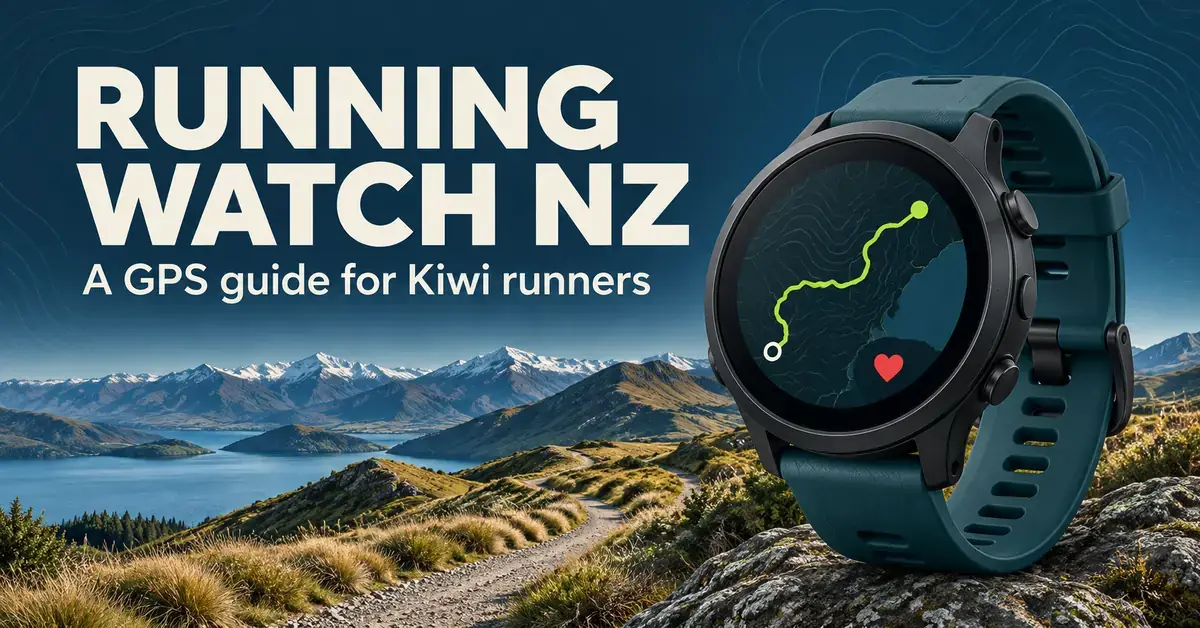
A running watch is a wrist-worn GPS device that records your pace, distance, route and heart rate, then turns that data into training and recovery feedback. For runners in New Zealand the choice comes down to how and where you run: a flat suburban 5K, a road marathon, or a full day out on a Department of Conservation (DOC) trail all reward different features, battery reserves and price points.
This guide explains what a modern running watch actually measures, how GPS accuracy and battery life differ between models, and what AMOLED and MIP screens mean in practice. It then compares the main Garmin, Coros, Suunto and Polar models sold in New Zealand, with current approximate prices, so you can match a watch to your budget and your usual terrain instead of paying for features you will never use.
Key Points
- Match the tier to your running: entry-level for parkruns and first races, mid-tier for marathon training, premium for trail, ultra and triathlon.
- GPS matters most in tough terrain: multi-band (dual-frequency) helps in bush, city streets and mountains; multi-GNSS is enough for open roads and lasts longer.
- Battery follows the screen: bright AMOLED watches charge every few days; MIP and solar watches last weeks and suit long events.
- Recovery data is the real edge: HRV, sleep and training-load metrics help you avoid overtraining, not just count kilometres.
- Buy for how you run: avoid paying for maps, titanium and multi-band you will never use — and always check the GPS-mode battery figure, not the smartwatch one.
What a running watch measures and how it works
A running watch combines a GPS/GNSS receiver, an optical heart-rate sensor and motion sensors to describe every run in numbers. The satellite receiver logs your position several times a minute to calculate distance and pace; the optical sensor shines light into the skin to estimate heart rate; and an accelerometer and (on better models) a barometric altimeter add cadence, stride and elevation. The watch’s software then blends these into metrics such as training load, estimated VO2 max and recovery time.
These devices grew out of the ordinary Wikipedia wristwatch, but a training watch is closer to a small computer than a timepiece. Understanding what each sensor does — and how accurate it really is — is the difference between trusting your data and being misled by it.
From basic stopwatch to training computer
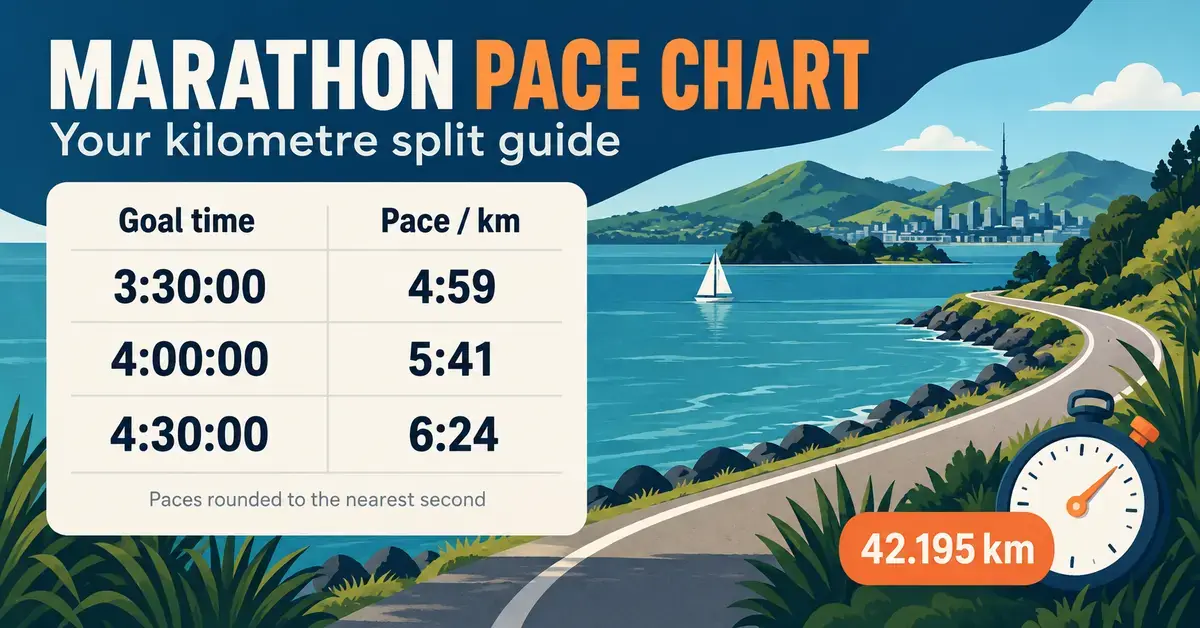
Early GPS watches did little more than time a run and estimate distance. Today’s models track heart-rate variability (HRV) overnight, suggest daily workouts, and flag when your training load is climbing faster than your body is recovering. That matters most if you are building consistency — for example, beginner runners following a couch to 5K plan — or holding a steady effort at your goal marathon pace. The trade-off is that more sensors and brighter screens use more battery, so the ‘best’ watch is the one whose feature set matches your running rather than the one with the longest spec sheet.
Types of running watch and who each suits
Running watches fall into four broad tiers, and picking the wrong tier is the most common and most expensive mistake. An over-built alpine watch feels heavy and complicated for a casual road runner, while an entry-level tracker will not have the battery or the maps for a backcountry ultra.
Matching the watch to your running
- Entry-level training watches: Best for parkrun regulars and new runners. They cover GPS pace, distance, time and wrist heart rate clearly, without overwhelming you. Example: Garmin Forerunner 165, Coros Pace 3.
- Mid-tier performance watches: Aimed at dedicated road runners and marathoners. They add multi-band GPS, running dynamics, race predictors and deeper recovery tracking. Example: Garmin Forerunner 265, Polar Vantage M3.
- Premium endurance watches: Built for trail runners, triathletes and ultramarathon athletes. They offer full offline topographic maps, long battery life and rugged titanium or sapphire builds. Example: Garmin Forerunner 970, Garmin Enduro 3, Suunto Race.
- Hybrid lifestyle smartwatches: Prioritise everyday use — bright touchscreens, apps and payments — with capable but less specialised run tracking. Example: Apple Watch, Samsung Galaxy Watch.
GPS accuracy: single-band, multi-GNSS and multi-band
Satellite hardware is the single biggest driver of how accurate your distance and pace look, especially in New Zealand’s steep terrain and dense native bush. Signals that bounce off cliffs, buildings or a thick canopy create ‘multipath’ errors that inflate distance or scribble your track across a map.
How satellite mode affects accuracy and battery
Older or budget watches use a single GPS frequency. Most current watches add multi-GNSS (also called ‘all-systems’), which listens to several satellite networks — GPS, GLONASS, Galileo, BeiDou and QZSS — at once for a faster, more reliable lock. The top tier adds multi-band (dual-frequency), receiving two signals from each satellite to cut multipath error in the hardest conditions. It is worth knowing that some popular beginner watches, including the Garmin Forerunner 165, use multi-GNSS but not multi-band; true dual-frequency starts one tier up. Each step up in accuracy costs battery life.
| Satellite mode | Accuracy | Battery impact | Best terrain |
|---|---|---|---|
| Single-band GPS | Basic; can drift near obstructions | Lowest | Open roads, flat suburbs, running tracks |
| Multi-GNSS (all-systems) | Good; fast, reliable lock | Moderate | Most road running and light tree cover |
| Multi-band (dual-frequency) | Highest; resists multipath error | High | City canyons, deep bush, alpine valleys |
| Power-save / expedition | Lower; reduced sampling rate | Very low | Multi-day trips where battery beats precision |
Heart rate, HRV and recovery data
Beyond pace, a running watch works as a continuous health monitor. Worn day and night it records resting heart rate, heart-rate variability, sleep stages and, on many models, blood-oxygen saturation. Together these describe how well your body is coping with training and everyday stress.
Reading HRV, VO2 max and training status
Heart-rate variability (HRV) is the tiny variation in time between heartbeats, measured mostly during sleep. A stable or rising HRV baseline suggests you are recovered; a sharp drop can signal fatigue, poor sleep or an oncoming illness, and is a cue to ease off. The main metrics to learn are:
- Heart-rate zones: Set five zones so easy runs stay genuinely easy and hard sessions are hard enough to count.
- Sleep score: Check that you are getting enough deep and REM sleep, when most physical repair happens.
- Training status / load: See whether your current volume is productive, maintaining or tipping into overreaching.
- Estimated VO2 max: Treat it as a long-term fitness trend, not an exact lab value — it is an estimate that is useful mainly as it moves over weeks.
Battery life and display: AMOLED vs MIP
Display type is the main lever on battery life. The market splits between vivid AMOLED touchscreens and sunlight-readable memory-in-pixel (MIP) screens, and the right choice depends on how long your runs are and where you do them.
Which display suits your runs
AMOLED screens look like a phone display — bright, colourful and easy to read in dim light — but they draw more power. MIP screens use ambient light to stay readable in glaring sun and sip battery, which is why the longest-lasting watches still use them, often with solar charging. Real figures make the gap clear: an AMOLED watch such as the Garmin Forerunner 165 lasts around 19 hours in GPS mode, whereas the MIP, solar-assisted Garmin Enduro 3 can run for hundreds of hours of GPS tracking.
- AMOLED watches: Best for everyday wear and shorter runs; expect to charge every few days to weekly.
- MIP / solar watches: Best for ultras, tramping and multi-day missions where recharging is impractical.
- Check the GPS-mode figure: Manufacturers quote a flattering ‘smartwatch’ battery; always read the multi-band GPS number before buying for long events.
- Use battery modes: Turning off notifications or dropping to a lower GPS mode extends life on long weekend runs.
Navigation and maps for New Zealand trails
On-wrist navigation is a genuine safety feature for trail runners exploring the DOC track network, because it works with no cellphone coverage. The level you need rises with how remote and unfamiliar your routes are — a well-marked hydration-pack loop needs less than a self-navigated day in the hills. For events such as the Taupō Ultramarathon, a watch that can follow a loaded course file is a real advantage.
| Navigation feature | What it needs | What it does | Best for |
|---|---|---|---|
| Full topographic maps | Large internal storage | Shows trail names, contours and nearby features on screen | Unfamiliar backcountry and alpine routes |
| Breadcrumb routing | Minimal storage | Follows a loaded track as a line with turn alerts | Marked trail races and long road routes |
| Back to Start / TracBack | Basic GPS | Reverses your recorded path to guide you back | Out-and-back runs and exploring new areas |
| ClimbPro-style ascent view | Barometer plus loaded route | Breaks upcoming climbs into gradient segments | Pacing effort on steep hill loops |
Comparing running watches available in New Zealand
The table below compares popular running watches sold through New Zealand retailers, with approximate street prices in NZD. Prices move often with sales and new releases, so treat them as a guide and confirm on the official pages linked before you buy. Battery figures are the manufacturer’s GPS-mode ratings, which shorten in multi-band mode.
Watch Comparison
| Watch | Display | GPS | Battery (GPS mode) | Best for | Approx. NZ price |
|---|---|---|---|---|---|
| Garmin Forerunner 165 | AMOLED | Multi-GNSS (no multi-band) | Up to ~19 h | Beginners, road 5K to marathon | From ~9 (~9 Music) |
| Garmin Forerunner 265 | AMOLED | Multi-band | Up to ~20 h | Dedicated road runners | ~0 |
| Garmin Forerunner 570 | AMOLED | Multi-band | Up to ~18 h | Marathoners wanting full metrics | ~ ,149 |
| Garmin Forerunner 970 | AMOLED | Multi-band | Up to ~26 h | Trail, triathlon, full topo maps | ~ ,599 |
| Coros Pace 3 | MIP transflective | Dual-frequency | Up to ~38 h | Budget pick, long battery | ~9 |
| Suunto Race | AMOLED | Multi-band | Up to ~40 h | Value maps and long battery | ~9 |
| Polar Vantage M3 | AMOLED | Dual-frequency | Up to ~30 h | Recovery and training-load focus | ~9 |
Two things matter beyond the raw specs. The first is ecosystem: Garmin has the widest range and the deepest platform (Garmin Connect, plus optional Connect+ extras), while Coros keeps things simple and its analysis free, and Suunto and Polar sit in between with strong training and recovery tools at lower prices. The second is running power and third-party sensors — if you already own a chest strap, footpod or power meter, check the watch supports the standards you use (ANT+ and Bluetooth) before switching brands.
Everyday features beyond running
Because most people wear a running watch all day, everyday features matter alongside training data. The extras below add convenience but also affect price and battery, so weigh them against how you will actually use the watch.
- Onboard music: Sync offline playlists from Spotify or Apple Music and pair Bluetooth headphones, so you can run without your phone.
- Contactless payments: Load a card to buy a post-run coffee without carrying a wallet, using services such as Garmin Pay.
- Smart notifications: See texts, calls and calendar alerts on your wrist, with control over what appears mid-run.
- Interchangeable bands: Quick-release straps let you swap a sweaty silicone band for something smarter for work.
Common mistakes when choosing a running watch
Most buyer’s regret comes from a handful of avoidable errors rather than from picking the wrong brand.
- Buying on the smartwatch battery figure: The headline number assumes GPS is off. Check the GPS and multi-band ratings if you run long.
- Overbuying features: Paying for full topo maps and titanium when you only run road loops adds weight and cost you will not use.
- Assuming every watch has multi-band GPS: Several entry models are multi-GNSS only, which is fine for open roads but less so in deep bush.
- Ignoring wrist fit: A large 51 mm case suits big wrists and long battery, but bounces and reads heart rate poorly on smaller wrists.
- Trusting wrist heart rate for intervals: Optical sensors lag during fast repeats; pair a chest strap if precise interval data matters.
- Forgetting the ecosystem: The companion app, subscription costs and how well it syncs with your other running gear and platforms matter as much as the hardware.
Looking after your running watch
A running watch is a significant investment, and sweat is its main enemy — salt builds up around the optical sensor and corrodes the charging contacts over time. A short, consistent routine keeps readings accurate and charging reliable for years.
- Rinse after sweaty runs: A quick rinse under cool fresh water flushes salt and grit from the case and band.
- Clean the charging contacts: Use a soft brush to clear dried sweat or lint from the charging pins or port.
- Dry before charging: Pat dry with a microfibre cloth and let the contacts air-dry fully before connecting the cable.
- Keep firmware updated: Sync every few weeks so GPS, battery and bug fixes stay current. Avoid harsh chemicals, abrasive pads and hot water, which damage seals and coatings.
How to choose the right running watch for you
The right watch is the cheapest one that covers where and how you actually run, not the one with the longest feature list. Work from your typical training rather than your ambitions: most runners spend far more time on familiar road and park loops than on remote alpine trails, and a mid-tier watch handles that comfortably.
A quick way to narrow the field: if you mostly run roads and races under a couple of hours, an entry or mid-tier AMOLED watch with multi-GNSS or multi-band GPS is plenty. If you run in deep bush or steep terrain, prioritise multi-band accuracy and a barometric altimeter. If you tackle all-day trail events or go tramping, put battery life and offline maps first and accept a larger, heavier case. And if the watch is as much a daily smartwatch as a training tool, weigh screen quality, payments and notifications alongside the running features. Set a firm budget before you shop, because it is easy to be talked up a tier by features you will rarely use.
Sources
- Garmin New Zealand — Forerunner 165
- Garmin New Zealand — Forerunner 970
- Garmin New Zealand — Forerunner 265
- COROS — PACE 3
- Polar New Zealand — Vantage M3
- Polar — Vantage M3 technical specifications
- DC Rainmaker — Garmin Forerunner 165 in-depth review
- Department of Conservation — walking and tramping tracks
Frequently Asked Questions (FAQ)
Which running watch is best for a beginner in New Zealand?
For new runners, the Garmin Forerunner 165 and the Coros Pace 3 are strong starting points. Both give accurate GPS pace and distance, wrist heart rate and clear recovery guidance without complex menus, and both sell in New Zealand for well under $500. They cover everything a parkrunner or first-time half-marathoner needs before spending more.
Do I really need a multi-band GPS watch?
Only if you regularly run where signals bounce — deep native bush, narrow city streets or alpine valleys. Multi-band (dual-frequency) GPS reduces distance and pace errors in those conditions, but it uses more battery and costs more. For open roads and running tracks, a multi-GNSS watch is accurate enough and lasts longer between charges.
What is the difference between an AMOLED and a MIP screen?
AMOLED screens are bright, colourful and easy to read in low light, but they drain battery faster and usually need charging every few days. Memory-in-pixel (MIP) screens use ambient light, stay sharp in direct sun and last far longer, which is why ultra-endurance and solar watches still use them. Choose AMOLED for everyday wear and MIP for very long events.
Can I listen to music and pay from my watch without my phone?
Yes, many mid-range and premium watches have onboard music storage and contactless payments. You can sync offline playlists from apps like Spotify over Wi-Fi, pair Bluetooth headphones and pay with services such as Garmin Pay, letting you leave your phone and wallet at home on a run.
Are running watches waterproof enough for swimming?
Almost all dedicated running and multisport watches carry at least a 5 ATM rating, meaning they withstand pressure equivalent to 50 metres of water. That makes them safe for pool and open-water swimming, showering and running in heavy rain, though 5 ATM is not rated for diving or high-speed water sports.